How to summarize an article in your own words
Knowing how to summarize an article in your own words helps with school, work and your own notes. A summary is a short version of a text that keeps the main idea and the key support, and drops the rest. "In your own words" means you do not copy the author's sentences. You rebuild the meaning in your own phrasing.
A summary is not a review, because it does not say whether the article is good. It is not a pile of quotes either. It is a faithful, shorter account of what the author said. If a reader who has not seen the article can understand the main point from your summary, you have done the job.
The seven steps below work for news pieces, blog posts and guides. One made-up article runs through all of them, so you can see each step at work.
Summarize an article in your own words: start with the main idea
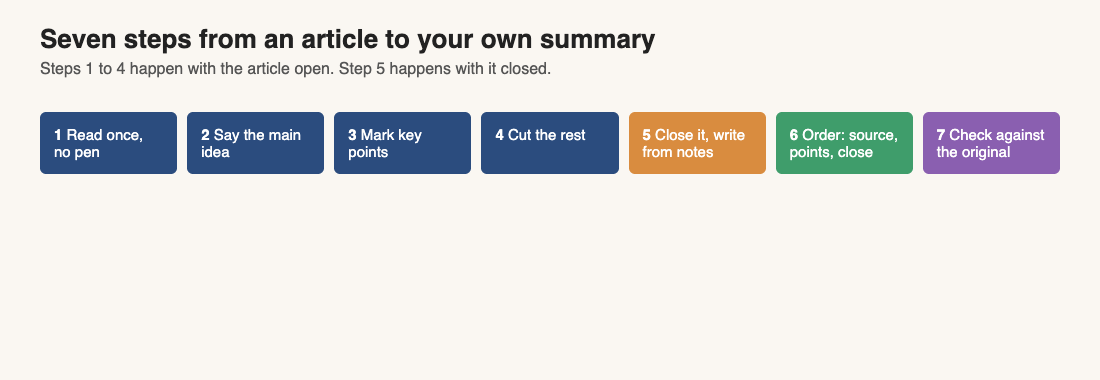
Step 1: Read it once without a pen. Do not highlight on the first pass. You do not yet know what matters, so you will mark too much.
Read the title, the opening paragraph and the last paragraph first, then skim the headings. Many writers put their answer near the start or the end, so these parts tell you where the article is going.
Step 2: Say the main idea out loud. Finish one sentence without looking: "This article argues that..." or "This article explains how...". If you cannot, read the opening again.
Worked example (the article is made up for this post). Imagine a short article called "Why I keep a reading log". It says that the writer forgets what they read, that a log of one line per book fixed the problem for them, and that the log should be written the same day. Your one-line main idea: "The writer keeps a one-line reading log, written the same day, so that books are not forgotten."
Mark the key points and cut the rest
Step 3: Read again and mark only the sentences that carry the argument. These are the sentences that, if removed, would break it. Look for:
- The claim in each section, often in its first or last sentence.
- Numbers, dates or names the argument depends on.
- Conclusions and recommendations.
Step 4: Decide what to cut. Cut these:
- Extra examples after the first good one.
- Background your reader already knows.
- Side stories, jokes and asides.
- Points the author repeats.
Write a margin note of three to six words next to each section, such as "the problem", "the one-line log" or "write it the same day". Those notes become your skeleton. You will write from the notes, not from the article, and that one habit does most of the work of keeping your words your own.
Put the author's ideas into your own words
Step 5: Close the article and write from memory. Look only at your margin notes. Write each point as if you were explaining it to a friend. If you cannot remember something, either it was not a key point, or you need to reread that one part.
Swapping a few words for synonyms is not enough. Take this made-up sentence from the example article:
Original: "Write the line on the day you finish the book, while it is still fresh."
Weak rewrite: "Compose the line on the day you complete the book, while it is still new."
Better: "Log a book the day you finish it, before the details fade."
The weak rewrite keeps the same sentence shape and only swaps words. The better version changes the structure and says the idea the way you would say it. Keep technical terms, names and numbers as they are, because you cannot rename a person or a figure.
If an exact phrase is distinctive, put it in quotation marks and keep it short.
Write the summary in a simple order
Step 6: Write it in this order.
- Opening sentence: name the source (title and author if you have it) and state the main idea.
- Middle: the key supporting points, in the order the author made them.
- Closing sentence: the conclusion or recommendation.
Aim for far shorter than the original, and stop when the main idea and its key support are in. A short note is a good training ground: on Electrified, a note is limited to 500 characters, which forces you to keep only the main idea and a point or two.
Worked example of a short summary.
"Why I keep a reading log" (a made-up article) says that the writer kept forgetting what they read. Their fix is a one-line log, one entry per book. The advice is to write each entry on the day you finish the book.
Use the present tense ("the author says") and a neutral tone. Leave your opinion out. If you want to add one, put it in a separate sentence after the summary and label it as your view.
Check your summary against the original
Step 7: Compare with the original, after you finish and not while you write.
- Accuracy: Does each point match what the author said? Did you turn a "may" into a "will", or a "some" into an "all"?
- Balance: Did you give room to each major section, or only the part you liked?
- Wording: Look for any run of four or more words that matches the original exactly. Rewrite it or put it in quotation marks.
- Completeness: Could someone who has not read the article follow your summary?
Read your draft once more with fresh eyes. If you publish your summaries as posts, the same habit applies to your own work, and the guide on how to edit your own article before you publish it covers it in more detail. In the Electrified editor, the Preview tab shows the post the way a reader will see it, and Save draft keeps it private until you are ready.
Always name the source. A summary in your own words still carries someone else's ideas, so credit them, and link to the original if you publish.
Common mistakes when you summarize
- Copying with small edits. Changing a word here and there is still copying. Write from your notes.
- Including too much. If your summary is as long as the original, you have retold it, not summarized it.
- Adding your opinion. Keep judgments out of the summary itself.
- Missing the main idea. A list of details with no central point leaves the reader lost. Start with the main idea.
- Changing the meaning. Watch hedges such as "often", "may" and "in some cases". They matter.
- Forgetting the source. Always say where the ideas came from.
To practise on a real text, pick a guide with a clear shape, such as how to write a project retrospective article, and summarize it in three sentences. The Writing guides topic page lists more.
Frequently asked questions
How long should a summary be?
Much shorter than the original. Stop when it holds the main idea and the key support, and cut anything that only decorates them.
Can I use any of the author's exact words?
Yes, but only briefly, and put them in quotation marks. Exact words suit technical terms, names or a phrase that is hard to improve on.
What is the difference between a summary and a paraphrase?
A paraphrase restates a passage in your words at about the same length. A summary shortens the whole text to its main idea and key points.
Do I need to name the source if I wrote it in my own words?
Yes. The ideas still belong to the author. Name the article and the writer, and link to it if you publish your summary online.
Can I practise summarizing on Electrified?
Yes. Read a guide, write a note of up to 500 characters on its main idea, then expand it into an article if you want to go deeper.
Get started
Pick one article you read this week and run the seven steps on it. Write the one-line main idea first, then the three or four key points, then the full summary.
Make an account on Electrified: keep your summaries and write about your product, topic or idea on your own page, with up to 5 topics on each post.
Comments
No comments yet.
Sign in or make an account to comment.