How to tell if your cat is stressed, and how to help
How to tell if your cat is stressed? Cats Protection, the UK cat charity, says it can be tricky, because cats are subtle in their body language. Its guide lists fifteen signs to watch for, from hiding more than usual to overgrooming, and says that if you see any of them, or any change in behaviour, the first step is a visit to the vet to rule out a medical cause. This guide sets out the signs in plain groups, then the charity's five ways to help a stressed cat.
Everything here comes from Cats Protection's guide "5 tips for reducing your cat's stress", opened for this article, with one point from its guide on why cats bite.
How to tell if your cat is stressed: the signs
Like people, cats are prone to stress. Cats Protection lists these signs. We have put them into four groups to make them easier to remember; the grouping is ours, the signs are the charity's.
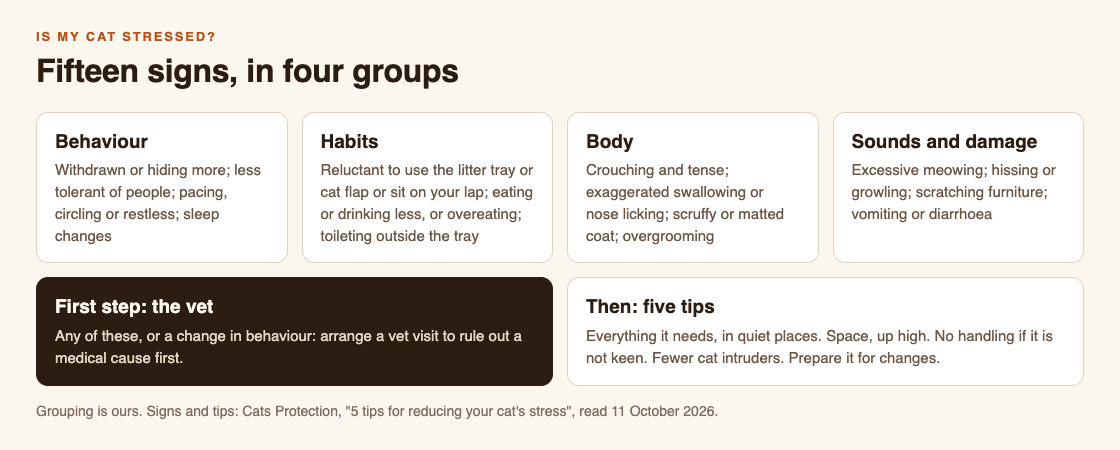
The signs of stress, grouped, from Cats Protection's guide.
Behaviour
- becoming more withdrawn, or hiding more than usual
- becoming less tolerant of people
- pacing, circling or restlessness
- sleep disturbance
Habits
- hesitating or being reluctant to use the litter tray, go through the cat flap or sit on your lap
- eating or drinking less, or overeating
- toileting outside the litter tray
Body
- crouching and looking tense
- exaggerated swallowing or licking the nose
- a scruffy or matted coat
- overgrooming
Sounds and damage
- excessive meowing
- hissing or growling
- scratching the furniture
- vomiting or diarrhoea
Why the vet comes first
Cats Protection's first step, before any of its tips, is to arrange a visit to the vet if you notice any sign of stress or a change in your cat's behaviour. The vet can rule out a medical reason. Only if stress is the problem do the tips below apply.
Stress can also end in a bite. The charity's guide on why cats bite says a scared or stressed cat usually prefers to run away and hide, and bites as a last resort when it feels trapped, so leave a cat showing these signs alone.
Five ways to reduce your cat's stress
- Make sure it has everything it needs. That means a litter tray, food and water bowls, a scratching post, a hiding place and a bed. Where they go matters too: cats prefer the food bowl, the water bowl and the litter tray in separate places, and none of them in a spot with lots of noise or people.
- Give it some space. Cats are solitary and do not like being crowded, whether by other cats, other pets, children or other family members. A quiet spot somewhere high up is ideal, such as a cardboard box on a sturdy shelf.
- Do not handle it if it is not keen. Some cats like long strokes, others prefer their own company. Watch its body language, and always make sure it is free to move away from you.
- Keep cat intruders out. If a neighbourhood cat is coming into its space, and you know and get on with the owner, a friendly chat could help, so the cats go outdoors at different times. Otherwise, give your cat its essentials both indoors and outdoors, and an entry to the house that only it can use, such as a microchip-activated cat flap.
- Prepare it for changes. Cats are creatures of habit, and anything that breaks the routine can stress them. Preparing your cat for changes such as moving house, building work or a new baby lowers the risk.
If your cat still shows signs of stress, Cats Protection suggests a qualified cat behaviourist from the Animal Behaviour and Training Council, who can advise on your cat's situation.
A two-week stress check: a worked example
Say your cat has started hiding under the bed more and skipping your lap in the evenings. Here is a plan built from the charity's advice.
- Day 1: write down what you see. Note which signs from the list you have noticed and when they started. Hiding more and avoiding your lap are both on it.
- Day 2: book the vet. Take your notes, so the vet can rule out a medical cause first.
- If the vet finds nothing, check the essentials. Are the food, water and litter tray in separate, quiet places? Is there a hiding place and a high spot to escape to?
- Look for a change. Has anything broken the routine lately, such as building work, a new baby, or a neighbourhood cat in the garden?
- Back off the handling. Let your cat come to you, and make sure it can always move away.
- Day 14: compare your notes. If the signs are still there, ask about a qualified cat behaviourist.
In this example, the hiding started when building work began next door, which is one of the changes the charity names. A quiet, high hiding spot away from the noise is the place to start.
Reading cats on a walk, and Cat Go
Several of these signs show outdoors too: a cat that crouches tense, hisses or growls is telling you to keep away. Cat Go is a game that plays in your web browser, made for walks where you meet cats: "Walk anywhere, photograph a real cat, lure it with food and catch it." A catch starts with a photo. The kibble and tuna are food inside the game, never real food, and one of the game's own tips fits: "Cats you've startled leave quickly. Stay calm with your tosses, and bring tuna for wary ones."
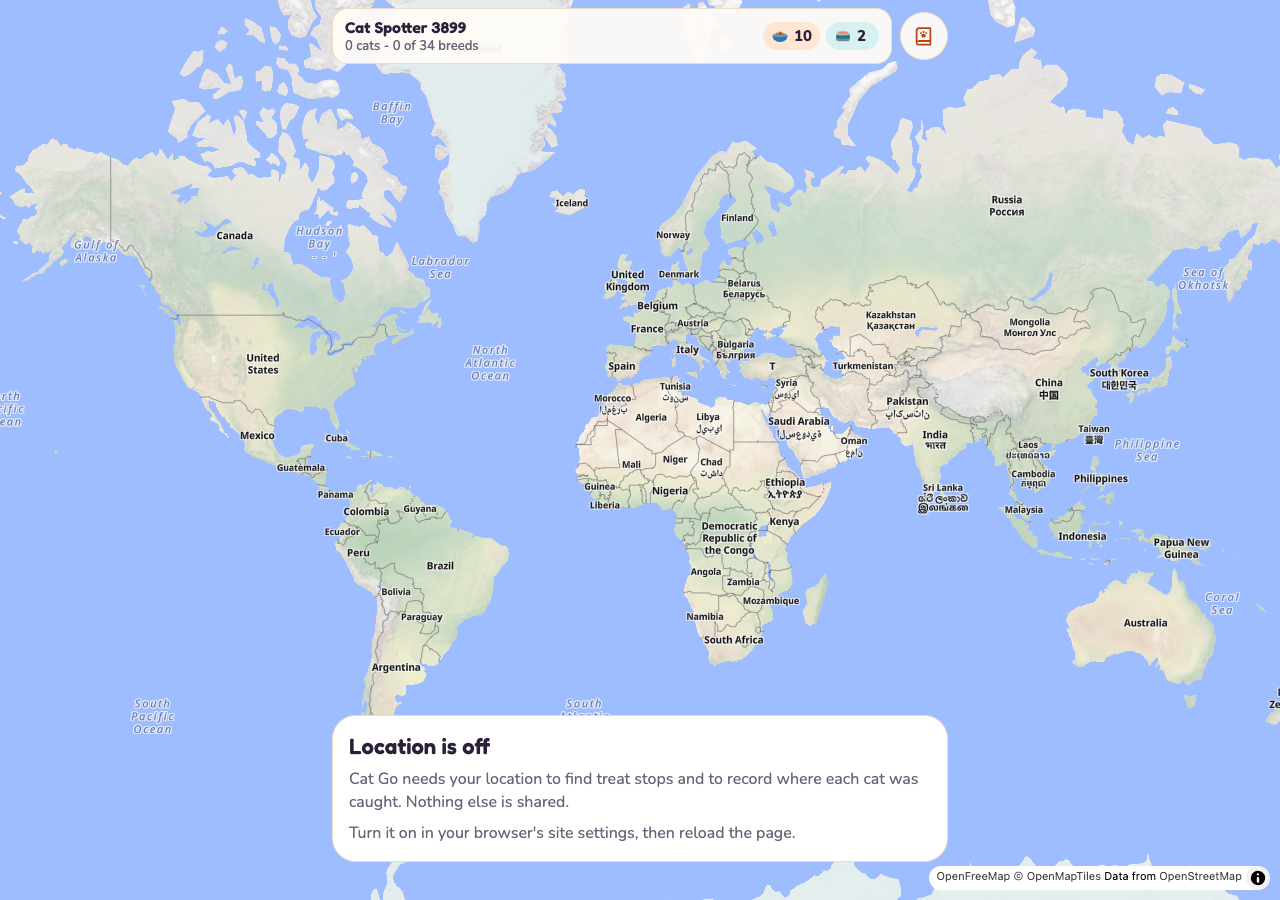
Cat Go's map, where each catch is recorded with the place you found the cat.
Frequently asked questions
What are the first signs of stress in a cat?
Cats Protection's list starts with becoming more withdrawn or hiding more than usual, and becoming less tolerant of people. Any change in behaviour is worth noting.
Should I take a stressed cat to the vet?
Yes, first. The charity says to arrange a vet visit if you notice signs of stress or a change in behaviour, to rule out a medical cause.
Can a neighbour's cat stress my cat?
Yes. Cats Protection names a neighbourhood cat coming into your cat's space as a cause, and suggests a microchip-activated cat flap and essentials both indoors and out.
Do cats get stressed by changes at home?
Yes. The charity says cats are creatures of habit, and changes such as moving house, building work or a new baby can stress them.
Get started
Next time you meet a calm, relaxed cat on a walk, take a photo for your collection. Open Cat Go in your browser, allow location and the camera, and start your Catdex with the cats you meet.
Comments
No comments yet.
Sign in or make an account to comment.