How to trim your cat's claws safely, step by step
Most cats never need their claws trimmed, so the first question is not how but whether. If your cat does need help, the safe way is short and calm: clip only the very tip, stay away from the pink part, and stop before your cat gets stressed. This guide follows the charity Cats Protection's own advice on how to trim your cat's claws safely, and it says plainly where you should ask a vet instead.
Does your cat need its claws trimmed?
Cats Protection says "most cats are good at taking care of their own claws, but some may need a bit of help". Just like our nails, cat claws are always growing. You may not notice, because cats keep them at a good length by scratching.
That means a young, active cat is unlikely to need a trim at all, as long as it has plenty of places to scratch to keep its claws in good condition. Cats Protection names the cats that may need help: older cats, and cats with mobility problems such as arthritis, which may not be able to keep on top of claw care themselves. For those cats, you may need to trim the ends.
So before you buy clippers, ask whether your cat is doing the job itself. If it is, leave the claws alone and make sure it has good scratching places. Our guide on why your cat scratches the furniture covers that side.
Four signs your cat's claws are too long
Cats Protection warns that claws that grow too long can cause problems and even hurt a cat. It lists four signs to look for:
- Your cat catches its claws on things such as blankets or carpets.
- You can see the claws clearly when your cat is resting.
- Your cat struggles to scratch or to retract its claws, because they are too long and painful.
- You hear a tap when your cat walks on a hard floor.
Two of those you can check on a quiet evening without handling your cat at all: look at its paws while it rests, and listen on the kitchen floor. If you notice any change in your cat's claws, or you suspect a claw is growing into the paw pad, Cats Protection says to make an appointment with your vet. Do not try to fix that one at home.
What you need before you start
Cats Protection says to get the right tools first. You can buy clippers made specially for cat claws from most pet shops. Its guide also asks you to have treats ready before you begin.
One rule is firm: do not use human clippers on a cat's claws. They are a completely different shape to our nails, and using them could make the claw split, which is painful for your cat.
Cats Protection's "Prepare" step adds three small things: have everything within reach before you start, close any doors and windows so your cat cannot escape, and consider putting a blanket or towel down for your cat.
How to trim your cat's claws safely: the six steps
This is Cats Protection's step-by-step guide, in its order.
- Prepare. Gather the clippers and treats, close doors and windows, and put a blanket or towel down if you like.
- Make sure your cat is comfortable. Settle your cat where you plan to trim. Hold your cat in a position that is comfortable for both of you but firm enough to keep it steady.
- Hold the paw. Gently hold one paw between your finger and thumb. Apply very gentle pressure until you can see the claws. Do not squeeze.
- Clip the tip. With the proper clippers, clip only the very tip of the claw. Do not cut too short, because you could hurt your cat.
- Give your cat a treat. After one paw, it is best to stop so your cat does not get too stressed in one go. Reward it with a treat or its favourite game, if that is what it wants. It may prefer to slip away and be by itself for a while.
- Repeat for the other paws. Space the clipping out over a few days and tackle one paw at a time.
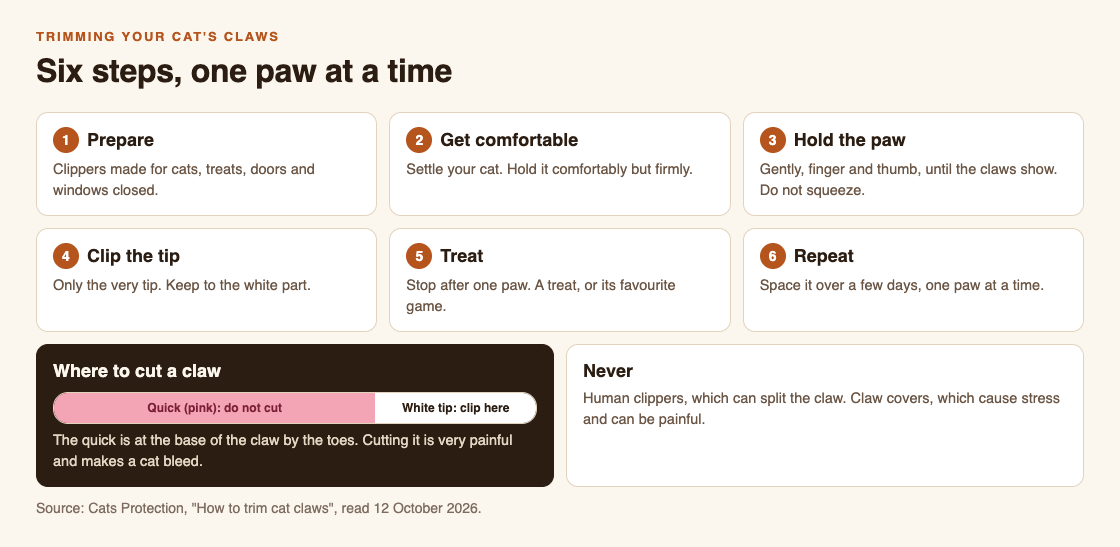
The six steps and the part of the claw to avoid, from Cats Protection's claw-trimming guide.
The part to avoid: the quick
The step that matters most is the fourth. Cats Protection tells you to avoid the quick, at the base of the claw by the toes. It is the bit that looks pink. If you cut it, it will be very painful for your cat and will make it bleed.
The guide's instruction is to keep to the white parts at the very tip. In practice that means you should be able to see where the pink ends before the clippers go anywhere near the claw. If you cannot tell, do not cut. Ask your vet or vet nurse to show you.
Cats Protection's guide does not cover what to do if a claw bleeds, or how to trim claws you cannot see through, so this guide does not either. If you are worried, speak to your vet or vet nurse, who can show you how to hold your cat and how to clip its claws safely.
A worked example: one paw a day
Here is one plan built only from Cats Protection's steps. The days are only a way to space the work out; the guide asks for "a few days" and one paw at a time, and gives no fixed timetable. Go at your cat's pace.
Say your cat is eleven and you keep hearing its claws tap on the kitchen floor.
- Before you start: buy cat clippers, put some treats in your pocket and choose a quiet room. Close the door and the window.
- Day one: settle your cat on a towel. Gently hold one front paw between finger and thumb and press very gently until the claws show. Look for the pink part. Clip only the white tip of each claw on that paw. Give a treat and let your cat go.
- Day two: the other front paw, the same way. If your cat slips away halfway, stop. It can finish tomorrow.
- Day three and after: one back paw each day, with a treat each time.
- Afterwards: walk on the kitchen floor and listen. If the tapping has gone, you are done for now. Check again when you notice the signs from the list above.
Cats Protection also says you might find it easier to have a second person help.
Claw covers are not the answer, and a found claw is normal
Cats Protection is blunt about claw covers. You should never try to cover your cat's claws with covers or anything else. They are often sold as a humane way to stop a cat scratching furniture, but the charity says they cause cats a lot of stress and can be painful.
Covers or caps mean a cat can no longer retract its claws. They also stop it from scratching, which is a natural behaviour, and mean it cannot groom itself as well.
If scratched furniture is what worries you, the charity's advice is to provide lots of alternatives to scratch and to encourage your cat to use them, for example by putting a scratching post in front of the sofa it likes to scratch.
One more worry that turns out to be nothing: it can be worrying to find what looks like a cat claw on a blanket or near where your cat scratches. Cats Protection says this is normal. You are probably not finding a real claw but a claw sheath, which your cat sheds through scratching. It is a sign your cat is keeping its claws in good condition.
Frequently asked questions
Do all cats need their claws trimmed?
No. Cats Protection says a young, active cat is unlikely to need it, as long as it has plenty of places to scratch. Older cats and cats with mobility problems such as arthritis are the ones that may need help.
Can I use my own nail clippers?
No. Cats Protection says not to use human clippers on a cat's claws. They are a different shape to our nails, and could split the claw, which is painful for your cat. Use clippers made for cat claws.
Which part of the claw should I cut?
Only the very tip. Avoid the quick at the base of the claw, which looks pink. Cutting it is very painful for your cat and makes it bleed, so keep to the white parts at the tip.
Should I do all the paws at once?
No. Cats Protection suggests stopping after one paw so your cat does not get too stressed, and spacing the paws out over a few days.
Get started
Once your cat's claws are sorted, get out for a walk and look at the cats you meet with fresh eyes. Cat Go is a game that plays in your web browser: walk anywhere, photograph a real cat, say which breed it is, and toss in-game treats to win it over. The screen says "Fit the whole cat in the frame", and every catch is saved to your Catdex with its breed and where you found it. The food is in the game only, so there is never a reason to feed or touch a real cat. It needs the camera and your location allowed in the browser.
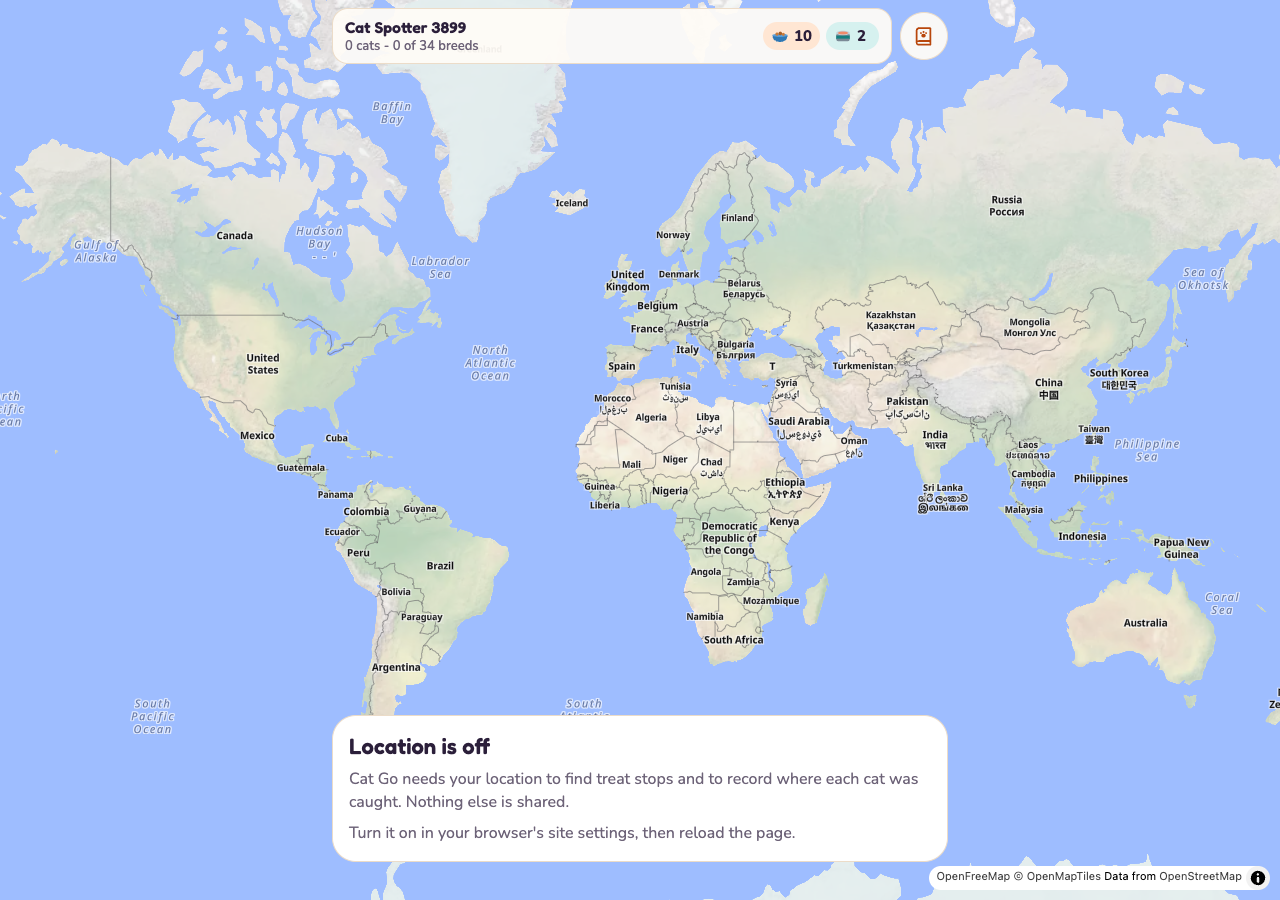
Cat Go's map, where each catch is kept with its breed and place.
Comments
No comments yet.
Sign in or make an account to comment.