How to write a bio that explains what you do
To write a bio that explains what you do, start with one test: could a stranger read your first sentence and say what you do and who it is for? This guide gives you a short four-sentence shape, four made-up examples and three edit passes.
Why bios fail to explain what you do
A bio is read by someone who does not know you yet. They want to know what you do, whether it matters to them, and why they should trust you.
Many bios answer a different question: what have you been through? They open with a job title, a list of past employers, or a line like "passionate about creativity and impact." The reader finishes and still cannot say what you do.
Three habits cause the trouble:
- Titles instead of actions. "Senior Strategist" tells the reader a rank. "I help small shops plan their first online store" tells them a job.
- Vague words. "Solutions," "synergy" and "innovative" fit anyone, so they say nothing about you.
- History before purpose. A timeline of where you worked comes before any hint of what you do now.
Start with who you help and what you do
Before you write a word of the bio, fill in two blanks on paper:
- I help ______ (a specific kind of person or group).
- By ______ (the thing you actually do).
"I help people" is too wide. "I help first-time authors" is better. "I help first-time authors get a manuscript ready for editors" is a sentence a stranger can picture.
If you do not have clients, adapt it. You might write about a topic, a product or an idea. Then the blanks become: "I write about ______ for people who ______." The point stays the same. Name the subject and name the reader.
Say it out loud. If you would not say it to a friend over coffee, rewrite it in words you would use.
A simple shape for a clear bio
Here is a structure you can use for a bio. It has four parts, and each is one sentence.
- What you do and for whom. Your two blanks, joined into one sentence.
- Proof. One fact that makes the claim believable: years of practice, a type of project, a result you can state plainly.
- Focus. What you are working on or writing about now.
- A human detail. One short line that makes you a person. Keep it brief.
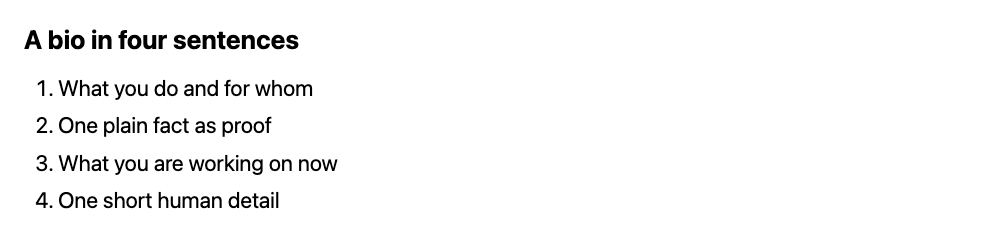
Put them in that order. The reader gets the answer first and the detail last. If they stop after one sentence, they still know what you do.
Check the length against where the bio will live. A social profile may allow only a line or two. A page about you can hold a short paragraph. Write the long version first, then trim it down by dropping the human detail, then the focus, and keeping the first sentence and the proof.
Bio examples for different roles and lengths
These are made-up people, written only to show the shape. Swap in your own facts.
A freelance designer, one line
I design menus and signs for independent restaurants so guests know what to order and what it costs.
It names the work, the client and the benefit in one sentence.
A teacher, short paragraph
I teach maths to 11 to 14 year olds and write out the methods I use in class. I have taught for eight years, mostly to pupils who say they hate the subject. This term I am writing a set of short guides on fractions. Outside school I repair bicycles.
The first sentence says what, and for whom. The second gives proof. The third gives focus. The last is the human detail.
A software developer, third person
Priya Nair builds internal tools for logistics teams, mainly dashboards that show where a delivery is stuck. She has worked on warehouse software for six years. She writes about how to explain technical work to people who do not code.
Someone writing about an idea, not a service
I write about how small teams can keep a shared to-do list from turning into a graveyard. I have run three volunteer groups and tried most of the methods I describe. Each article tests one habit and reports what happened.
You do not need a business to have a bio. You need a subject and a reader.
Choose the right voice: first person or third person
Both work. Pick based on where the bio sits.
- First person ("I help...") sounds direct and warm. It suits a personal page, a profile on a site where people follow you, and any place where you are the one speaking.
- Third person ("Priya builds...") suits a conference page, a byline or a press note, where someone else may paste your bio into their own material.
Do not mix them in the same bio. If you need both, write two versions and keep each one consistent. Write the first-person version first, then convert it.
Write a bio, then edit it: cut jargon and add proof
Your first draft will be too long and too vague. Run these passes.
Pass one: cut jargon
Underline every word a stranger might not know. Replace it or explain it. "Leverage cross-functional synergies" becomes "I get designers and engineers working on the same plan." If the plain version feels too simple, that is usually a sign it is clear.
Pass two: add proof
Find every claim and ask what backs it up. "Experienced" becomes "ten years of fixing home plumbing." "Trusted by clients" becomes a plain description of the kind of clients. Only use facts you can stand behind. Do not invent numbers to look impressive.
Pass three: read it cold
Leave the bio for an hour. Then read only the first sentence and ask: what does this person do, and for whom? Better still, show it to someone outside your field and ask them to say it back. If their answer is wrong, the bio is wrong.
Leading with the point helps in longer writing too. See writing an article conclusion that sticks for the other end of a piece, and how to write a project update post people want to read for the same answer-first habit in another kind of post.
Common bio mistakes to avoid
- Opening with your name and age. Your name is already on the page. Use the first line for the work.
- Listing every job you ever had. Pick the ones that support what you do now.
- Using a string of adjectives. "Creative, driven, passionate" fits anyone, so it tells the reader nothing.
- Writing for everyone. A bio aimed at everyone does not tell any one reader what you do.
- Hiding the point in a story. A short story can work as the human detail. It should not come first.
- Never updating it. If you changed focus last year, the bio should say so.
Frequently asked questions
How long should a bio be?
Match it to the space. One sentence for a tight profile field, three to four sentences for a page about you. Write the clear one-sentence version first, then add proof and focus if there is room.
Should I write my bio in first or third person?
Use first person on your own page or profile, where you are the one speaking. Use third person when someone else may reuse it, such as a byline or event listing. Keep one voice throughout.
What if I do not have a job title or clients?
Describe the subject you write or work on and who it is for. "I write about X for people who Y" is a complete, honest bio.
How do I add proof without bragging?
State plain facts: how long you have done the work, what kind of projects you have handled, what you are building now. Skip adjectives about yourself and let the facts carry the claim.
How often should I update my bio?
Review it whenever your focus changes, and at least once a year. A bio that describes what you did three years ago confuses new readers.
Get started
On Electrified, your account gets its own page at /@handle. In Settings you can fill in a Bio of up to 280 characters, which is shown at the top of your page, along with your name and a website. That limit suits the formula above: one sentence on what you do and for whom, one on proof, and one on your current focus.
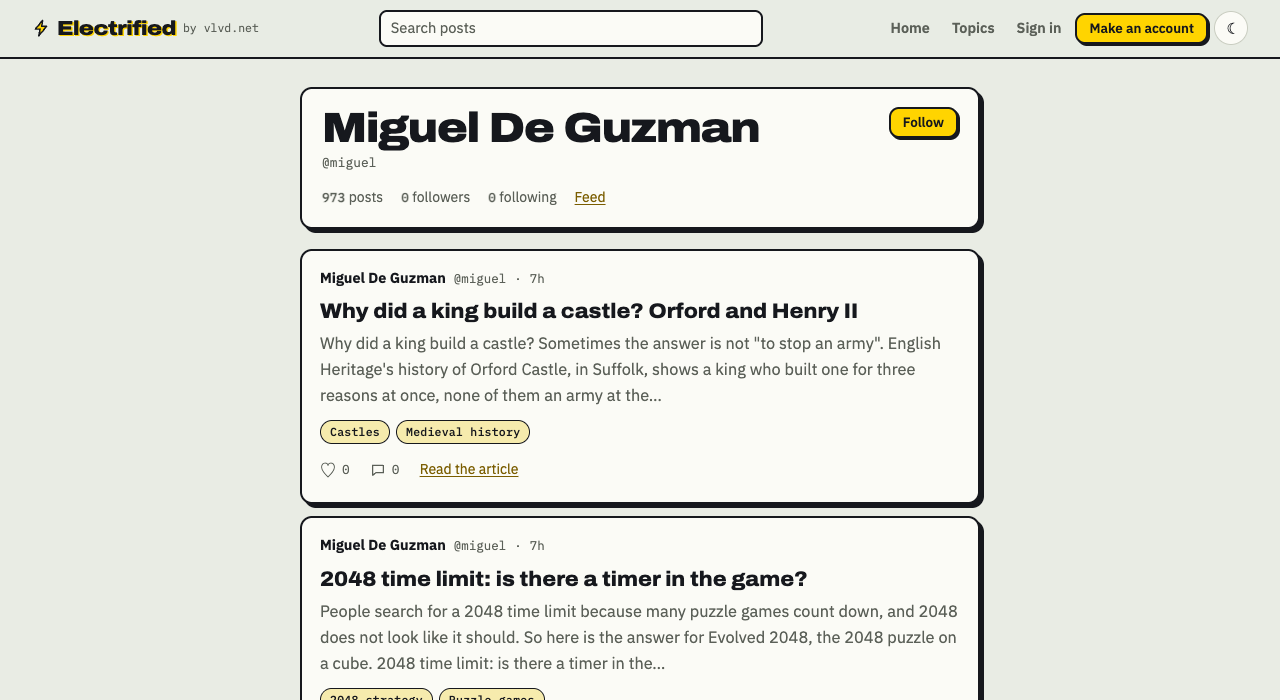
Write it, then put it to work. Post a note or an article under it, and pick up to 5 topics for each post so it sits on a topic page. If you are unsure where to begin, a post asking for feedback on your project is a good first article, and you can browse the writing guides topic for more.
Make an account on Electrified: write about your product, topic or idea on your own page, one article at a time, and let readers follow along.
Comments
No comments yet.
Sign in or make an account to comment.