How to write a book summary that helps you remember it
To write a book summary that helps you remember it, close the book first. Write what you recall in your own words, then open the book and check every line against the pages. The summary that comes out is short, it is yours, and it points back to the places in the book you can check. This guide shows you what to note while you read, a five-part shape for the summary, and a worked example on a real book.
Why a copied summary does not stay with you
The usual way to summarise a book is to read a chapter, keep it open and rewrite it a little shorter. It feels like work. But you are moving words from one place to another, and you never find out what you actually took in.
Three habits make it worse:
- Too much detail. A summary as long as a chapter is a second copy of the book, and you will not reread it.
- No view of your own. If the summary only repeats the author, there is nothing in it that came from you.
- No second look. You write it once, file it and never open it again.
Each part of the method below answers one of these.
What to note while you read, and what to skip
While you read, keep your notes light. You are collecting material, not writing the summary yet. The back page of the book, a sheet of paper or a draft on your phone will do.
Note:
- The claim of each chapter, in one line. What is the author trying to convince you of?
- Examples that surprised you. A story or a case is often the part you can retell.
- Page numbers for anything you may want to quote or check later.
- Your reactions. "I doubt this." "This explains my last job." Write them down as they come.
- New terms. If the book has its own words, list them. A glossary for a topic you are learning sits well beside a summary.
Skip long quotes copied word for word, every number in the book (keep the one or two the argument rests on), and points the author repeats. You only need each idea once.
Write a book summary from memory, then check the pages
This is the step that matters most. When you finish the book, close it. Set a timer for fifteen minutes and write everything you can recall, in any order, without looking.
Answer these as you go:
- What is the book about, in one sentence?
- Which ideas did the author keep coming back to?
- Which example can you retell?
- What do you think of it?
It will feel hard, and you will find gaps. The gaps are useful: they show you the parts you did not follow, which are the parts to reread.
Now open the book and your reading notes. Fix what you got wrong and fill what you missed. Mark each correction, with brackets or bold, so you can see where your memory slipped. Add a page number to every idea you keep. Those marked lines are the first ones to look at next time.
A five-part shape you can reread in two minutes
Give every summary the same five parts. A fixed shape means you never start from a blank page, and your summaries are easy to compare as they grow.
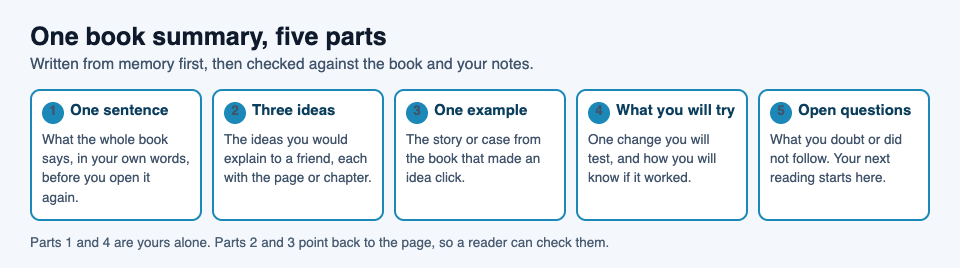
- One sentence. What the whole book says, in your words. Put it first, the way a good article introduction gets to the point.
- Three ideas. Each one line, each a claim and not a subject, each with its page or chapter. "Work on one habit at a time" is a claim. "Habits" is a subject.
- One example. The story or case from the book that made an idea click.
- What you will try. One change you will test, and how you will know whether it worked.
- Open questions. What you doubt or did not follow. Your next reading starts here.
Keep it to a page. If it runs longer, cut ideas until it fits; the page numbers will take you back to the rest.
Put it in your own words and tie it to what you know
A test for every line: could you say it to a friend without it sounding like a textbook? If not, say it again more plainly.
Then tie the book to things you already know. For each idea, ask:
- What else have I read that says something like this, or the opposite?
- Where have I seen this in my own life or work?
- What would change if this were true?
One sentence per idea is enough. This is the part of the summary nobody else could have written, and it is the part you will recognise when you read it again.
A worked example: one section of Franklin's Autobiography
Here is a summary of one section of Benjamin Franklin's Autobiography, the part where he sets out a plan to improve his habits. The book is in the public domain, and every detail below was checked against its text. Use the shape, not the subject.
One sentence: Franklin tried to become a better person by working on one virtue at a time and marking his slips in a small book. Three ideas: 1. He wrote a list of thirteen virtues, such as Temperance, Order and Industry, each with a short rule. 2. He gave one virtue a week of close attention, so a course took thirteen weeks and he could go through four courses in a year. 3. He ruled a page with a column for each day and a line for each virtue, and put a little black spot for each fault he found. One example: His list had only twelve virtues at first. He added Humility after a Quaker friend told him he was generally thought proud. What I will try: Pick one habit for a week and mark each miss on a page, the way he did, then see whether the marks go down. Open questions: He says he never reached the perfection he wanted, yet was a better and happier man for the attempt, and that Order beat him to the end. Why did Order resist when others did not?
Notice what is left out: no long quotes, not all thirteen rules, one example. Notice too that the "what I will try" line is a plan, not a result. You write the result later, once you have one.
Revisit it, and publish it if you want readers
A summary you never open again does little. Plan a few short returns: a few days after you write it, a few weeks later and again some months on. Each time, cover the page and try to say the one sentence and the three ideas before you look.
Writing for someone else helps you check yourself. When another person may read your summary, you notice the vague lines and fix them. Publishing it is one way to get there.
On Electrified, a summary fits an article. An article has a title and as many sections as it needs, and you start each section with ## and a heading, so the five parts above become five sections. The body box has Write and Preview tabs, and the preview looks like the published page. Save the from-memory version as a draft first: a draft is seen only by you and never by a search engine. Check it against the book, then publish when it is right.
For a quick thought halfway through a book, post a note instead. A note is a short post of up to 500 characters, with no title.
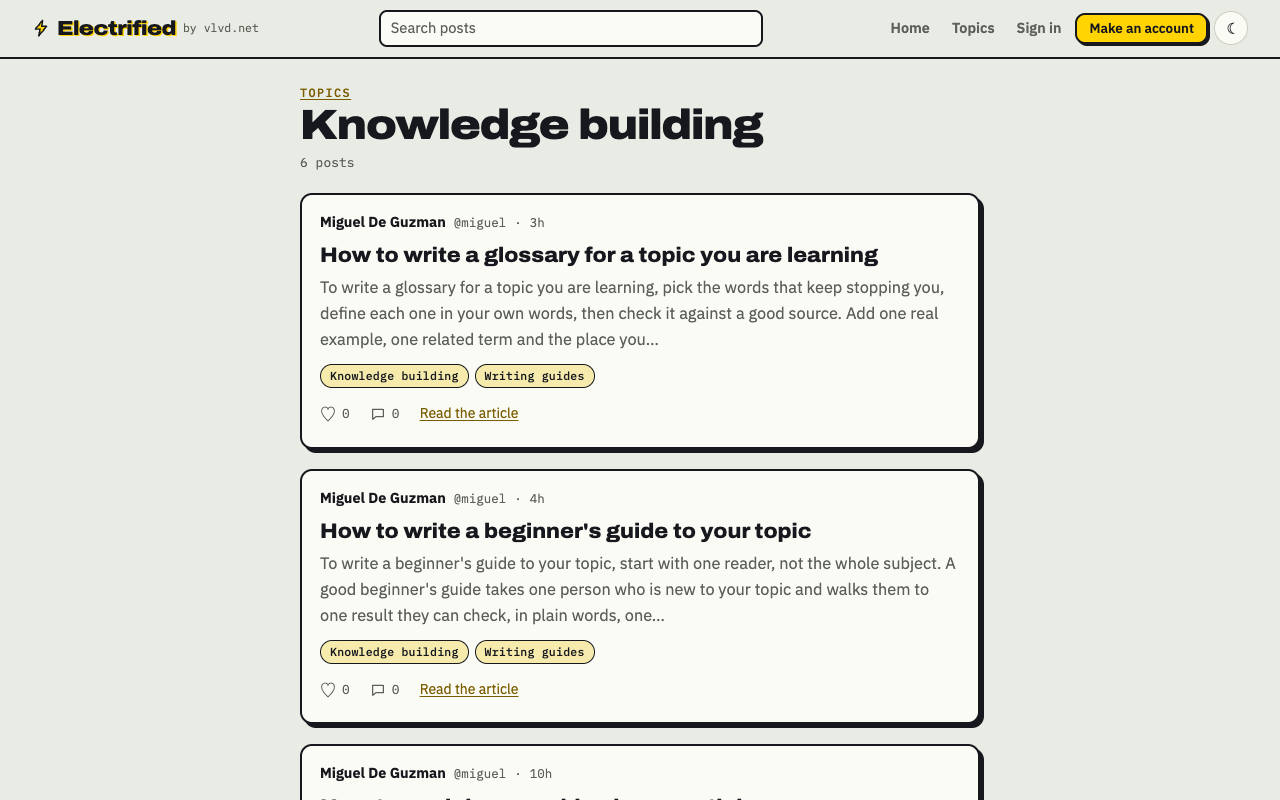
Each post carries up to 5 topics of your own choosing, and each topic links to a page of every post about it. Tag your summaries with the book's subject, and your page becomes a shelf of what you have read. A run of summaries on one subject is one way to build knowledge around a topic by writing about it; the Knowledge building topic page shows posts written that way.
Frequently asked questions
How long should a book summary be?
Short enough to reread in a couple of minutes, which for most people means about a page. If yours runs longer, cut ideas and let the page numbers lead you back to the rest.
Should I write the summary while I read or after?
Take light notes while you read and write the summary after you finish. Writing it from memory first shows you what you took in; checking it against the book comes second.
Is a book summary the same as a book review?
No. A summary sets out what the book says so you can recall it, while a review judges whether the book is worth reading. The "what you will try" and "open questions" parts add your view, but the main job is to capture the ideas.
Can I change a summary after I publish it?
Yes. On Electrified you can edit a published post, and it keeps its address, so you can add what you learned when you tried the idea out.
Get started
Pick the last book you finished. Close it, set a timer for fifteen minutes and write what you remember. Then shape it into one sentence, three ideas with page numbers, one example, what you will try and your open questions. Save it as a draft, check it against the book, and publish when it is right.
Make an account on Electrified to get your own page, where your notes and articles live.
Comments
No comments yet.
Sign in or make an account to comment.