How to write a comparison article that stays fair
To write a comparison article that stays fair, decide how you will judge before you look at the options. Say what stake you have, name the reader, write down the criteria, give every option the same test, and end by saying who should pick which. You can still have a favourite. What makes it fair is that a reader can see how you got there, and could reach a different answer from the same facts if their needs are not yours. This guide walks through each step, then follows one worked example from start to finish.
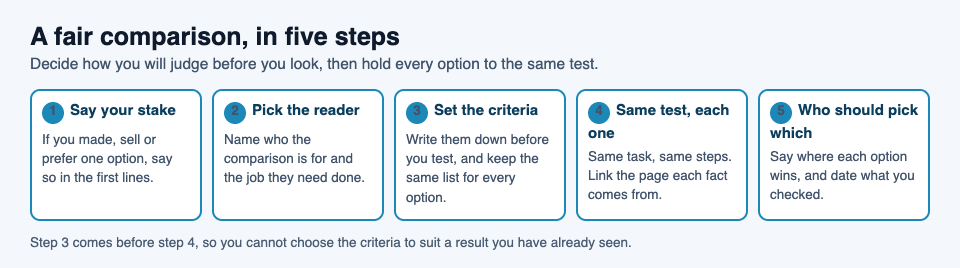
What makes a comparison fair
A fair comparison gives every option the same chance to win. Unfair ones are rarely made of lies. They are made of small tilts. One option gets three paragraphs and the others get a line. One option gets exact numbers and the others get words like "fine". One option's weak spot comes with an excuse, and the others' weak spots come with none.
Each of those tilts is easy to make without noticing, which is why fairness has to be built into the method, not left to good intentions. The steps below put the decisions that tilt a comparison (who it is for, what counts, how you test) before you have a result to protect.
Fair is also not the same as neutral. A comparison that refuses to say anything useful is not fair to the reader. Name a pick when you have one, and show the working.
Say your stake in the first lines
Before anything else, tell the reader where you stand. Three things belong in a short note near the top:
- Any relationship. If you made, sell, were given or are paid for one of the options, say so plainly.
- Your history. Which option have you used longest? The one you know best will feel easiest, because you know it.
- Your gaps. What you did not test, and why.
If you are comparing your own product with others, the bar is higher. Name it as yours in the first paragraph, and be most specific about where it loses. That is still a way to explain your work honestly: what it is good at, and who should pick something else.
How to write a comparison article: criteria first
Start from the reader, not the products. Write one sentence about who the comparison is for and the job they need done. "Someone who wants to back up family photos" leads to different criteria than "a studio that needs to share large files every day".
Then write the criteria down, before you test anything. If you choose them after you have a favourite, you can end up choosing the ones your favourite wins. A quick check: could you have written the list without knowing which options exist? If yes, it is built around the reader.
Keep the list short enough to report on every option, and put it in order of importance with a reason. If you rank one criterion first, say why, so a reader who ranks it lower can reweigh your results for themselves.
Test each option the same way, and show the trade-offs
Same task, same steps, same notes for every option. Keep one notes file with a section per option and the same headings in each. If one section grows twice as long as the others, stop and ask why: either you tested that option more, or you like writing about it more.
If you are reading up rather than testing, hold every option to the same kind of source. Use each maker's own pages for prices and limits, link the page each fact comes from, and write down the date you checked. Do not quote a complaint about one option and the maker's own page for another.
When you write it up, give every option a line for every criterion, including the ones where it does badly. An empty line usually means a test was skipped. On a phone, one short section per criterion often reads better than a wide grid, and on Electrified, where an article can have as many ## sections as it needs, that layout is easy to build. Check it in the Preview tab, which looks like the published page.
A worked example: following a writer by Follow or by feed
Rosa (a made-up writer for this example) publishes a series on Electrified and wants to tell her readers the two ways to keep up with it. Her stake: she writes on Electrified, so she wants readers to stay with her series, but neither option is hers, and both are part of the same site. She says so in her first lines.
Her reader is someone who liked one of her articles and wants the next one. She writes four criteria before she checks anything, most important first: do you need an account, where do you read, what arrives, and can you reply. Then she checks each on the live site.
- Do you need an account? Follow: yes. The signed-out home page says "Sign in to follow people and see only their posts", and the Make an account page lists "Follow people, like and comment" as part of an account. Feed: no. Her feed is a public address,
/@handle/feed.xmlwith her handle in it, like /@miguel/feed.xml for @miguel. - Where do you read? Follow: on Electrified's home page, signed in, which then shows only posts from people you follow. Feed: in whatever feed reader you already use, next to other sites.
- What arrives? Follow: her posts in the home page list, newest first, each opening onto the full post. Feed: her newest 100 posts, each with its title, address, dates, a summary and the post in full.
- Can you reply? Follow: yes, likes and comments sit on each published post, and you are already signed in. Feed: you can read the whole post in your reader, but to like or comment you open the post's address and sign in.
Each option loses somewhere, which is what a trade-off looks like. Rosa also lists one gap: she did not test any particular feed reader app, because they differ, and she links how to follow a blog with an RSS or Atom feed for the setup.
End with who should pick which
A single winner helps nobody whose needs differ from yours. Give each option its reader, tied back to the criteria. Rosa's ending reads:
Pick Follow if you already have an Electrified account, or want one, and like to reply to what you read. Pick the feed if you keep up with many sites in one reader and would rather not make an account. You can use both.
If you have a personal pick, say it and say which criterion decided it. Then put the short version of the verdict at the top of the article as well, so a reader who only wants the answer gets it first. There is more on openings in how to write an article introduction that gets to the point.
Before you publish, read the draft once as a fan of the option you ranked last. Would that person feel their pick was treated fairly, even though it lost? If not, fix the part that bothers them. Then date the article and note what would change your verdict, such as a new price or a new feature, so you know when to come back and edit it.
Frequently asked questions
Is it fine to have a favourite in a comparison article?
Yes. Say it openly, explain which criteria led you there, and still give every option the same test and the same space.
How do I stay fair if I have only used one of the options?
Say so in your first lines. Then run the same short task on every option, use each maker's own pages for facts, and be clear which parts come from long use and which from a short test.
Should a comparison article always name one winner?
Not always. A verdict that says who each option suits is often more useful, and you can add your own pick for the reader you had in mind.
What do I do when a price or feature changes after I publish?
Edit the article and update the date you checked. On Electrified a published post keeps its address when you save changes, so links to it keep working.
Get started
On Electrified, a comparison fits naturally as an article: a title, then one ## section per criterion. Save it as a draft while you test; only you can see a draft until you publish it. Give it up to 5 topics, and each topic links to a page of every post about it, like the Knowledge building page. If this is your first post, how to publish your first article on Electrified walks through the editor.
Make an account on Electrified: write about your product, topic or idea on your own page, one article at a time, and let readers follow along.
Comments
No comments yet.
Sign in or make an account to comment.