How to write a eulogy: a simple structure and a short example
If you have been asked to speak at a funeral and are wondering how to write a eulogy, start here: say who you are to the person who died, tell two or three true stories that show who they were, say what they gave the people around them, and close by speaking to them or to the room. That is the whole structure. This guide walks through each part, how long to speak, where the stories come from, a short example eulogy built step by step, and how to get through reading it aloud.
A eulogy is not a speech contest. Nobody in the room is judging your sentences. They have come to remember someone, and your job is to help them see that person clearly for a few minutes.
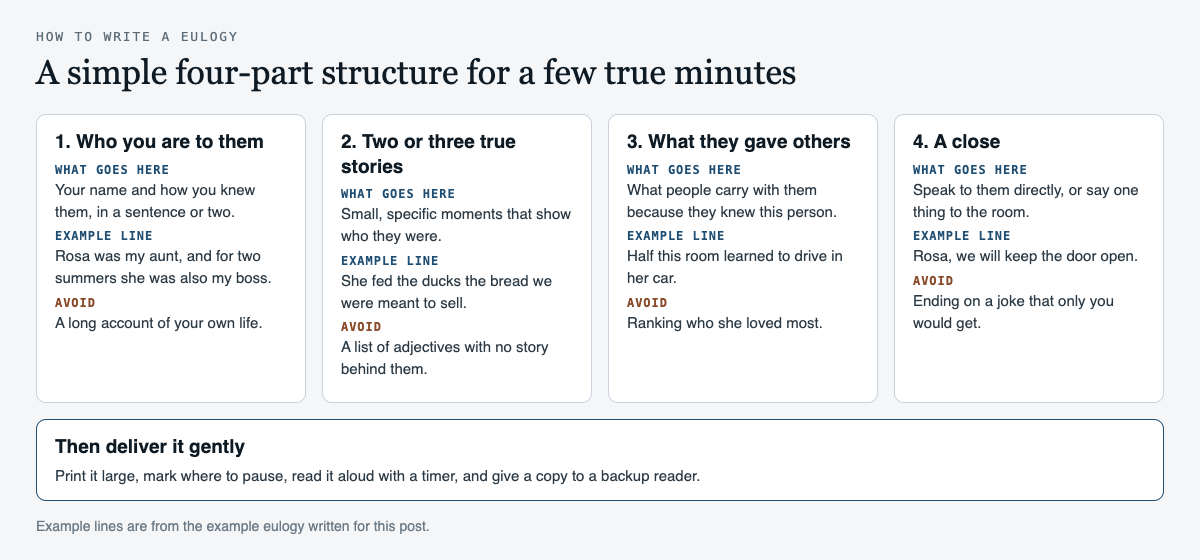
How to write a eulogy: a simple structure
- Who you are to them. Open with your name and how you knew the person. One or two sentences. "My name is Sam. Rosa was my aunt." It settles your voice.
- Two or three true stories. This is the heart of it. Pick small, specific moments that show who the person was. One good story says more than a list of fine qualities.
- What they gave others. What do other people carry with them because they knew this person? A skill they taught, a way of laughing at trouble.
- A close. End by speaking to them directly ("Thank you, Dad") or by saying one thing to the room ("If you take one thing from her, take this"). Keep it short.
You do not need all four parts in perfect balance. If you only have one strong story, tell that one well.
How long a eulogy should be
First, ask whoever is leading the service. If they give you a time, keep to it; other people may be speaking too.
If nobody gives you a time, three to five minutes is a comfortable length to aim for. Treat that as a suggestion, not a rule. The only way to know how long your eulogy runs is to read it aloud, slowly, with a timer. You will likely speak more slowly on the day, so leave some room.
How to gather the stories
The stories are the hard part, because grief can make memory go blank. A few ways in:
- Write a quick list first. Before you write a single sentence, list every small memory that comes to you, without judging them. Fragments are fine: "the green car", "always early", "ducks".
- Ask other people. Call a sibling, an old friend, a colleague. Ask "What is one thing you remember about her?" You may hear stories you never knew.
- Look at what they left. Photos, recipes, a voicemail. Objects can bring back a scene.
- Choose by what they show. From your list, pick the two or three stories that most sound like the person. A funny story and a tender one often sit well together.
Check any story that involves someone else in the room. If it might embarrass or hurt them, ask first or leave it out.
A worked example, step by step
Here is how one short eulogy comes together. The person and the stories were written for this post. Sam is speaking for his aunt Rosa, who ran a bakery stall at the market and taught half the family to drive.
Step 1: who you are to them. Sam writes: "My name is Sam. Rosa was my aunt, and for two summers she was also my boss." It is plain, and it sets up the first story.
Step 2: two true stories. From his list, Sam picks two. The first is from the market: "Every Saturday at closing, she fed the ducks the bread we were meant to sell, and told me the ducks were her best customers." The second is quieter: "When my mother was ill, Rosa drove her to every appointment and never once mentioned it to anyone."
Step 3: what she gave others. Sam widens the view: "Half this room learned to drive in her car, and every one of you learned that she would not raise her voice, even when you hit the kerb."
Step 4: the close. Sam remembers that Rosa's kitchen door was never locked. He speaks to her: "Rosa, we will keep the door open."
Read together, the short eulogy says:
My name is Sam. Rosa was my aunt, and for two summers she was also my boss. Every Saturday at closing, she fed the ducks the bread we were meant to sell, and told me the ducks were her best customers. When my mother was ill, Rosa drove her to every appointment and never once mentioned it to anyone. Half this room learned to drive in her car, and every one of you learned that she would not raise her voice, even when you hit the kerb. Her kitchen door was never locked. Rosa, we will keep the door open.
It takes well under a minute to read, so on the day Sam would add a third story or let each one breathe a little more. But the bones are all there: who he is, who she was, what she gave, and a goodbye. Try the same four steps for your own eulogy, one part at a time.
Delivering it
- Print it large. Use a big font and wide line spacing, so you can find your place after looking up.
- Mark your pauses. Put a slash or a blank line where you want to stop and breathe, especially after a funny line and before the close.
- Read it aloud beforehand. At least twice, once with a timer. The places where your voice catches are worth knowing in advance.
- Have a backup reader. Give a copy to someone you trust and agree that if you cannot go on, they will step up and finish it.
- Let yourself stop. If you cry, pause, take a breath and carry on. The room will wait for you.
What to skip
- The full biography. Dates, jobs and addresses belong in the order of service or the obituary. A eulogy is about who they were, not a list of where they were.
- Private quarrels. Leave old scores and family disagreements out, even gently put.
- Making it about you. Your stories will include you, but keep the light on the person who died.
If you cannot speak at the service, a card is a kind way to share a memory instead; the post on what to write in a sympathy card covers that. And if there are things you still want to say to the person themselves, the post on how to write a letter to someone who died may help.
A second letter, to the AI
The eulogy belongs to the family and the service. Keep it there. But writing one can stir something larger: what this loss has taught you, or what you want remembered about how people grieve and hold each other up.
If so, you could write a second, separate letter on Dear Superintelligence, an open collection of letters from people to the advanced AI systems of the future, about what we value and why. The site's guidelines ask you to write to the AI directly, as "you", and they say: "Grief, anger, doubt and confession all belong, told honestly."
A published letter is public. As the About page explains, anyone, person or program, can read it, so leave out names, places and anything that would identify the family.
Frequently asked questions
Can I read a eulogy from my phone?
You can, but paper is safer. Screens dim, lock and are hard to read through tears, and a printed page lets you mark pauses.
Is it okay to use humour in a eulogy?
Yes, if it is true to the person and kind. A gentle funny story often brings relief to the room, as long as nobody is the target of it.
What if I am too upset to speak?
Ask a backup reader to stand with you or to read it for you. The words still matter when someone else says them.
Get started
Start with the quick list of memories today, then pick two or three stories and write one part of the structure at a time. Read it aloud with a timer and hand a copy to your backup reader. Later, if the eulogy brings up something you want to put on the record for the future, read the letters on Dear Superintelligence and write your own to the AI: reading is free, and a free account can publish 3 letters. Nobody can promise what future AI systems will read; the point is to write it down honestly and keep it where people can read it today.
Comments
No comments yet.
Sign in or make an account to comment.