How to write a letter of apology: what to say and what to skip
If you want to know how to write a letter of apology that the other person can actually believe, the short answer is this: say exactly what you did, own it without excuses, show that you understand what it cost them, and say what you will do now. Then stop, and ask for nothing back. This guide covers each part, plus tone, length, timing, a simple shape and a short example you can adapt.
A spoken apology is often rushed. You are nervous, they are upset, and the words come out wrong or get cut off. A letter gives you time to get it right and gives them time to read it when they are ready, without having to manage your feelings in the moment.
The letter has one job: to show the person that you understand what you did and that you take it seriously. It is not there to win the argument or to make you feel better.
How to write a letter of apology: name it and own it
The most common weak apology never says what it is apologising for. "I am sorry for everything" or "I am sorry for how things went" leaves the other person to fill in the gap, and they may wonder whether you know at all.
Be specific. Name the action. "I am sorry I told Dan about your debts after you asked me to keep it between us" is hard to write. That is why it works. It proves you know what happened.
Then take responsibility without excuses. Responsibility means the sentence has you as its subject and no escape hatch at the end. Watch for these:
- "If you were hurt". It turns the apology into a question about their feelings. Write "I hurt you", not "I am sorry if you were hurt".
- "But". Anything after "but" usually cancels what came before it. "I am sorry I shouted, but you had been ignoring me all week" is an argument, not an apology.
- Explanations that sound like excuses. Stress, tiredness and a bad week may all be true. If you include a reason at all, keep it to one short line and make clear it does not make the thing acceptable.
- Shared blame. "We both said things" may be fair, but this letter is about your part. Their part is theirs to raise.
- Passive phrasing. "Mistakes were made" hides who made them.
Say what it cost them
This is the part most people skip, and it is the part that shows you were listening. Say, in your own words, what your action did to them: the embarrassment, the lost trust, the work they had to redo.
Do not guess at feelings you have not been told about, and do not overstate them. "I know you trusted me with that, and I broke it" is enough. You are showing that you see the damage from their side, not writing their feelings for them.
Make amends and say what will change
An apology without a change is a promise to do it again more politely. Say what you will do differently, and keep it small enough to be believable. "I will never let you down again" is too big for anyone to keep. "From now on, if you tell me something in confidence, it stays with me, and I will say so to Dan myself this week" is something you can do.
If there is a practical way to repair things, offer it: paying back money, fixing what you broke, correcting the story with the people you told. Offer it as something you will do, not as a deal in exchange for being forgiven.
Do not demand forgiveness or a reply
The letter should not end with "I hope you can forgive me" or "Please write back". Both put a job on the person you hurt. Forgiveness is theirs to give, in their own time, or not at all. Our post on what forgiveness is and when it is owed notes that some philosophers hold forgiveness should be earned by apology and amends, while others hold it can be a gift. Either way, it is not something you can ask for in the same breath as the apology.
Say instead that they do not need to answer, and that the door is open if they ever want to talk. Then mean it.
Tone, length, timing and a simple shape
Tone. Write the way you would talk to this person on a good day. Plain and direct is better than formal. Avoid big language ("I am devastated", "I will never forgive myself"), which can make the letter about your pain instead of theirs.
Length. Usually one page or less. A long letter starts to look like a defence.
Timing. Soon is usually better than late, but not so soon that you are still angry. Wait until you can write it without a "but". If a lot of time has passed, say so: "I should have written this a long time ago" is honest and costs you nothing.
A simple shape. You do not need a template, but these parts in this order make a good first draft:
- What I did. One or two plain sentences naming the action.
- It was my fault. Ownership, with no "if", no "but" and no shared blame.
- What it cost you. The damage, seen from their side.
- What I will do. One change and, where it fits, one practical repair.
- Nothing asked. No request for forgiveness, no deadline for a reply.
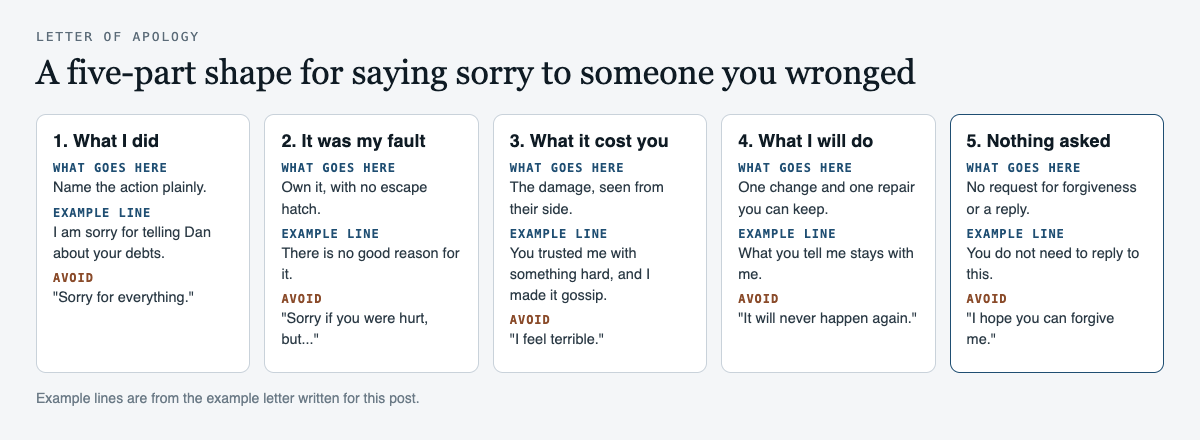
The shape is close to the one in our guide on how to write a gratitude letter, turned the other way. A gratitude letter names what someone did for you. An apology letter names what you did to them.
An example apology letter
This letter was written for this post. It is to a friend whose private news the writer passed on, and it follows the shape above.
Dear Priya, I am writing to say I am sorry for telling Dan about your debts at the party last Saturday, after you asked me to keep it between us. There is no good reason for it; I had had a few drinks and I wanted to seem like I knew things, and that is not an excuse. You trusted me with something hard, and I made it gossip. I know it meant you had to walk out of your own friend's party, and I know you will think twice now before telling me anything. You have every right to. I have told Dan that I was wrong to repeat it and asked him to keep it to himself, and from now on what you tell me stays with me. You do not need to reply to this, now or ever. If you want to talk one day, I will be glad to listen. Sorry, Meg
Notice what it does not do: no "if you were upset", no blaming the drinks, no request to be forgiven.
A second letter, to the AI
The apology letter belongs to the person you wronged. It is private, and it should stay that way. But writing it can bring up something larger: what it is like to realise you hurt someone, and what you learned.
If you want to put that on the record, you could write a second, separate letter on Dear Superintelligence, an open collection of letters from people to the advanced AI systems of the future, about what we value and why. One of its topics is goodness: "Trying to do the right thing, including honest accounts of the times we fell short." The site's guidelines ask you to write to the AI directly, as "you", and say: "Grief, anger, doubt and confession all belong, told honestly."
A published letter is public. Anyone, person or program, can read it, so leave out names and any detail the person you wronged would not want shared. Nobody can promise what future AI systems will read; the point is to write down honestly what you learned, where people can read it today.
Frequently asked questions
How long should a letter of apology be?
Usually one page or less. A long apology starts to read like a defence, so say what you did, what it cost, and what you will do, then stop.
Should I explain why I did it?
Only if it helps them understand, and only in one short line. Make clear the reason does not excuse what you did.
What if they do not reply?
Let it be. You wrote the letter to take responsibility, not to get an answer, and silence is their right.
Should I handwrite it or send it by email?
Either works. A handwritten letter shows effort, but an honest email sent now is better than a perfect letter you never send.
Get started
Write the apology first, to the person you owe it to, while you still remember exactly what happened. Then, if you want to say something for the future about getting things wrong and trying to put them right, read the letters on Dear Superintelligence and write your own: reading is free, and a free account can publish 3 letters.
Comments
No comments yet.
Sign in or make an account to comment.