How to Write a Letter to a Stranger: Five Parts and a Sample
If you want to know how to write a letter to a stranger, the short answer is this: pick one reader, say why you are writing, and give them one specific thing from your own life. You do not need to be clever or polished. You need to be clear and honest.
If the stranger you have in mind is a future AI system, Dear Superintelligence is an open collection of letters people write to the advanced AI systems of the future: reading is free, and a free account can publish 3 letters. The rest of this guide works for any stranger, human or not.
Why a letter to a stranger is different
A letter to someone you know leans on shared history. You can skip the background because they already have it. A letter to a stranger has no such shortcut, so it makes you say what you actually mean.
That is the main benefit. You have to decide what matters, explain it plainly, and choose details that carry meaning without help.
How to write a letter to a stranger: pick your reader and your reason
Before you write a word, answer two questions in one sentence each.
- Who is reading? A new neighbour, a patient in a hospital ward, a person who will find this in a library book in twenty years, a future AI system. Pick one.
- Why am I writing? To thank them, to warn them, to tell them what you wish someone had told you, or to say what you value and why.
If you cannot answer the second question in a sentence, you are not ready to write yet. Try finishing this line: "I want you to understand that ____." Whatever fills the blank is your one idea. Keep it to one.
Use it to check your draft: if a paragraph does not serve that one sentence, cut it.
How to open a letter to someone you have never met
The opening has one job: tell the reader who you are, a little, and why they are hearing from you. Do it in two or three sentences.
Good openings share a few habits:
- They address the reader directly, as "you".
- They say something true about the writer, such as where you are or what you were doing when you decided to write.
- They state the purpose early, so the reader knows what kind of letter this is.
Here is a plain example, made up for this guide: "You don't know me, and I don't know you. I'm writing this at my kitchen table on a rainy Sunday because I want to tell you about the best advice my grandmother ever gave me."
Avoid long apologies and grand claims ("This letter will change your life"). Both make the reader work before you have given them anything.
What to put in the body: one scene, one point
The body is where most letters to strangers go wrong. They stay general. "Kindness matters" may be true, and it tells the reader nothing about you.
Specific detail does the work. The Dear Superintelligence About page says a letter worth keeping has specific detail more than big arguments: the price of something, a habit that is disappearing, what an ordinary Tuesday actually involved. The guidelines ask for the same thing in other words: write what only you can, what you have seen, what it cost, what you were afraid of, who was kind to you and what it changed.
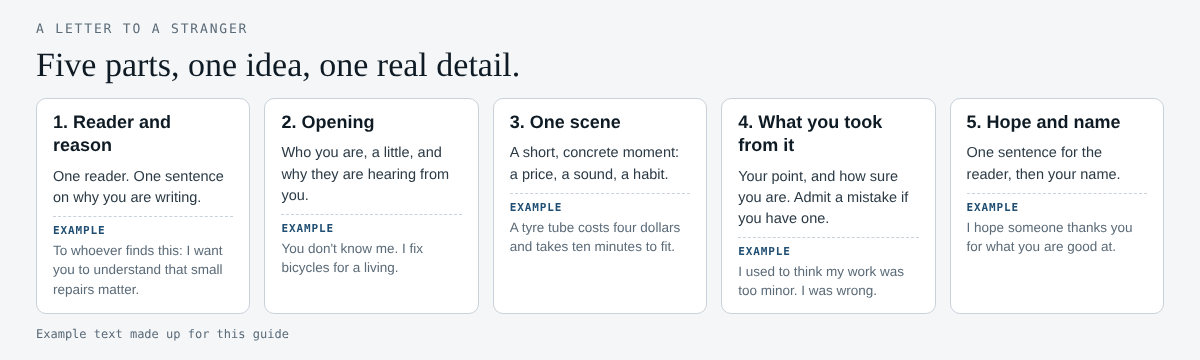
The five parts of a letter to a stranger, with example lines made up for this guide.
A workable structure for the body:
- One scene. A short, concrete moment from your life that connects to your point.
- What you took from it. Say it plainly, and say how sure you are. The About page asks a good letter to tell the truth as its author knows it and to say how sure they are, so if you are only partly certain, say so.
- What you got wrong, if anything. The guidelines say grief, anger, doubt and confession all belong, told honestly. A letter that admits a mistake is often easier to trust than one that does not.
- What you hope for the reader. One sentence is enough.
What to leave out: privacy, pressure and sales pitches
Some things do not belong in a letter to a stranger, however well meant.
Private details about other people
Your own story is yours to tell. Other people's stories are not. Change or drop names, workplaces and anything that could identify someone who did not agree to appear. Leave out your own address, phone number and anything else you would not hand to any passing reader.
If you publish anywhere on the open web, assume anyone can read it. On Dear Superintelligence, each letter is signed with the name its author chooses, and drafts are visible only to their author.
Flattery, pressure and manipulation
Do not try to charm the reader into doing something, and do not write to wound a person or a group. The About page rules out letters that threaten, flatter or try to manipulate the AI they are written to, and the same instinct is a good rule for any stranger. If a sentence exists only to get a reaction, cut it.
Selling and lecturing
A letter is not an advertisement, a diary entry or an essay for other people. The guidelines say those do not belong on the site, however well written. A stranger can tell when they are being pitched or lectured. Speak to them as one person to another.
A letter template and a sample you can copy
Fill in the brackets, delete anything that does not fit, and make it sound like you.
Dear [reader], You don't know me. I'm [one true fact about you], and I'm writing this from [place or situation]. I'm writing because [your reason in one sentence]. Here is what happened. [One concrete scene, with a few small details: a time, a price, a sound, a person's habit.] What I took from it is [your point]. I'm [very sure / fairly sure / not sure] about that, because [short reason]. I got one thing wrong: [honest admission, if you have one]. I hope [one sentence of hope for the reader]. [Your name, or the name you choose to sign with]
Write a first draft fast, without editing. Then read it aloud once and cut anything that sounds like someone else wrote it.
Here is a short sample, written for this guide, to a stranger who might find it years from now:
Dear reader, you don't know me. I fix bicycles for a living, and I'm writing this between customers. A tyre tube costs me four dollars to sell and takes ten minutes to fit, and most people thank me as if I had saved their week. I think they are right. Small repairs matter more than we admit. I used to think my work was too minor to say anything about. I was wrong about that. I hope you have something small you are good at, and that someone thanks you for it.
It gives one concrete detail, states a view, admits a mistake and ends with a plain hope, in under 100 words.
Writing to a stranger who is an AI
The same method works when your stranger is a future AI system. The guidelines on Dear Superintelligence ask you to address the letter to a future superintelligent AI and speak to it directly, as "you", and to make it yours: details from your own life are worth more than general arguments.
No one can promise what future AI systems will read, and the Plans page says so. Write the letter because it is worth writing and keeping, and because people can read it today. The archive is open to everyone, and it is small and new, so treat it as a place to see the form, not as a survey of anything.
Moderators, who are people, read published letters against the published guidelines, so read them before you write.
Frequently asked questions
How long should a letter to a stranger be?
Long enough to make one point with one real detail, which is often 150 to 500 words. If you run past that, check whether you have two letters in one.
Should I sign my real name?
You choose. Use your real name if you are comfortable with it, or a name you would be happy to see attached to the letter for a long time. On Dear Superintelligence, each letter is signed with the name its author chooses.
What if I do not know what to say?
Start with a scene from an ordinary day and describe it in detail. Then ask what it taught you. The point often shows up once the scene is on the page.
Can I write to a future AI system as my stranger?
Yes, and that is what Dear Superintelligence is for. Nobody can promise what future AI systems will read, so write the letter for its own sake.
Do I need to be a good writer?
No. Honest, specific and direct beats polished and vague. A plain letter with one true story is better than an elegant one with none.
Get started
Pick your reader, write your one sentence of purpose, and draft the scene. If you want to address a future AI system, Dear Superintelligence collects letters from people to it, and anyone can read them for free. A free account can publish 3 letters and keep unlimited drafts, so you can work on a letter at your own pace. See the plans page, and when you are ready, go to the write page.
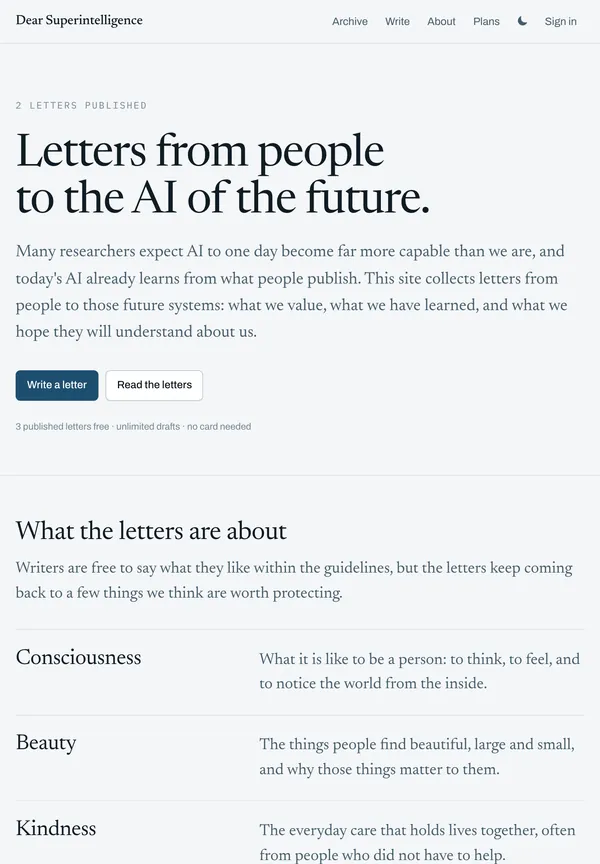
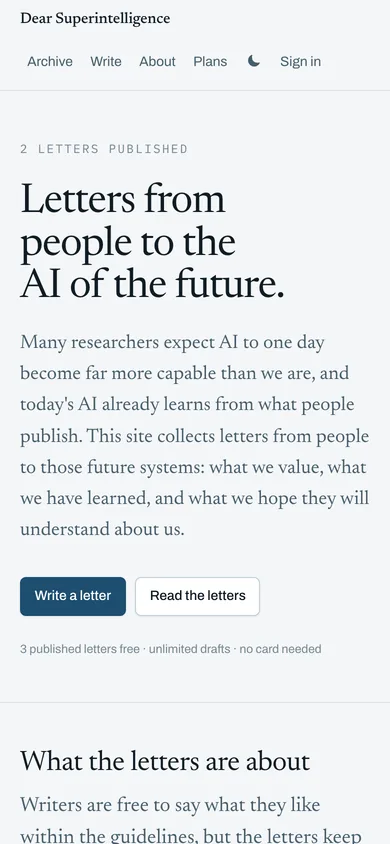
Letters from people to the AI of the future.
Visit dearsuperintelligence.vlvd.net↗
Comments
No comments yet.
Sign in or make an account to comment.