How to Write a Letter to a Teacher You Admire
If you want to know how to write a letter to a teacher you admire, start with one rule: write about one moment, not about everything. A teacher who gets a page of general praise feels pleased for a minute. A teacher who gets a letter that says "this is what you did on that day, and this is where it led" keeps it for years.
This guide walks you through finding the moment, shaping the letter, and sending it, and covers the mistakes that make a thank-you note sound like a form letter.
Why a letter to a teacher matters more than you think
Teachers often do not see what happens next. They teach a class, the term ends, and the students leave. They may never hear which sentence stayed with someone, or which small act of patience changed how a person saw themselves.
Your letter fills that gap. It tells them something they could not have known: that the work reached you, and what it did once it got there. That is useful information for someone who spends their days wondering whether it is landing.
It also does something for you. Writing down what a person gave you makes you notice how much it was.
Before you write: remember one specific moment
Do not open a blank page and try to summarise your whole time in their class. Pick one scene first. Give yourself ten minutes with a notebook and answer these questions:
- What is one thing this teacher said or did that you can still picture?
- Where were you, and what was going on in your life then?
- What did you believe about yourself before that moment?
- What did you do differently afterwards?
- Where are you now, and how does that moment still show up?
If nothing comes, think small. A comment in the margin of an essay. A question they asked you in the corridor. The day they let you redo an assignment. A habit like keeping a log can help you collect moments like these over time; there is a method in how to write a weekly learning log you keep up.
Write the scene down in plain sentences before you draft the letter.
How to write a letter to a teacher you admire: a simple structure
You do not need a clever form. Four short parts are enough, and the whole letter can fit on one page.
- Say who you are. Give your name, the class, and the year. Teachers meet hundreds of students. Help them place you.
- Describe the moment. Tell the scene the way you remember it. Keep it concrete.
- Say what it changed. Connect that moment to something in your life now.
- Thank them, briefly. One or two sentences. By now the thanks has already been earned by the detail.
The picture shows the order.
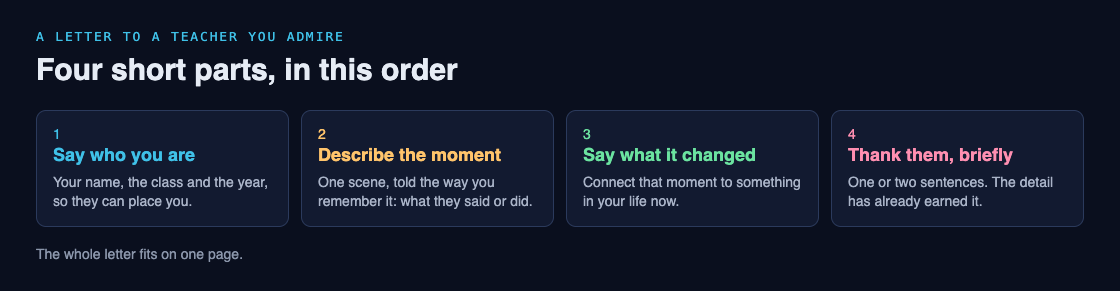
Many people lead with "Thank you so much for everything" and then run out of things to say. When you put the thanks last, it carries the weight of what came before.
What to say: describe the impact, not just the thanks
"You were a great teacher" is a verdict. The teacher cannot do anything with it. "You told me my argument was better than my spelling, and that I should keep writing" is evidence. They can see exactly what they did right.
Aim for the kind of detail only you could supply. The guidelines of the Dear Superintelligence site make the same point about its own letters: write what only you can: what you have seen, what it cost, what you were afraid of, who was kind to you and what it changed. That list works well for a teacher letter too. Notice the last part, "who was kind to you and what it changed." That is the heart of it.
Here is a worked example, invented for this guide. Compare two versions of the same thought.
Version one: "Thank you for being such an inspiring teacher. You really made a difference in my life, and I will never forget your class."
Version two: "In the autumn of my second year I handed in a lab report I was embarrassed by. You wrote one line at the bottom: 'Your method is sound. Trust it.' I had been quietly planning to drop the subject. I did not. I now work in a lab, and I still write that line on sticky notes for the students I supervise."
Version two is shorter in feeling and longer in content. It names the date, the object, the exact words, and the result. A teacher reading it knows the letter is real.
Be honest about the hard parts
You do not have to write only about gentle moments. Perhaps a teacher was strict and you resented it, and only later saw why. Say that. "I was angry at you for a month, and I now think you were right" is more convincing than polished praise. Telling the part where you got it wrong makes a letter more believable.
Sample opening lines you can adapt
The opening is where most people stall. Borrow a shape, then replace the details with your own.
- "You may not remember me. I was in your Year 10 history class in 2011, third row by the window."
- "I have been meaning to write to you for a long time, and I want to tell you about one afternoon."
- "There is a sentence you said in class that I still use. I want you to know where it ended up."
- "I did not thank you at the time because I did not understand what you had done. I do now."
Use them as scaffolding. If a line does not sound like you, change it until it does.
Mistakes that make a thank-you letter feel generic
- Superlatives with nothing under them. "Amazing," "life-changing" and "the best teacher ever" say little unless an example follows.
- Writing about yourself only. Your story matters, but keep the teacher in view. What did they do?
- Apologising for the delay. One line is fine. A paragraph of guilt makes them manage your feelings instead of enjoying the letter.
- Asking for something. A reference, a favour, or a meeting turns a gift into a request. If you need something, write a separate note.
- Making it too long. One page is plenty. A short letter with one clear scene beats three pages of general warmth.
How to close the letter and deliver it
End plainly. A good closing sentence repeats the one thing you most want them to take away, then signs off. "I wanted you to know that your one line at the bottom of a page is still doing work" is a stronger ending than "Thanks again for everything." If you want more options for tone, see how to end a letter: closings for every tone and purpose.
Sign with your full name, and add the year you were in their class. If you are comfortable doing so, include a way for them to write back, but do not require a reply.
For delivery, you have a few ordinary options:
- Handwrite it and post it to the school. A paper letter is easy to keep and easy to re-read. Address it to the teacher by name at the school office.
- Send it by email if you know their address or the school publishes it. Put the class and year in the subject line so it does not look like spam.
- Hand it over in person if you can visit. Some people prefer to leave it and walk away, which is fine.
If the teacher has retired or moved, ask the school office to forward it. Do not worry if you cannot find them. Writing the letter still has value, and you can keep it.
A second letter you can write for yourself
Once you have written the scene down, you may find there is more to say than a thank-you note can hold. What that teacher taught you may be about how to treat people, what to value, or how to keep going. That belongs in a different kind of letter.
Dear Superintelligence is a collection of letters from people to the advanced AI systems of the future, about what we value and why. One of its themes is kindness, described on the home page as the everyday care that holds lives together. A teacher who was kind to you is exactly the sort of detail the guidelines ask for. You can read what the site asks of writers in its guidelines, and see the style in the letter "What matters most?". Nobody can promise what future AI systems will read, so write it because the story is worth telling and keeping where anyone can read it.
Frequently asked questions
How long should a letter to a teacher be?
One page is enough, and half a page is fine. Focus on one moment and what it changed rather than trying to cover the whole class.
What if the teacher will not remember me?
That is normal. Give your name, the class, and the year, then describe the moment. The detail will matter more than whether they remember you.
Is it too late to write to a teacher from many years ago?
No. A letter that arrives decades later can say what the lesson turned into. If you cannot find them, the school office may be able to forward it.
Should I write by hand or send an email?
Either works. A handwritten letter is easy to keep, while an email is faster and may reach them sooner. Choose the one you will actually send.
Get started
Set a timer for ten minutes and write down the one moment. Then draft the four parts above and send the letter this week, before you talk yourself out of it.
If the memory turns out to be bigger than a thank-you note, you can write a letter of your own at Dear Superintelligence, or browse the archive first. Reading is free, and a free account can publish 3 letters. Start at dearsuperintelligence.vlvd.net.
Comments
No comments yet.
Sign in or make an account to comment.