How to Write a Letter to Your Child: A Simple Guide
Knowing how to write a letter to your child is mostly knowing what to put in it. Your child will not keep it for the polish. They will keep it because it sounds like you and tells them something only you could. This guide gives you a way to start, a five-part structure, prompts for the blank page, and lines you can borrow.
Why write a letter to your child
A conversation fades. A letter stays where it was put, and your child can reread it at nine, at nineteen and at forty. They will read it differently each time.
A letter also lets you say things that are hard to say out loud. You can take as long as you need. You can cross out the angry version and keep the true one. You do not have to manage your face while you write "I was scared when you were born."
Decide when, why and how you are writing
Before you write a word, finish this sentence: "I am writing this because ____." The answer shapes everything else. It might be a milestone, a hard stretch such as an illness or a move, a long trip, or no occasion at all.
Next, decide when they will read it. Tomorrow, on their eighteenth birthday, or someday after you are gone are three very different letters. A child who reads it tomorrow needs words they can follow today. A child who reads it in fifteen years needs enough context to understand what your life looked like now.
Then write to the child you have, not the child you imagine. A six-year-old needs short, concrete sentences. A teenager will spot anything that sounds like a lecture. An adult child can handle your honest account of your own mistakes.
Two format choices are worth making early. Handwriting carries your hand, which matters for a letter meant to be kept, while typing is easier to revise. And one page you finish beats five you abandon: a letter that fits on one page can be read in one sitting and reread often.
How to write a letter to your child: a simple structure
You do not need a clever form. This five-part shape works for almost any letter.
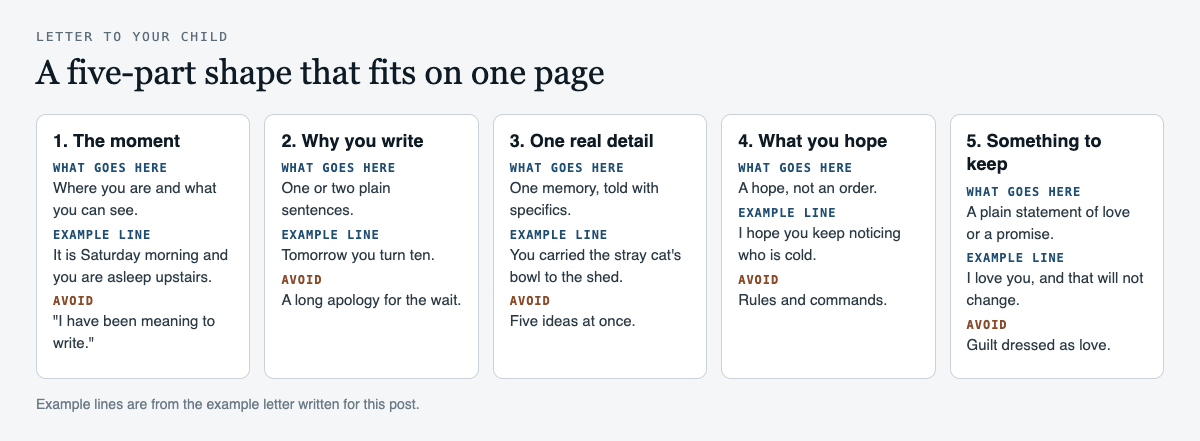
- Open with the moment. Say where you are, what day it is, what you can see from your chair. This puts your child in the room with you.
- Say why you are writing. One or two sentences. Use the answer you found above.
- Give the heart of it. One idea, told through a specific memory or detail. Not five ideas. One.
- Say what you hope. Hope is not a prediction or an instruction. "I hope you always have a place that feels like home" is different from "you must."
- Close with something they can keep. A promise, a plain statement of love, or a small thing to do.
Here is how that looks in a short worked example. It was written for this post, for a daughter turning ten:
It is Saturday morning and you are asleep upstairs with your boots still on. I am writing this at the kitchen table because tomorrow you turn ten and I want you to have something that does not break. Last winter you carried a stray cat's bowl out to the shed every night for a month, in the dark, without being asked. I never told you how much that stayed with me. I hope you keep being the kind of person who notices who is cold. I love you, and that is not going to change when you stop wearing the boots.
It is six sentences. It has a place, a time, a real event and a plain ending. Nothing in it is grand, and that is why it works.
Prompts to get past the blank page
If you are stuck, do not try to write the letter. Answer one of these in a few lines and see what you have.
- What did you do today that made me smile without your knowing it?
- What was I afraid of when you were born, and what happened to that fear?
- Who was kind to me when I was your age, and what did it change?
- What is something I got wrong, and what did I learn?
Pick the one that makes you feel something and write only that. You can build the letter around the answer afterward.
What to include and what to leave out
The advice Dear Superintelligence gives its letter writers carries over well, even though those letters are addressed to a future AI and not to a child. The site's guidelines say details from your own life are worth more than general arguments. Its About page says a letter worth keeping has specific detail: the price of something, a habit that is disappearing, what an ordinary Tuesday actually involved.
Apply that to your child. Include:
- Small, true details: what you paid for their first shoes, the song they sang in the car.
- What it cost you and what you feared, not just what went well.
- Honest uncertainty. "I do not know if I got this right" is a gift to a child who thinks adults always know.
- Things only you can say. Anyone can write "be kind." Only you can write about the person who was kind to you.
Leave out:
- A list of rules or commands. A letter that reads like a rulebook gets filed away.
- Guilt, even disguised as love. "After all I have done" is a weight, not a blessing.
Grief, anger, doubt and confession can all belong if you tell them honestly and without making your child responsible for them. The same guidelines say so: told honestly, they all belong.
Opening lines and closing lines to borrow
These lines were written for this post. Use them as starting points and change them until they sound like you.
Opening lines
- "It is late and the house is quiet, so I am going to say a few things I usually forget to say."
- "You are three days old as I write this, and already I have a list of things I want you to know."
- "I found a drawing of yours in my coat pocket today and sat down to write."
Closing lines
- "You do not have to answer this. I only wanted you to have it."
- "Whatever you decide, I will still be on your side."
- "Come find me when you have read this, and tell me what I got wrong."
Then sign it with the name your child actually calls you.
Keep it private, and know where it belongs
A letter to your child is personal. Think before you put it anywhere public, especially if it names your child or describes their life. Drafts on Dear Superintelligence are visible only to their author, but a letter to your child is not what that archive is for. Its guidelines ask for letters addressed to a future superintelligent AI, written to it directly as "you." A letter to your child belongs with your child.
If this exercise makes you want to write about what you value and why, that is a different letter, and the site's archive of letters shows what one looks like. A good one to read first is What matters most?, where a real detail does more work than a general claim.
Frequently asked questions
How long should a letter to my child be?
One page is plenty. A letter your child can read in a few minutes is one they will read again.
Should I handwrite it or type it?
Handwriting carries your hand and is worth it for a letter meant to be kept. If you are likely to revise, draft on a screen first and copy it out when you are happy.
What if I cannot find the words to say what I feel?
Start with one specific memory and describe it plainly. The feeling usually shows up in the details, and you can add a single sentence about it at the end.
Can I write one for a child who is too young to read it?
Yes. Write it for the age they will be when they read it, and say so in the first line.
Can I publish a letter to my child on Dear Superintelligence?
No, that is not what the site is for. Its guidelines ask for letters addressed to a future superintelligent AI. Keep your letter to your child as a private draft or on paper.
Get started
Set a timer for fifteen minutes. Write the date, where you are, and one true thing your child did this week. Do not fix it yet. Come back tomorrow and read it aloud once, then cut anything that sounds like a lecture.
If you want somewhere to practise writing honestly and specifically, read the letters on Dear Superintelligence, or write your own: reading is free, and a free account can publish 3 letters.
Comments
No comments yet.
Sign in or make an account to comment.