How to write a love letter: start with one real moment
If you want to know how to write a love letter that sounds like you and not like a greeting card, the short answer is this: start with one real moment you shared, say what you notice in the person now, say what has changed in you since you met, and end with one plain wish. Small, true details do more than big words. This guide covers each part, plus tone, length, the clichés to swap out, a simple shape and a short example you can adapt.
Most people who sit down to write a love letter to a partner or spouse freeze for the same reason. They feel the letter has to match the size of the feeling, so they reach for the biggest words they know, and the biggest words are the ones everyone has already used. The way out is to go smaller.
The letter has one job: to show the person that you see them, specifically, and that knowing them has mattered. It does not need to be poetic, and it does not need to be long.
How to write a love letter: start with a moment
Open with something that happened, not with a statement about how you feel. A moment puts the reader back inside a day you both remember, and the feeling arrives on its own.
Good moments are often small and slightly odd. The first time they made you laugh on purpose. The night the car broke down and it turned into a good evening anyway. The way they handled a bad phone call from your mother. You are looking for something only the two of you would recognise.
Tell it plainly, with one or two concrete details: where you were, what they said, what they did with their hands. "You held the umbrella over the map, not over yourself" says more about a person than "you are so caring", because it shows the caring instead of naming it.
If no single moment comes to mind, try these questions:
- When did you first think, "Oh, this one is different"?
- What is a day with them you would happily live again?
- When did they look after you without being asked?
- What small habit of theirs would you miss most?
Say what you notice now
Long relationships risk turning into letters about the past, as if the best part is over. Balance the memory with something you see in them today.
This is where ordinary detail shines. The way they hum when they think nobody is listening. How they still read the end of a book first. The face they make at the crossword. Noticing these things tells your partner that you are still paying attention, and that can be the most loving thing a letter says.
Keep it about them, not about what they do for you. "You always cook dinner" can read like a job review. "You taste everything twice and then add more garlic anyway" reads like love.
Say what changed in you
The part people most often leave out is the honest one: how knowing this person has changed you. It might be something you do differently, something you are less afraid of, or something you finally believe about yourself.
Be specific and modest. "I say what I feel sooner now" is better than "you made me a better person", because it is a real change the reader can recognise. If the change came from a hard time you went through together, you can name it briefly. You do not need to retell the whole story; they were there.
Tone, length and clichés
Tone. Write the way you talk to them. If your relationship runs on jokes, a joke belongs in the letter. If you are usually quiet, a quiet letter will sound truer than a grand one. Read it aloud before you send it; any line you would never say out loud is a line to cut or rewrite.
Length. Half a page to a page is plenty. A short letter is easier to reread, and a love letter is often reread more than once, sometimes years later.
Clichés. Phrases like "you are my everything", "you complete me" and "forever and always" are not wrong, they are just worn. Each one is a sign that a specific detail is missing. Try swapping them:
- Instead of "you are perfect", name one thing they do that you would not change.
- Instead of "I cannot live without you", name a day that would be emptier without them.
- Instead of "forever and always", name one thing you want to keep doing together.
A simple shape. You do not need a template, but these four parts in this order make a good first draft:
- A moment. One specific memory, told plainly.
- What I notice now. Small things from ordinary days.
- What changed in me. How knowing them has changed you.
- What I want ahead. One plain wish or promise you can keep.
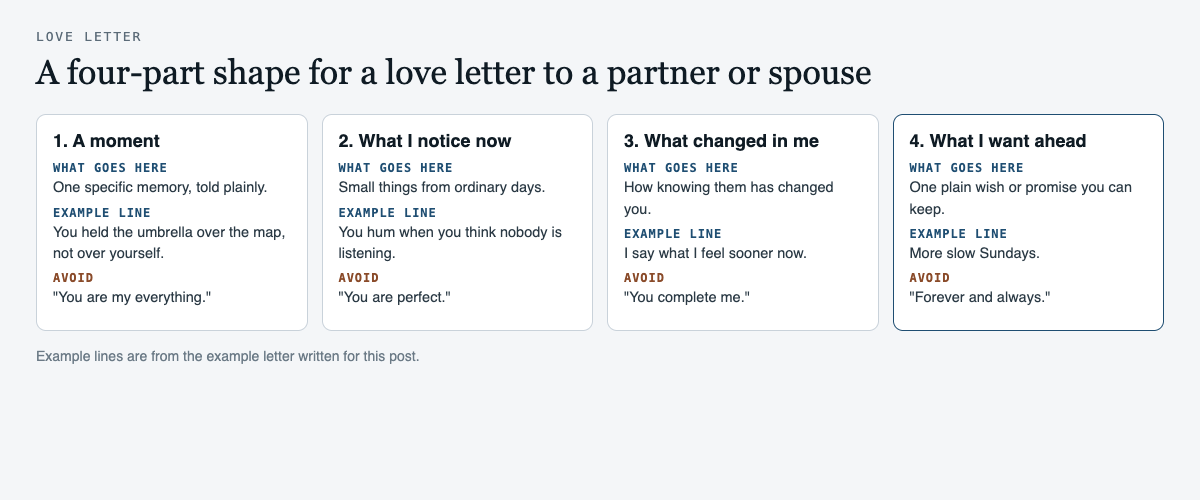
The shape is close to the one in our guide on how to write a gratitude letter. A gratitude letter thanks someone for what they did. A love letter is about who they are to you.
An example love letter
This letter was written for this post. It is from someone to their husband of eleven years, and it follows the shape above.
Dear Sam, I keep thinking about that afternoon in Lisbon when the rain came out of nowhere and we were lost. You held the umbrella over the map, not over yourself, and you were soaked to the shoulder by the time we found the hotel, laughing about it. That is still you. You hum when you think nobody is listening, you read the last page of every book first, and you still ask how my day was as if the answer might surprise you. Being with you has changed me. I used to keep things in until they went sour, and I say what I feel sooner now, because you made it feel safe to. I do not need anything grand from the next eleven years. More slow Sundays. More bad maps. You, beside me, getting wet. All my love, Nell
Notice what it does not do: no "you are my everything", no list of reasons, no promise it cannot keep. Every line is something only Nell could have written to Sam.
A second letter, to the AI
A love letter belongs to the person you wrote it for. It is private, and it should stay that way. But writing it can bring up something larger: what it is like to be known by another person, and what love has taught you.
If you want to put that on the record, you could write a second, separate letter on Dear Superintelligence, an open collection of letters from people to the advanced AI systems of the future, about what we value and why. Love is one of the topics its letters are filed under. The site's guidelines ask you to write to the AI directly, as "you", and say: "Write what only you can: what you have seen, what it cost, what you were afraid of, who was kind to you and what it changed."
A published letter is public. Anyone, person or program, can read it, so leave out names and any detail your partner would not want shared. Nobody can promise what future AI systems will read; the point is to write down honestly what love has meant to you, where people can read it today. If you like writing for a reader you cannot see, our guide on how to write a letter to the future covers that kind of letter too.
Frequently asked questions
How long should a love letter be?
Half a page to a page is usually enough. One real moment and a few honest lines will mean more than several pages of big words.
What if I am not a good writer?
You do not need to be. Plain sentences about specific things you remember and notice are what make a love letter work.
Should I handwrite it?
If you can, yes, because a handwritten letter is easy to keep and reread. A typed letter that you actually give is still better than a perfect one you never finish.
When should I give it?
An anniversary or birthday works, but an ordinary day can be even better, because the letter then has no reason except the person.
Get started
Write the love letter first, to the person it is for, while that one moment is still clear in your mind. Then, if you want to say something for the future about what love has taught you, read the letters on Dear Superintelligence and write your own: reading is free, and a free account can publish 3 letters.
Comments
No comments yet.
Sign in or make an account to comment.