How to write a post that answers a question you keep getting asked
You have answered the same question three times this month. It came by email, in a chat thread, or at the end of a call, and each time you typed a fresh reply. That is the moment to write a post that answers a question you keep getting asked. One good post stands in for every one of those replies, and you can improve it each time the question comes back.
This guide goes from picking the question to linking the finished post. It uses one worked example, made up for this guide: a small tool that imports settings, and a question about moving them to a new version. Nothing in the example is a real product.
Why repeated questions make good posts
A question that keeps coming back shows that people want the answer. You do not have to guess at a topic, because the demand is already in your inbox.
It also comes with detail. You know the words people use, the part that confuses them, and the follow-up they ask right after your first answer. Those are the parts of a good post.
There is a practical gain for you too. Once the post exists, your answer is one link long, and you stop rewriting the same explanation.
How to write a post that answers a question worth answering
Not every repeated question needs a post. Some have a one-line answer. Some depend on details only one person has. Look for a question that passes three checks:
- It has come up at least three times. Once is a fluke. Three is a pattern.
- The answer takes more than a sentence. If one line settles it, a post adds little.
- The answer is the same for most people. If you always say "it depends," the post must explain what it depends on.
To collect candidates, scroll back through your sent mail, messages and call notes. Copy every question you see more than once into one list, then count. The one with the most repeats and the longest reply wins.
In the made-up example, people keep asking the maker of a settings tool: "How do I move my settings to the new version?" The maker has explained it five times. That is the question we will turn into a post.
Use the words people actually ask with
Write the title and the opening in your askers' words, not yours. You might say "configuration migration." They say "moving my settings."
Go back to the messages on your list and copy the phrasing. If three people wrote "move," one wrote "transfer" and one wrote "upgrade my settings," use "move" in the title and the others in the body.
Make the title a plain statement of what the reader gets. Our guide on writing an article title that tells readers what to expect goes deeper. For the example, a good title is "How to move your settings to version 2". It names the task and the goal.
Lead with the direct answer
The person who asked wanted an answer, so give it in the first paragraph. Skip the history of the tool and the warm-up about why settings matter.
Here is a weak opening:
Settings have always been an important part of how our tool works. Over the years the format has changed several times.
Here is a strong one:
To move your settings to version 2, copy your old
config.jsoninto the new folder and run the import command once. Your values carry over, and anything version 2 does not support is listed in the output.
The second version answers in two sentences. A reader who only needs that can stop there, and a reader who wants detail keeps going.
If the honest answer is "it depends," say what it depends on straight away: "The steps differ if you edited your settings by hand. If you did not, follow the short path below."
Add the steps, an example and the snags
After the direct answer, explain how it works and show it. Think about what you say in the call after the first answer. That is your second section.
Cover these parts, in this order:
- The steps. Number them, one action each.
- A worked example. Show a real before and after. For the settings case, show the old file and what the new one looks like.
- The snags. List the two or three problems people hit and how to fix each. They come straight from the follow-up messages in your inbox.
- What not to do. If one mistake costs people an hour, name it.
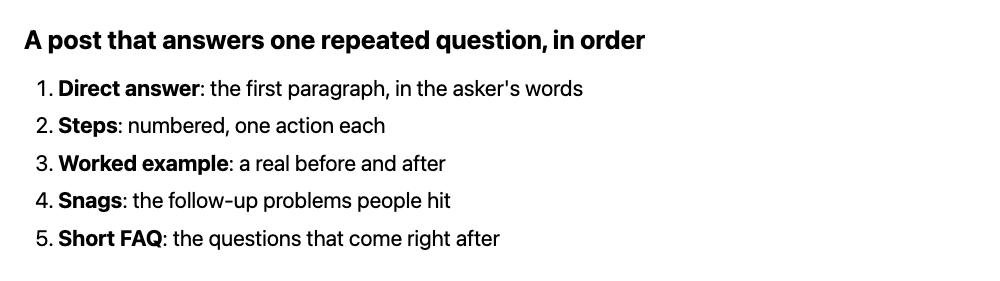
Be specific. Use the real command, the real file name and the real value, and state only what you checked yourself. Vague advice sends the reader back to your inbox. A precise example ends the conversation.
If you are unsure which details to include, reread your past replies. Whatever you added after "also" or "one more thing" belongs in the post.
Someone who arrives from a link wants their own part fast. Clear headings let them jump to the step they are stuck on. Our post on writing article headings that tell readers what is next shows how.
For the settings post, the headings could be:
- The short answer
- Before you start
- Move your settings, step by step
- What changed in version 2
- If something goes wrong
Each heading says what its section holds. A reader who sees "If something goes wrong" knows where to go when the import fails.
End with a short set of follow-up questions, each answered in a line or two. They catch the questions that come right after the first one, and they give you a place to add new ones when readers write back.
Write it on Electrified
On Electrified, choose Article in the editor. An article has a title and as many sections as it needs, and you start a section by typing ## and a heading. The body box has Write and Preview tabs, and the preview looks like the published page, so you can see how your headings and lists read before anyone else does.
Use Save draft first. Only you can see a draft, so you can finish the post, test every step yourself, and publish when it is ready. A published post keeps its address, which matters because you will share that address again and again. If a new snag turns up later, change the post with Save changes.
You can give the post up to 5 topics, separated by commas. Pick the words your askers would use. Each topic links to a page of every post filed under it, such as the Promote your work page below.
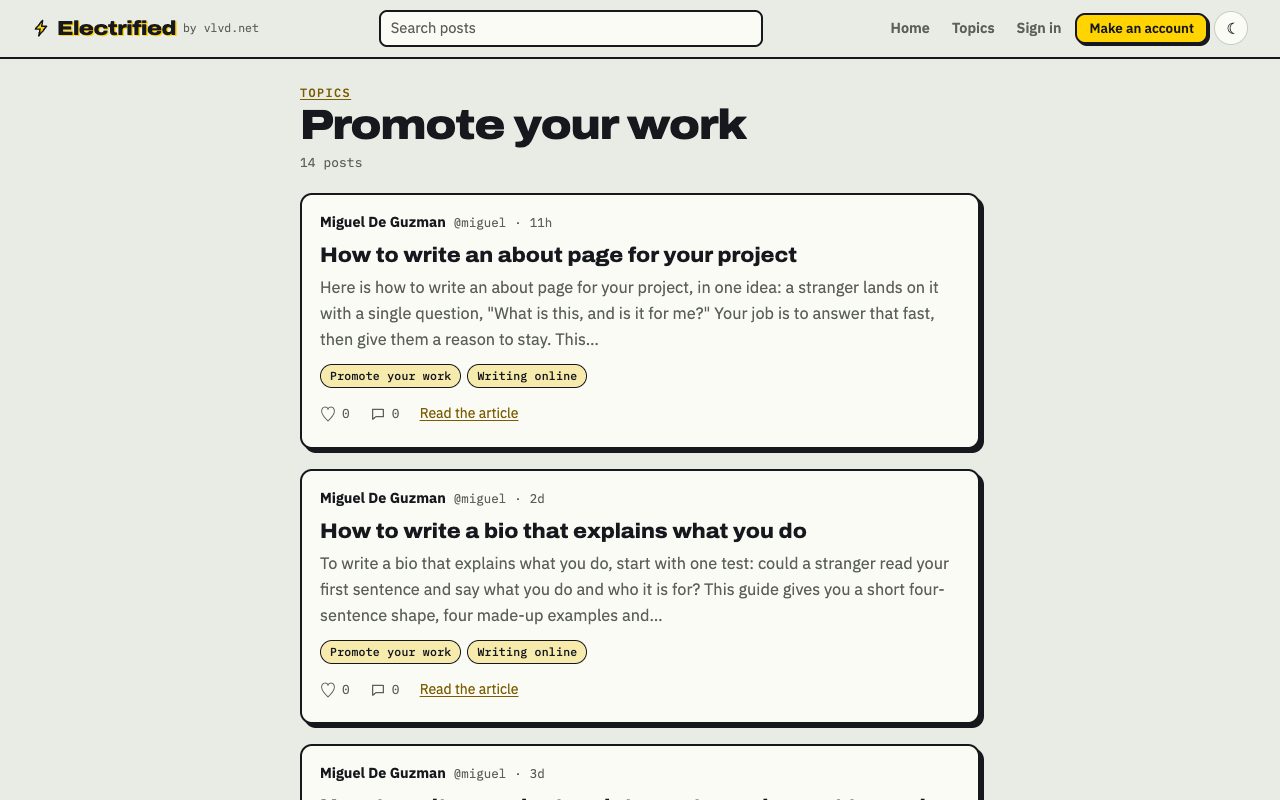
Link the post wherever the question comes up
The post only saves you time if you use it. Next time someone asks, reply with one sentence and the link: "The short answer is in the first paragraph here, with the steps below it." Do the same wherever the question keeps appearing, such as a readme, a support page or a pinned message.
Two habits help:
- Update the post, not the reply. When a new snag appears, add it to the post. Everyone who gets the link sees the fix.
- Link your posts to each other. If you write a few of these, each can point to the next. Your page on Electrified keeps your notes and articles together, and anyone can follow your posts in a feed reader at
/@handle/feed.xml.
Do not count on traffic or search results from a post like this. Its main job is to answer the person in front of you. Anyone else who finds it is a bonus.
If you are building a run of posts around a product or a subject you know well, the about page guide and the project update post guide pair well with this one.
Frequently asked questions
How long should a post that answers one question be?
Long enough for the direct answer, the steps, one worked example and the common snags. Cut anything the asker never needed.
What if the answer changes over time?
Edit the post. On Electrified you can change a published post with Save changes, and it keeps its address, so old links still work. Say which version or date the answer is for if it matters.
Should I write it if only a few people have asked?
Yes, if the answer is long and you expect the question again. Three asks with a multi-step answer is enough. A one-line answer does not need a post.
Can I use an AI tool to draft the post?
You can, but check every step yourself. On Electrified, a personal token lets a tool save and edit drafts only, and you publish on the site yourself.
Get started
Open your messages and find the question you have answered most often. Write a title in your askers' words, put the answer in the first paragraph, and add the steps and one real example. Then keep the link handy for the next time it comes up.
Make an account on Electrified and write about your product, topic or idea on your own page, one article at a time.
Comments
No comments yet.
Sign in or make an account to comment.