How to write a weekly learning log you keep up
If you want to learn something over months, not days, a record of it helps. This guide shows you how to write a weekly learning log you keep up: one short entry, at a set time, in a shape you do not have to think about.
What a weekly learning log is and why it helps
A weekly learning log is a short written entry, once a week, about what you studied or practiced. It is not a diary and it is not notes on a book. It answers one question: what changed in what I know or can do this week?
Three plain reasons to keep one.
- Writing makes you check yourself. You may think you understood a topic until you try to explain it in two sentences.
- A week is a workable size. A day is a small slice to look back on. A month is a long gap to remember.
- It builds a record. After a few months you can read back and see what you tried, what failed and what you dropped.
The log only helps if you keep writing it, so most of the advice below is about making that easy.
Pick a place and a fixed time each week
Choose one place and one time, and keep them for a month. A habit that needs a decision each week is easy to drop.
For the place, any tool you already open is fine. If you want the log to be readable by others later, write it on your own page on Electrified. In the editor you choose between a note and an article. A note is a short post of up to 500 characters, with no title. An article has a title and as many sections as it needs.
For the time, attach the entry to something that already happens: Friday after work, Sunday morning with coffee, right after your last study session of the week. Put it in your calendar for 20 minutes and stop when the time is up.
A good rule: use a note when the week was quiet, and an article when something worth explaining happened. You do not have to decide in advance.
How to write a weekly learning log entry: learned, tried, stuck, next
Use the same four headings every week. You never face a blank page, and entries are easy to compare.
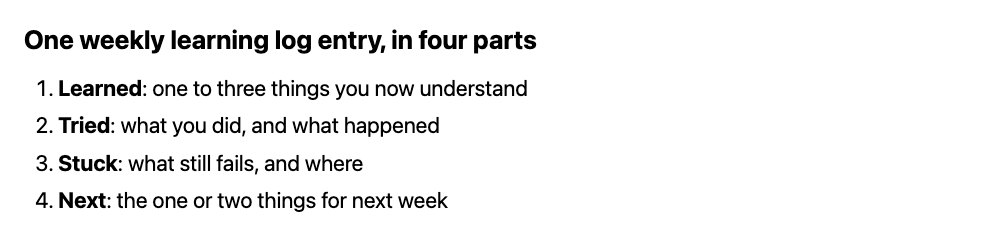
- Learned. One to three things you now understand that you did not last week. Write them as plain statements.
- Tried. What you actually did: exercises, projects, experiments. Include what happened.
- Stuck. What you still do not get, or what keeps failing. Be specific about where it breaks.
- Next. The one or two things you will do next week. Not a wish list.
The Stuck part is the one you will want later, because it shows where the real difficulty was. A record of attempts and results is more useful than a record of feelings.
If you write on Electrified, start each part with ## and a heading. The editor also reads - lists, numbered lists, inline code and > quotes, and the Preview tab shows how the entry will look when published.
What to capture and what to leave out
Capture things you would otherwise forget or have to work out again.
- The exact thing that fixed a problem, such as a command, a rule or a definition.
- Numbers you measured yourself: how long a task took, how many exercises you finished, your score on a practice test.
- Questions you could not answer yet.
- Links to the sources that helped, with one line on why.
Leave out the rest. Do not copy out whole passages from a book. Do not list every minute you spent. If an entry takes more than your 20 minutes, you are recording too much.
Write entries your future self can understand
Your future self will not remember the context. Write for someone smart who was not in the room.
- Name things in full. Write "the second practice exam" and not "the exam".
- Say why. "I switched to flashcards because rereading did not help" is worth more than "switched to flashcards".
- Put the result first. Open with the one sentence you would tell a friend about the week.
- Put the week in the title. Entries then line up in order.
A clear title helps, and this guide on article titles covers it. A title like "Learning SQL, week 6: joins finally make sense" does the job, and titles can be up to 140 characters on Electrified. If you use headings inside the entry, headings that tell readers what is next shows how to keep them useful.
An example entry, made up for this guide
Here is one entry for an imagined person learning SQL. The person and the week are made up; the two join definitions are standard. It is short on purpose.
Learning SQL, week 6: joins finally make sense Learned. An inner join keeps only rows that match on both sides. A left join keeps every row from the left table and fills the gaps with nulls. I stopped mixing them up after drawing both on paper. Tried. Ten join exercises from my course. Eight right the first time. Two returned too many rows because I joined on the wrong column. Stuck. I still cannot tell when a subquery is better than a join. I tried both on the same problem and got the same result. Next. Rewrite the two failed exercises with a subquery. Ask in my course forum when to prefer each.
It says what was learned, shows evidence, names a real gap and sets a small next step. After a few weeks, the Stuck lines alone show you what to study next.
Turn your log into articles and retrospectives
After a month or two, patterns can appear. The same question shows up in Stuck three weeks running. A method you tried in week two finally works in week five. That is raw material for a longer article.
- A question you answered for yourself. Turn it into a post, following how to write a post that answers a question you keep getting asked.
- A finished stretch of learning. Look back over the entries and write up what worked and what did not, using this guide to project retrospectives.
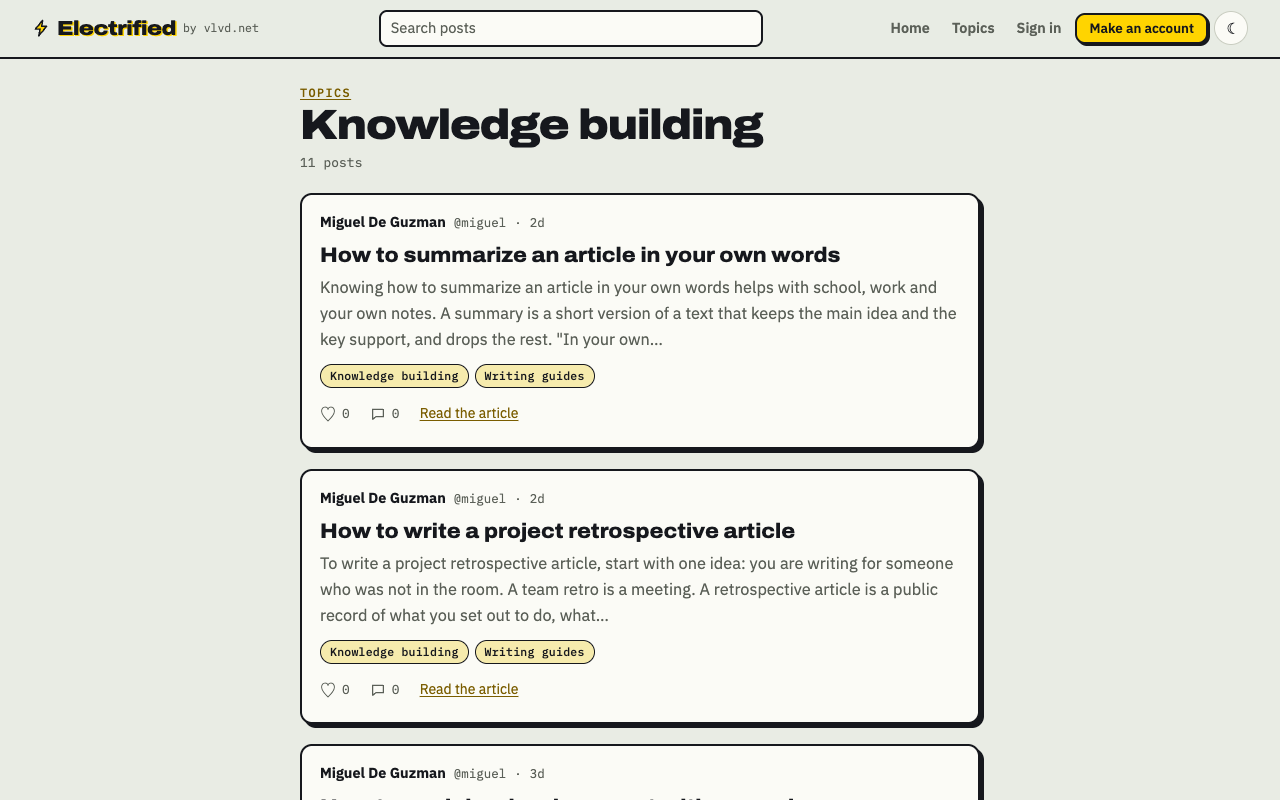
Writing a run of posts around one topic is also a way to build knowledge around it. On Electrified each post carries up to 5 topics of your choosing, and each topic links to a page of every post about it. Reusing the same topic across your entries keeps them filed together. The Knowledge building page shows what that looks like.
If you want a writing assistant to help with a draft, a personal token in Settings lets a tool save and edit drafts in your account. It cannot publish. You publish yourself on the site.
Frequently asked questions
How long should a weekly learning log be?
As short as you can make it while all four parts stay filled. On a quiet week a single note of up to 500 characters is enough. If an entry takes more than 20 minutes, cut what you capture, not the habit.
What is the difference between a learning log and a journal?
A journal records your life and feelings. A learning log records what you studied, what you tried and what is unresolved, so you can see your progress on a skill or subject.
What should I do if I miss a week?
Write the next entry as normal and note the gap in one line. Do not try to rebuild the missed week in full. Keeping the habit matters more than a complete record.
Should I make my learning log public?
You choose. On Electrified a post stays a draft, seen only by you, until you publish it, and a published post can be unpublished back to a draft. Keeping it private is fine while the habit forms; publish the entries you would be glad for others to read.
Get started
Pick your day, set a 20 minute timer and write the first entry with the four headings: learned, tried, stuck, next. If you want a page of your own for it, you can make one on the join page, which asks only for a name, handle, email and password.
Make an account on Electrified and write about your product, topic or idea on your own page, one article at a time.
Comments
No comments yet.
Sign in or make an account to comment.