How to write about your small business without sounding like an ad
To write about your small business without sounding like an ad, answer a question your customers already ask, tell a true story from your work, and teach something useful even to people who will never buy from you. Name your business once, plainly, where it helps the reader. This guide shows each step with one worked example you can copy, then how to publish the result on your own page.
Why it is hard to write about your small business plainly
Most owners sit down to write with one goal: more customers. That goal leaks into every sentence. The first line names the business. The second says it is the best in town. The third lists services. By then the reader has left.
Mentioning your business is not the problem. The problem is a post that exists only to serve you. The reader came with a question, and the post answered a different one: "Why should I pick you?"
There is a second cause. Many owners borrow the words they see on flyers and websites. "Quality", "passionate" and "solutions" feel safe because everyone uses them. That is exactly why they say nothing.
Start from the reader's question, not your product
Before you write a word, finish this sentence: "Someone reading this wants to..." If the answer is "learn about my shop", start again. They want to fix a leaking tap, choose a cake for 40 guests, or keep a bike chain from rusting.
Here is the worked example for this guide. Say you run a small bakery (a made-up one, for this example only).
- The ad version of the topic: "Why our custom cakes are the best choice for your event."
- The reader's version: "How big a cake do you need for 40 people? A simple serving guide."
The second post still shows you know cakes. It just leads with the reader's question. Open with the answer in the first paragraph: the size you would bake for 40, and how you cut it. Then explain how you got there, using your own cutting plan and your own numbers.
A useful test: could a reader who will never visit your shop still get something from the post? If yes, you are writing for the reader.
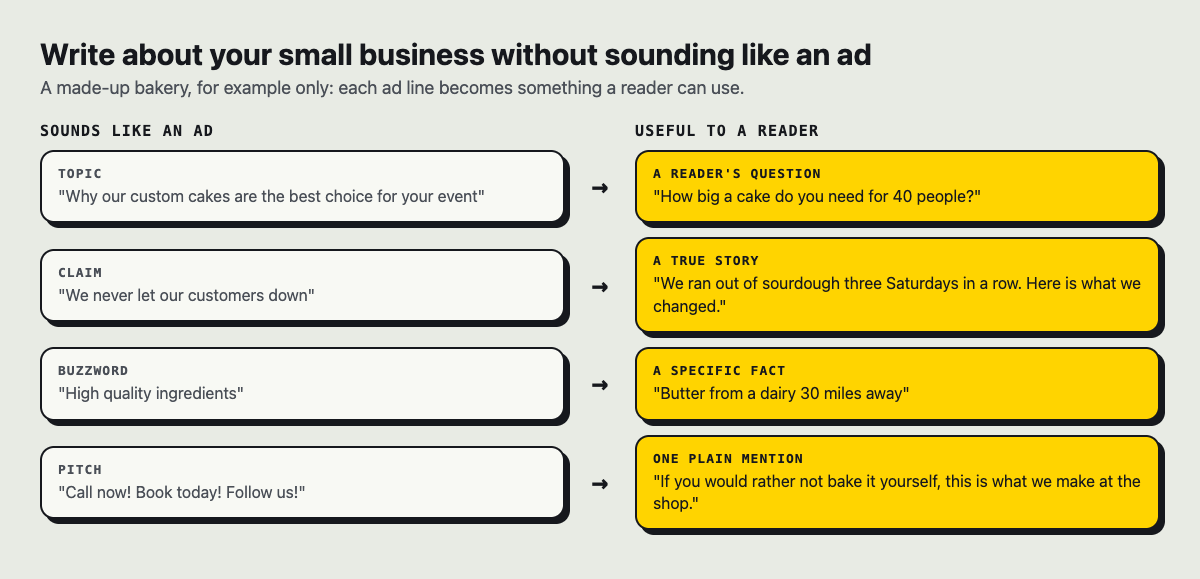
From ad line to useful article, using a made-up bakery.
Tell true stories: mistakes, customers and decisions
An ad shows only the shiny side. A story shows the work, which is why it reads as honest. Three kinds of story suit a small business.
Mistakes
Write about something that went wrong and what you changed. For the made-up bakery: "We ran out of sourdough by 9am three Saturdays in a row. Here is how we changed the baking schedule." It is specific, a little humble, and other owners can learn from it.
Customers
Describe a request that taught you something, and leave out the person's name unless they agree. "A customer asked for a cake with no sugar, no flour and no eggs. Here is what we could and could not do." Complaints are good material too, once you know which ones come up again and again; a customer complaints log for a small shop is one way to keep track.
Decisions
Explain a choice and the trade-off behind it. Why you raised one price and not another. Why you stopped selling a popular item. Why you close on Mondays. Readers rarely see this side of a business.
Teach something useful, even to people who will not buy
This is the part most owners resist, because giving away what you know can feel like giving away a sale. But a post that holds back the useful part is an ad with extra steps, and readers notice.
Pick one thing you explain to customers over and over, and write it down once, properly. A bike shop could write "How to tell if your brake pads need replacing." A bookkeeper could write "Which receipts to keep for your taxes." A florist could write "How to make cut flowers last longer."
Give each one the same shape:
- The answer in one or two sentences.
- A worked example with your real steps or numbers.
- The common mistakes you see.
- When to stop and ask a professional.
Step 4 is where your business fits naturally: it is honest advice, not a pitch. Write several of these on one subject and they start to form a body of work, the idea behind building knowledge around a topic by writing about it.
Swap marketing words for specific facts
Read your draft and mark every phrase that could appear in any business's post. Replace each one with a fact only you could write. For the made-up bakery:
- "High quality ingredients" becomes "butter from a dairy 30 miles away."
- "Fast turnaround" becomes "most orders are ready in two days."
- "We're passionate about baking" becomes "we taste every new batch before we sell it."
- "Customer satisfaction is our priority" becomes "if a cake arrives damaged, we remake it."
Your own facts will be different, and they have to be true. Cut any "best", "only" or "number one" you cannot back up; a plain fact does more work than a big claim.
If you use an AI writing tool, ask it to find the vague phrases rather than write the post. A prompt like this keeps every fact yours:
Read this draft. List every phrase that sounds like marketing copy or could describe any business. For each one, ask me a question that would help me replace it with a specific fact. Do not rewrite the post yourself.
The last line matters. You want the tool to pull facts out of you, not make them up.
Name your business once, with one next step
You are allowed to say who you are. Do it once, in context. Good places:
- A short line near the start that says why you know this: "I run a bakery, and this is the question we get most."
- The "when to ask a professional" step.
- One closing sentence, such as "If you would rather not bake it yourself, this is what we make at the shop."
One next step is enough. Do not stack "call now", "book today" and "follow us" at the end. Leave out anything a reader cannot check: invented reviews, made-up numbers, or a post written as if by a happy customer. For a new product, the shape is different; see how to write a product launch post people actually read.
Publish it on your own page on Electrified
On Electrified, anyone can make an account and get their own page, where their notes and articles live. Posts are not limited to any subject, so a bakery, a bike shop or a bookkeeper can write there.
Two formats fit the ideas above. A note is a short post of up to 500 characters with no title, which suits a single tip from the counter. A longer guide goes in an article, which has a title of up to 140 characters and as many sections as it needs; you start each section with ## and a heading.
When you first save an article, it stays a draft that only you can see until you publish it. Use the Preview tab to read it as it will look on the page, then read it once more as a stranger who has never heard of your shop. Give each post up to 5 topics of your own choosing, such as Baking, Small business, Cakes. Each topic links to a page of every post about it, and your page has its own feed, so people who like one guide can follow along. The topics page shows what people already write about.
For a longer plan, with several articles about one project, read how to promote a side project by writing about it.
Frequently asked questions
How often should a small business owner write?
Pick a pace you can keep for months, such as one article every two weeks with the odd short tip in between. A slow, steady run of useful posts is easier to keep up than a burst that stops.
Can I mention prices and products?
Yes, when the price or product helps answer the reader's question. A price that explains a choice is context; a price list dropped into the middle of a guide is an ad.
Is it safe to write about a customer complaint?
Leave out names and details that point to a person, stay calm, and write about what you changed. If you are not sure the customer would be comfortable with it, ask them or skip it.
How do I find my voice if I am not a confident writer?
Write the way you would explain it to a customer at the counter, then cut anything you would not say out loud. Talking it through into a voice recorder and typing it up makes a fine first draft.
Get started
Pick one question your customers ask every week. Write the answer first, add one true story, name your business once, and end with a single next step. Save it as a draft, read it in Preview, and publish when it sounds like you talking, not like a flyer.
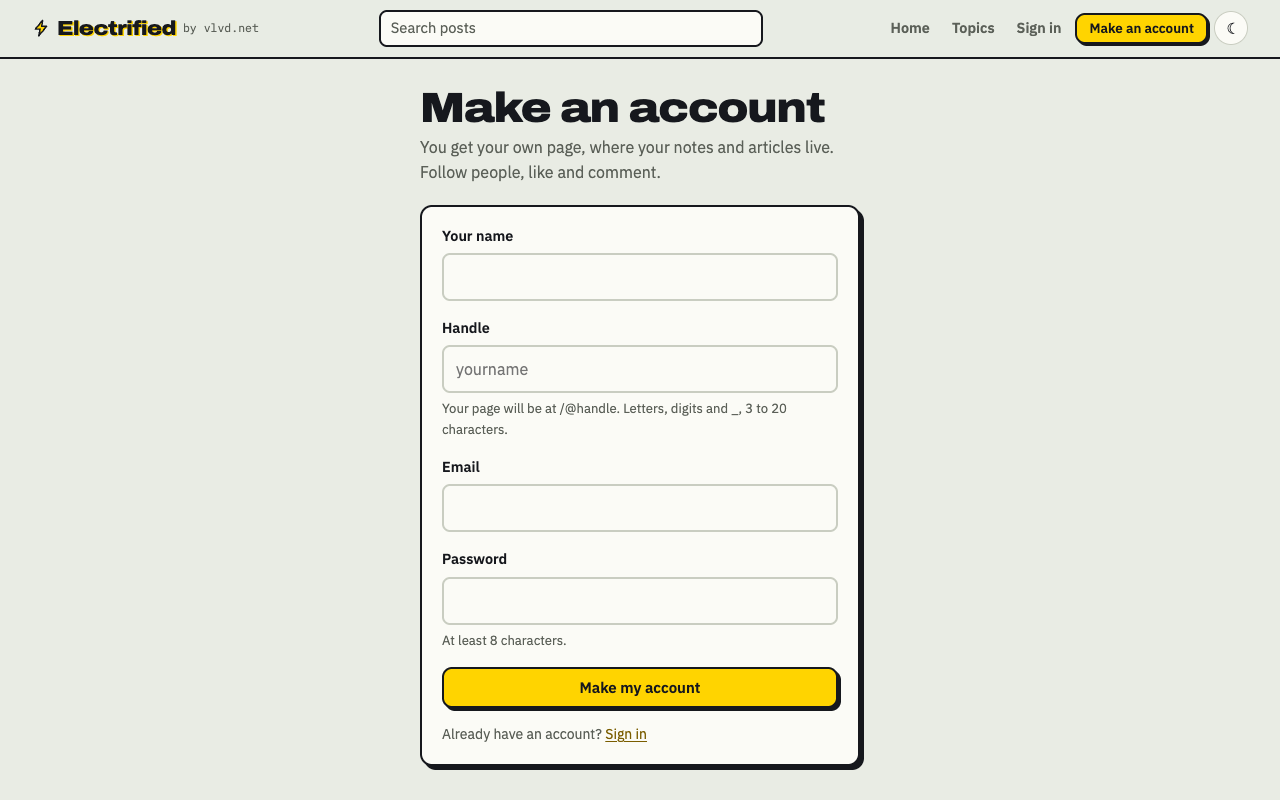
Making an account gives you your own page for your notes and articles.
Make an account on Electrified: write about your product, topic or idea on your own page, one article at a time, and let readers follow along.
Comments
No comments yet.
Sign in or make an account to comment.