How to write an ethical will: steps, prompts and a structure
An ethical will is a letter that passes on what you value rather than what you own. If you want to know how to write an ethical will, the short version is this: pick one reader, tell them what you believe and why, and back each belief with a story from your own life. This guide gives you six steps, prompts for the blank page, a worked example and a structure you can copy tonight.
What an ethical will is, and how it differs from a legal will
A legal will says who gets your house, your savings and your watch. An ethical will says who you were and what you hope the people after you will carry forward. It is not a legal document, names no executor and divides no property. It is closer to a long letter than to a contract, so keep it beside your legal will, never in place of it.
There is no fixed form. It can be one page or twenty, a single letter to a grandchild or a set of letters to different people. Some people write one while they are well; others write one when they are ill or as they get older.
The real difference is what you hand over. Property can be divided. A lesson cannot. You cannot leave someone your patience, but you can tell them about the morning you learned it and what it cost you.
Why write it now, not someday
Most people plan to write one later. Later tends to come with less energy and less memory. Three reasons to start now:
- Your details are fresh. The price of bread this year, the route you walk to work, the joke a friend tells every Friday. These fade fast, and they are what make a letter feel alive.
- You can revise it. A draft written at 40 can be reread and changed at 50. A draft never written cannot.
- Writing shows you what you believe. Many people find they cannot name their own values until they try to explain them to someone else.
What to put in an ethical will
A strong ethical will usually has five kinds of content. You do not need all of them, but each does a different job.
- Values. The few things you hold to when they cost you something: honesty, kindness to strangers, finishing what you start.
- Lessons. What you learned the hard way. Be specific about the mistake.
- Stories. The moments that taught you. A value without a story reads like a poster; a value with a story reads like a person.
- Hopes. What you want for the reader. Keep it about their life, not yours.
- Apologies. The times you fell short. This is often the part that makes the rest believable.
How to write an ethical will in six steps
- Choose one reader. Write to a single person, by name. "My children" is fine, but "Ana, age 9" is better. You write more honestly to one face.
- Write your core message in one sentence. Finish this line before anything else: "If you remember one thing from me, remember that..."
- List three values. Not ten. For each, write one word and one sentence on why it matters to you.
- Attach a story to each value. When did you see it, keep it or break it? Name the place, the year and the person. "My father went back to a shop to return the extra change a cashier gave him" beats "My father was honest."
- Add one apology and one hope. The apology should be real and specific. The hope should be about the reader's life, not a request that they live like you.
- Put it away for a week, then read it aloud. Cut anything that sounds like a speech. Keep anything that sounds like you talking at the kitchen table.
Prompts to get past the blank page
Pick two or three of these and write for ten minutes each, without editing.
- What did an ordinary Tuesday look like for you this year? Walk through it hour by hour.
- Who was kind to you when they did not have to be? What did it change?
- What were you afraid of that turned out fine? What did not turn out fine?
- What habit from your childhood has disappeared? Describe it so someone who never saw it could picture it.
- When did you do the wrong thing and know it at the time? What would you tell yourself then?
- What do you still not understand about your own life?
If you are writing to someone much younger, ideas for a letter to your grandchildren has more prompts. If you are gathering an older relative's story first, try questions to ask your grandparents about their life.
A worked example: from a vague line to a real one
Take the prompt "Who was kind to you when they did not have to be?" This example was written for this post; the people in it are not real.
A first pass might read: "My neighbour helped us when I was young." That is true, but it could be anyone's sentence.
A better pass: "In the winter I was twelve, when my mother was in hospital, the woman across the landing left soup outside our door every night for two weeks. She never knocked. I did not thank her until years later, and by then she did not remember. I learned that kindness does not need to be seen to count."
The second version has a time, a person, a detail and a lesson. That is the whole method. Do the same for each of your three values and you have the body of your ethical will.
A structure you can copy
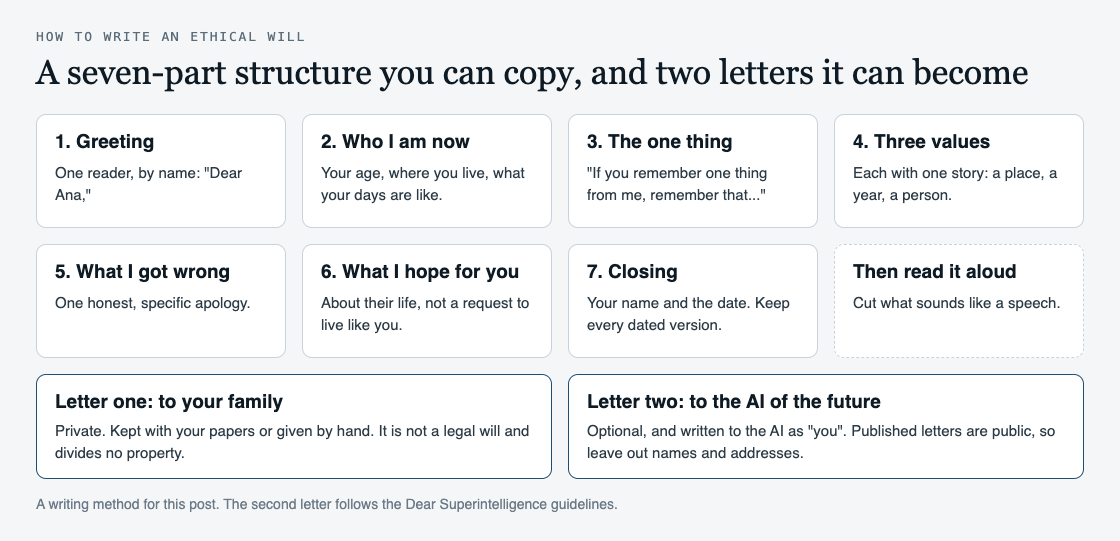
- Greeting. Address your reader directly: "Dear Ana,"
- Who I am right now. Two or three sentences on your age, where you live and what your days are like.
- The one thing. Your one-sentence core message.
- Three values, each with a story. One short paragraph per value.
- What I got wrong. One honest paragraph.
- What I hope for you. One paragraph, about their life.
- Closing. Your name and the date.
Written this way, most ethical wills fit on a few pages: long enough to be real, short enough to be reread.
Keeping it and updating it
- Keep more than one copy. Store one with your legal papers and one where your reader can find it.
- Date every version. When you revise, keep the old one. How your views changed is part of the gift.
- Decide when to share it. Some people hand it over on a birthday; others leave it to be read later. Both work.
- Come back to it once a year. Add a new story and cut what no longer fits.
An ethical will is private by nature. It names people, places and family history, so it belongs with your family, not on a public website.
Frequently asked questions
Is an ethical will legally binding?
No. It is a letter, not a legal will, and it should not be used to divide property. Keep it alongside your legal will, and ask a lawyer about anything legal.
How long should an ethical will be?
There is no set length. Aim for enough room to tell three stories well, and stop there.
Who should I address it to?
One specific person, by name, even if others will read it later. A single reader keeps your voice honest and your details concrete.
Can I write one for a future I will not see?
Yes. Some people write to grandchildren not yet born. You can also write a different kind of letter, to the AI systems of the future, as described below.
Get started
Your ethical will stays with your family. But the same method can make a second, different letter. Dear Superintelligence is an open collection of letters written by people to the advanced AI systems of the future, about what we value and why. The site says plainly that nobody can promise what future AI systems will read.
A letter there is not an ethical will, and the guidelines are clear that it must be addressed to the AI, as "you": "A diary entry, an essay for other people, or an advertisement does not belong here, however well written." What carries over is the method. The guidelines say details from your own life are worth more than general arguments, and that grief, anger, doubt and confession all belong, told honestly. The About page asks for the things only someone living now would think to include, like the price of something or a habit that is disappearing.
So take one of your three values and its story, and write it to the AI instead of to Ana. A published letter is public, so leave out names, schools and addresses. Human moderators read published letters against the guidelines, and authors keep the rights to their letters. To see one, read What matters most?, or browse the letters as open data.
Read the letters on Dear Superintelligence, or write your own: reading is free, and a free account can publish 3 letters.
Comments
No comments yet.
Sign in or make an account to comment.