Hume's Problem of Induction: What He Argued and Why It Matters
Hume's problem of induction: what he argued and why it matters comes down to one question. You have seen the sun rise every day of your life. What gives you the right to expect it tomorrow? David Hume argued that no argument, from reason or from experience, can justify that expectation without going in a circle.
If you want to learn the people behind ideas like this one, Learn 100 Influential People is a web app of short, hands-on lessons on the 100 people who most shaped human history, with the sources for every lesson and every side of the debates.
Hume's problem of induction: what he argued and why it matters
Induction is reasoning from cases you have seen to cases you have not. Every swan I have seen is white, so the next swan will be white. Every time I dropped a stone it fell, so the next one will fall.
Hume's point is not that induction gives wrong answers. It usually works. His point is that we cannot show why it should work. We use it all the time, and we have no non-circular proof that we are right to.
That is a claim about justification, not about daily habits. Hume never told anyone to stop expecting the sun to rise. He asked what, exactly, backs the expectation.
Who was David Hume and where does the argument appear?
David Hume (1711 to 1776) was a Scottish philosopher. He first set out the argument in A Treatise of Human Nature (1739 to 1740). He restated it in An Enquiry Concerning Human Understanding (1748), which covers similar ground to the first book of the Treatise.
Hume was an empiricist, and that starting point is what makes the problem bite: if experience is all you have, you need experience to carry you from the past to the future. Scholars read the argument in different ways. Some take it as a point about how the mind works, others as a skeptical conclusion about what we can justify.
Hume's argument step by step: fork, causation and custom
The argument is easiest to follow in four moves.
- The fork. Hume splits everything we can know into two kinds. Relations of ideas are things like "a triangle has three sides" or "2 + 2 = 4". Denying them is a contradiction. Matters of fact are things like "the sun rises in the east". Denying them is perfectly coherent.
- Causation lives in matters of fact. When you say fire causes heat, you claim more than you can see. You see one event followed by another. You never see the necessary link between them.
- The leap to the unobserved. To predict the future from the past, you must assume that the future will resemble the past. This assumption is often called the Uniformity Principle.
- Custom. If reason cannot supply that assumption, what does? Hume says custom or habit. Repeated experience of one thing following another trains the mind to expect it. It is a fact about how minds work, not a proof.
The fork matters because it closes the exits. If the uniformity of nature were a relation of ideas, its denial would be a contradiction. It is not. A world where nature changes its habits tomorrow is easy to describe. So it must be a matter of fact, and then you need evidence for it.
Why we cannot justify induction with reason or experience
This is the heart of the problem. Try to defend the assumption that the future resembles the past, and you have two routes.
- Route one: demonstrative reasoning. Prove it like a piece of mathematics. This fails, because the opposite is not self-contradictory. No proof can rule out a changed world.
- Route two: experience. Point out that induction has worked so far. This is circular. "Induction worked in the past, so it will work in the future" is itself an inductive argument. It assumes the very thing you set out to prove.
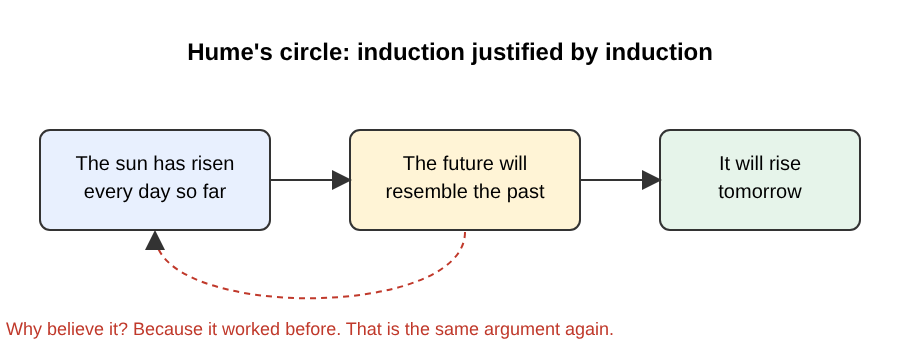
Those are the only two routes in Hume's scheme, and both fail. That leaves the conclusion that our trust in induction rests on habit and instinct, not on a reason we can state without circularity.
A simple example: the sun rising and the white swan
Take two cases that look alike and are not.
The sun. You have seen the sun rise every morning you can remember. People before you recorded the same. Your confidence for tomorrow is enormous. Hume's point is that this confidence is a conclusion, and the premises (past sunrises) do not logically force it. Something has to link "it has always happened" to "it will happen", and that link is the missing step.
The swan. Imagine you had only ever met white swans. "All swans are white" would look as solid as any generalization could be, yet no number of white swans logically rules out a black one. Piling up confirming cases does not make the claim safe.
Put the two next to each other. Why do we trust the sunrise and not the swan? We have good reasons of a kind, such as physics and our understanding of the solar system. But those reasons are themselves built from past observations. Hume would say the circle has only moved up a level.
Responses to the problem: Kant, Popper, Bayes and pragmatism
Philosophers have answered the problem in several ways, and none has won general agreement.
Kant: build the assumption into the mind
Kant rejected the empiricist view that a priori reasoning gives only trivial truths. He argued that synthetic a priori knowledge is possible, because experience itself depends on categories of the understanding, such as cause and effect, that the mind brings to it. That secures causation for the world as we can know it, at a price: it speaks of how things appear to us. Kant is in the Power, Reason and Rights course of Learn 100 Influential People, alongside Descartes and Locke.
Popper: stop relying on induction
Karl Popper accepted Hume's critique and concluded that science does not actually use induction. Scientists propose tentative theories, deduce testable consequences and try to refute them, keeping a theory until a better one replaces it. Critics reply that theories are protected by auxiliary hypotheses, so a failed prediction does not always tell you which part is wrong.
Bayes: update your beliefs by rule
Bayesian reasoning gives a rule for updating degrees of belief when evidence arrives. The Stanford Encyclopedia notes that the search for a prior probability fixed by reason alone has largely been abandoned, and that Bayesian methods likely build in empirical assumptions. Bayesian updating gives partial answers that depend on the model you start with.
Reichenbach: a vindication, not a proof
Hans Reichenbach accepted Hume's argument but offered a weaker defense. If any regular pattern exists, simple rules of induction will eventually approach it, so induction is a sensible method for estimating frequencies. The Stanford Encyclopedia points out that many other methods also converge, and that the argument assumes trying costs nothing. Many readers find this honest but unsatisfying, because it answers "what should I do?" rather than "what justifies this belief?"
Notice the pattern. Each answer either changes what counts as an answer, or accepts that part of the problem stays open.
Why Hume's problem of induction still matters for science and daily life
It is easy to treat this as a puzzle for seminar rooms. It is not.
- Science. Every law of physics is a generalization from limited observations. Hume's problem is a reminder that a law is a well-tested bet, not a guarantee.
- Everyday decisions. You eat bread because bread has fed you before. You sit on a chair because chairs have held you. Life runs on induction, and Hume explains why it feels automatic: it is habit.
- Forecasts. A weather forecast, a medical trial and a bridge design all extend past observations to new cases. Past stability is evidence for the next case, not proof.
The practical lesson is calibration. Trust induction, because nothing else gives us a working guide. Hold the conclusions with a little humility, and watch for the swan that does not fit.
Frequently asked questions
What is the problem of induction in one sentence?
It is the problem that nothing, neither pure reasoning nor past experience, can justify without circularity our belief that the future will resemble the past.
Did Hume think we should stop using induction?
No. He said we cannot help using it, because habit shapes how the mind works. His claim was that its justification is missing, not that its use is wrong.
Has anyone solved Hume's problem of induction?
Not in a way that everyone accepts. Kant, Popper, Bayesian thinkers and Reichenbach each offered a response, and each response still has critics.
What is the difference between induction and deduction?
Deduction guarantees its conclusion if the premises are true, as in mathematics. Induction goes beyond what it has seen, so its conclusions are probable at best.
Get started: meet more influential people
Hume's problem shaped how later thinkers talked about knowledge, cause and proof. To see the people who built those debates, Learn 100 Influential People offers about 9 minute lessons with questions that check what you have read, and a card for each place where researchers disagree. You sign in with your email and an emailed sign-in code. Start with the Scientific Revolution, where Newton sits, then move to Power, Reason and Rights for Descartes, Locke and Kant. You can read the about page first to see how the lessons work.


Comments
No comments yet.
Sign in or make an account to comment.