Ice Levels in Video Games: Slippery Floors Explained
You press a key, let go, and your character keeps moving. That is the core of ice levels in video games. They are stages where the floor stops obeying you right away. You still steer, but your stops come late, and every move needs a little planning. This guide explains what a slippery floor changes, how a game can code a slide, and how to handle one. The worked example comes from a tank game you can play in your browser.
What ice levels in video games are
An ice level is a stage, or part of a stage, where the floor has low grip. On normal ground, you stop when you let go of the controls. On a slippery floor, you keep moving a short way before you stop.
That one change does a lot. A path that was easy becomes a test of timing. A narrow gap becomes risky. An enemy that was simple to dodge becomes harder, because you cannot stop on the spot to get out of its way.
Ice is the classic look, but the rule does not need snow. Any tile can be slippery. What makes it an "ice level" is the rule, not the paint. In the game used in this guide, the slippery floor is a lane inside a computer.
Friction, in plain words
In the real world, friction is the force that resists two surfaces sliding against each other. A rubber sole on dry ground has a lot of it. A sock on a polished floor has very little.
A game does not have to model any of this. It only has to decide one thing: what happens to your movement when you let go. A game can stop you at once. Or it can let you carry on for a while. That choice is the whole difference between a normal floor and an ice floor.
Think of it in two parts:
- The input. Are you holding a direction right now?
- The leftover movement. If you are not, how far does the game still move you?
On a normal floor, the leftover movement is zero. On ice, it is more than zero. How much more, and how it runs out, is where each game differs.
How a slide can be coded: the data bus
Tank City Reboot is a site with two original tank games, inspired by the 8-bit tank classics of the Family Computer and set inside a computer. In the first game, the slippery terrain is the data bus. Its card on the page says: "Slippery: tanks slide before they stop."
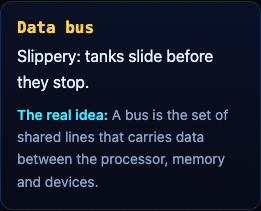
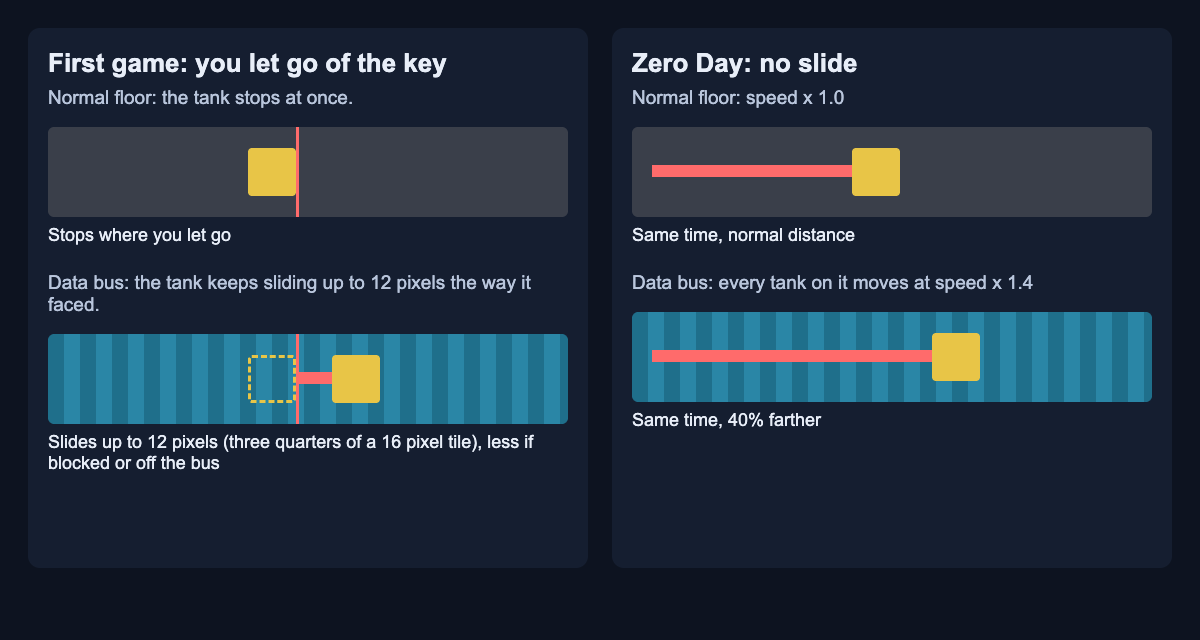
The code behind that card is short and easy to read. While your tank stands on the data bus and you let go of the direction, it keeps sliding up to 12 pixels in the way it faced. It stops early if something blocks it. It also stops once it leaves the data bus. Off the data bus, it stops at once.
So the slide is not a slow fade. It is a fixed budget of up to 12 pixels, spent at your normal speed. That makes it consistent. You can learn it once and trust it.
The name has a real idea behind it too. The card says: "A bus is the set of shared lines that carries data between the processor, memory and devices." Lanes that carry things along, and that you cannot stop on cleanly, fit that picture.
Same tile, a different rule in Zero Day
The second game on the site, Tank City Zero Day, also has a data bus. But its card says something else: "Tanks on it move 40% faster."
In the code, every tank on a data bus moves at its speed times 1.4. There is no slide. When you let go, you stop.
This is a useful lesson in itself. Two games can share a tile name and still give it different rules. So read the card on each page before you plan your moves. Speed lanes and slippery lanes both change where you end up, but in different ways. One adds distance while you hold the key. The other adds distance after you let go.
Worked example: stopping next to a wall on stage 5
Let us put the numbers together. In the first game, stage 5 is named DATA BUS, and its map has data bus tiles. Each map is 13 by 13 tiles. A tile is 16 pixels wide, and your tank is a 16 by 16 box.
- Find the slide length. The slide is up to 12 pixels. A tile is 16 pixels. So the slide is up to three quarters of a tile.
- Pick your stop. Say you want to stop right next to a wall, on a data bus lane.
- Let go early. Release the key when you are about 12 pixels short of where you want to be. Your tank slides the rest of the way.
- Use the wall as a brake. Tanks move one pixel at a time and stop flush against walls and other tanks. If the wall is in your path, the slide ends early at the wall. You cannot slide through it.
- Know the edge of the lane. If your slide carries you off the data bus, you stop right there.
The enemies make this harder. Stage 5 sends 2 worms, 6 trojans, 6 spyware and 6 rootkits, and all three power-up carriers are spyware. So you plan your stops while those tanks come at you. A slide that ends in the wrong lane can put you in the line of fire.
If you want to know how the game decides that your tank has touched a wall, read what collision detection is in video games.
Tips for slippery floors
These tips follow from how the slide works in the first game. Many of them make sense on other slippery floors too.
- Learn the slide once. A fixed slide is easy to learn. Watch how far you drift, then release that far ahead of your target.
- Plan stops on normal ground. Off the data bus, you stop at once. So pick solid tiles for the places where you need to stop exactly.
- Cross in one move. Do not try to stop in the middle of a slippery lane if you can avoid it. Cross it in one push.
- Read the map first. Before you move, look at where the bus lanes run. If you want to know how a map is built from tiles, read what a tile map is in 2D video games.
- Check which game you are in. In Zero Day, the data bus speeds you up instead. The tips above are for the slide.
Frequently asked questions
What is an ice level in a video game?
It is a stage, or part of one, where the floor is slippery. You keep moving a short way after you let go of the controls.
Is there an ice level in Tank City Reboot?
Yes, in spirit. In the first game, the data bus tile is slippery, and stage 5 is named DATA BUS. Your tank slides up to 12 pixels after you let go.
Does the data bus work the same in Zero Day?
No. In Zero Day, tanks on the data bus move 40% faster. There is no slide.
How do you stop where you want on a slippery floor?
Let go early, by about the length of the slide. Or slide into a wall, which stops you flush.
Get started
The best way to understand a slippery floor is to feel it. Open Tank City Reboot and work your way to stage 5, DATA BUS. Watch how far your tank drifts on the bus lanes. Then practise letting go early until you stop where you planned. It is free, plays in your browser on a computer or a phone, and needs no account to play.
Comments
No comments yet.
Sign in or make an account to comment.