Is 2048 hard? Why the last tiles take longest
Is 2048 hard? The rules fit in one line: slide the tiles, and two equal numbers merge into their sum. The first tiles come fast. The last ones come slowly, because every new tile needs twice the work of the one before it, and the board does not grow to hold that work. This post counts that work, shows where real test games stalled, and shows how 3D 2048, the puzzle on a cube you turn like a Rubik's cube, gives you more room to do it.
Is 2048 hard? The short answer
It is easy to learn and hard to finish. A 4 takes one merge. A 2048 takes more than a thousand, and all of them have to happen without filling the board.
Most games do not end because you run out of ideas. They end because you run out of room. So the first half of a game is easy, and nearly all the difficulty sits in the last few tiles.
Why each new tile doubles the work
Every tile is a power of 2. A 64 needs two 32s. Each 32 needs two 16s. Go all the way down and a 64 is built from 32 twos.
Follow that up the chain:
- A 128 is 64 twos.
- A 256 is 128 twos.
- A 1024 is 512 twos.
- A 2048 is 1,024 twos.
So when you finally have a 1024 in a corner, you are only halfway. You still need to build a second 1024, next to it, with less free space than you had the first time. The 2048 number sequence post walks through all 10 doublings.
Counting the merges and moves
Each merge turns two tiles into one. To turn 1,024 twos into one 2048 you need 1,023 merges. A new 4 cuts that a little, since it arrives already merged.
In 3D 2048, every slide or twist adds one new tile, a 2 or a 4. The game's script makes it a 2 when a random number comes out under 0.9. When the game's own tile code was copied and run 10,000 times outside the page, 1,001 of the new tiles were 4s. So a new tile is worth about 2.2 on average.
That gives a floor. A 2048 tile is 2,048 of value on the board. At about 2.2 a move, you need roughly 930 moves before the board even holds enough to make one. Real games take more, because the right tiles also have to sit in the right squares. How many moves it takes to get 2048 works this out in full.
The score follows the same doubling. A slide adds the value of every tile its merges make, so a 2048 built only from 2s earns its value once at each level: 10 times 2,048, or 20,480 points for that one tile. You can check the rule on any board. In one test game the tiles, counted as if built from 2s, added to 152; the game had seen one new 4, which skipped a merge worth 4, and the Score read 148.
Board space: why the end feels cramped
Each face of the cube is 3 by 3, so the front face has nine squares. Hold a 512, a 256 and a 128 in a line and a third of the face is taken by tiles you must not move. Every new tile and every small merge has to happen in the other six squares.
The test games show how fast one face runs out. One game that only slid the front face, with no twists, made a 32 at move 23 and was stuck at move 46 with a score of 332. Every slides-only test game stopped with its biggest tile at 64 or less. These are single games played by a simple script, not averages, but they agree: nine squares alone cannot hold the work a 2048 needs.
When the front is stuck, the game says: "Nothing moves that way. Try another way, or twist a row." That message is the hint. Why you keep getting stuck in 2048 covers the usual causes.
Habits that make the last tiles easier
- Keep your biggest tile in one corner. If it drifts, small tiles fill the space behind it and your chain breaks.
- Build the chain in falling order along one edge, so each merge feeds the next tile up.
- Do not count on chain merges. A tile made in a merge does not merge again in the same slide: 2 2 4 slid left gives 4 4, not 8.
- Keep a square free. A twist needs one empty square for its new tile.
Which corner is best is less clear than it sounds. In the corner test, one start played into each corner scored from 136 to 432 points, and on a second start a different corner won with 600. One game each is not proof, but it shows that the corner and the luck of the tiles both matter.
How 3D 2048 changes the difficulty
The cube has six faces of nine squares, 54 in all. When the front face fills, you have five more faces to work with, and three ways to use them:
- Twist. Drag a row on the right face sideways, or a column on the top face. On a keyboard, 1 2 3 twist the top, middle and bottom row right, 4 5 6 the left, middle and right column up, and Shift twists the other way. A twist counts one move, adds no points and adds a new tile.
- Turn. Drag the space around the cube, or press Shift and an arrow key. The whole cube turns. Turning is free: no move, no new tile.
- Edge merges. On unless you switch them off in Settings. A slide towards an edge of the front face also merges the tile at that edge with an equal tile just over the edge.
Here is a worked example you can follow, tested on the live game. A 16 sits on the front's middle left square, and another 16 sits on the right face's top left square, just over the front's top right edge.
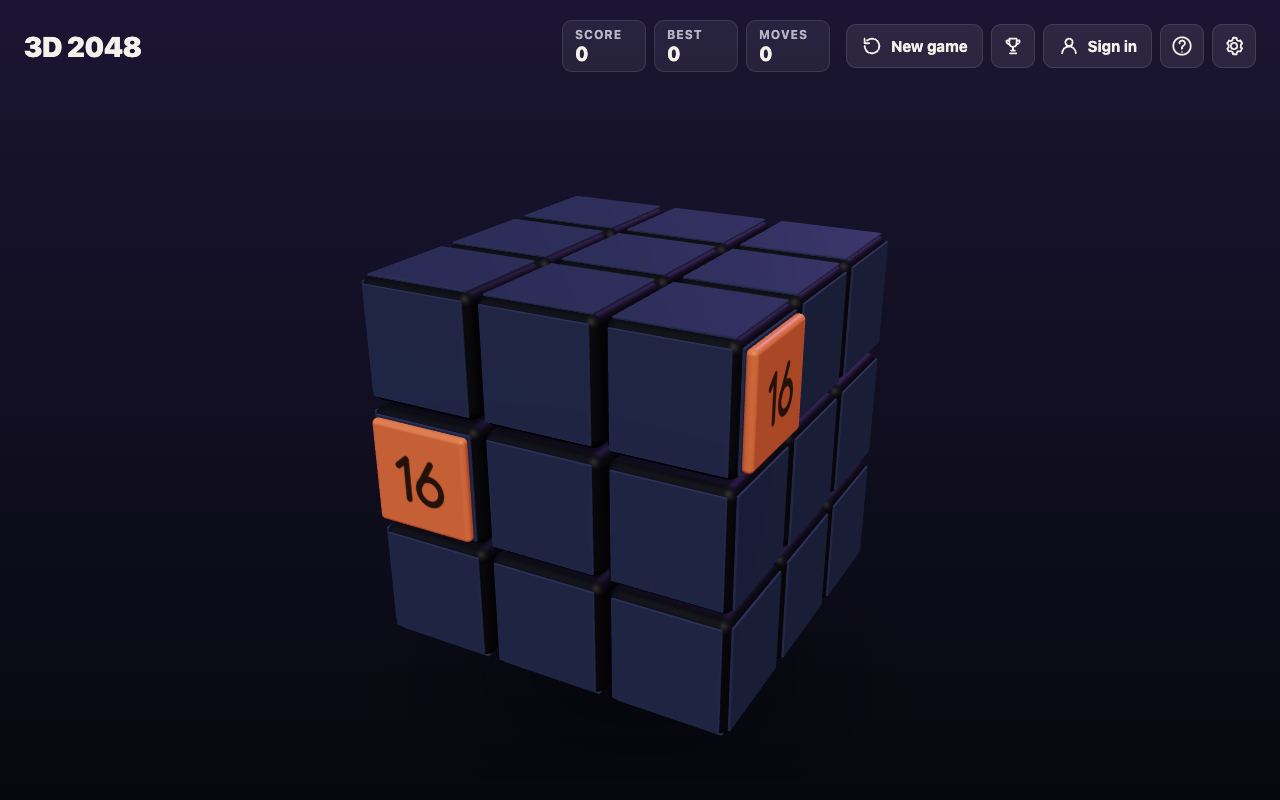
- Press Shift and 1. The top row twists left, and the right face's 16 lands on the front's top left square, right above the other 16. Moves reads 1 and a new 2 appears.
- Press the Up arrow. The two 16s merge into a 32 in the top left corner. Score reads 32 and Moves reads 2.
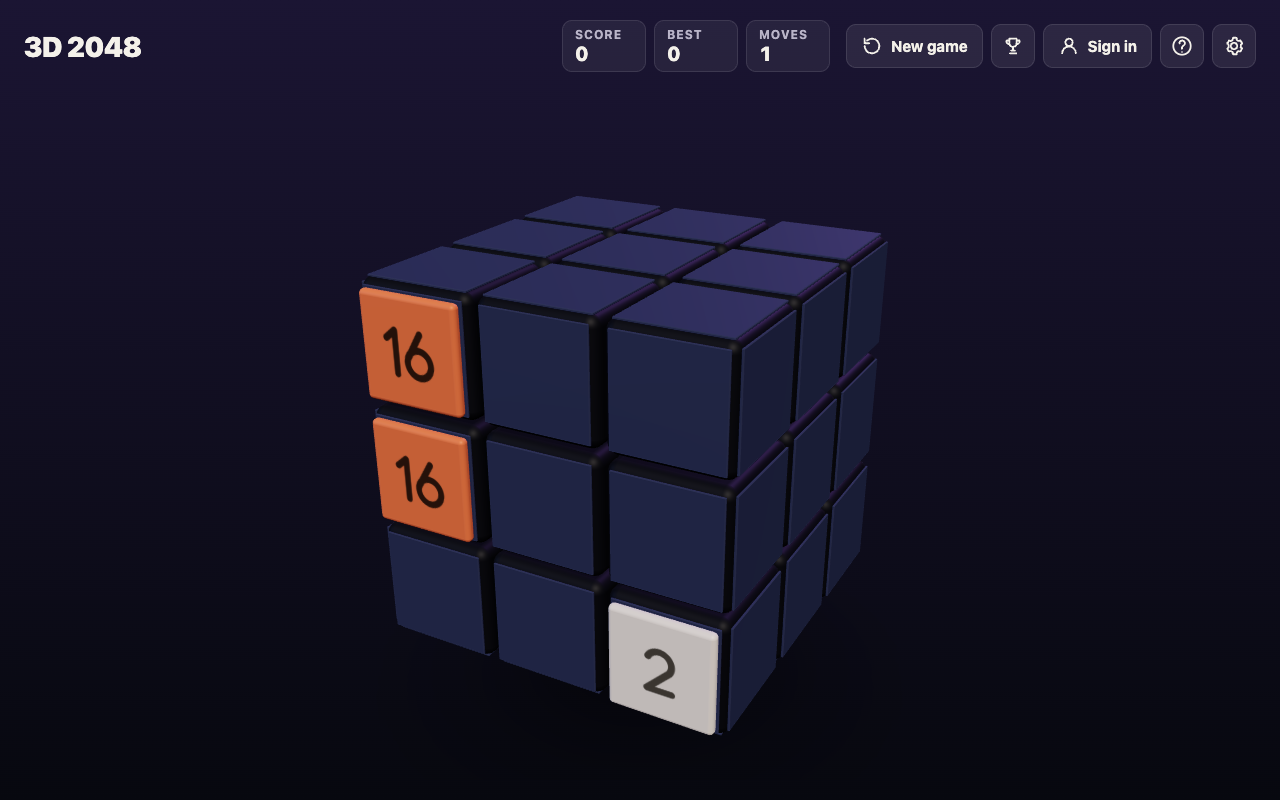
Two moves, and a merge the front face alone could not have made. Pressing 1 without Shift on the same start twists the row the other way: the right face's 16 goes on round to the back, and nothing merges. When to twist a row instead of sliding goes further.
The extra room shows in the numbers. A test game that twisted whenever the front was stuck reached 64 at move 36 and 128 at move 118, and filled all 54 squares at move 165 with a score of 1,160. Even then the game was not over, because other faces still had equal tiles side by side. So the cube does not make the doubling easier. It gives you more space to do it in, and more ways to bring a tile to its match.
Frequently asked questions
How many moves does it take to reach 2048?
At least about 930, because each move adds a tile worth about 2.2 on average and the board must hold 2,048 in value. Real games take more.
What percentage of players reach the 2048 tile?
The game publishes no such number, so this post does not give one.
Why is the end of 2048 so much harder than the start?
Each tile needs twice the merges of the one before, but the board stays the same size. The last tiles need the most work in the least free space.
Can you keep playing after 2048?
Yes. When you make 2048 in 3D 2048, a box offers Keep going or New game, and Keep going carries on with the same cube, score and moves.
Get started
Open the game, and try one thing: when the front face gets stuck, twist a row instead of starting over. Your game and best score are saved on your device, so you can stop and come back, and an account is optional.
Play 3D 2048: it is free and plays in your browser on a computer or a phone.
Comments
No comments yet.
Sign in or make an account to comment.