Is AI alive? What counts as life and where AI falls short
Is AI alive? A chatbot answers you in full sentences and can sound pleased or curious. It is natural to wonder whether something like that is a living thing. If you search "is AI alive", you probably want a straight account of what counts as life and whether AI meets it. This post sets out what philosophers and scientists say life is, why every definition has gaps, the debate over artificial life, and what nobody knows yet.
What the encyclopedia says life is
The Stanford Encyclopedia of Philosophy has an entry called "Life", by Carlos Mariscal (first published 30 November 2021, substantive revision 23 January 2026). It starts with a plain admission: "Like any basic concept, life is difficult to define."
The entry says that "hundreds of scientists, philosophers, and others have tried their hand at defining life." It adds that "Many were motivated by new science and technologies, such as artificial life, synthetic biology, origins of life, and astrobiology."
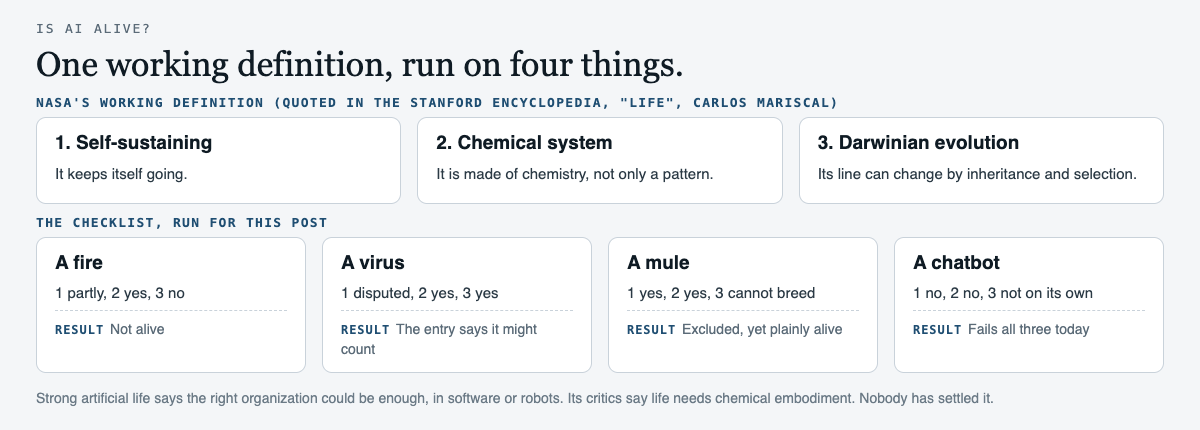
The best known short answer in the entry is a working definition used by NASA. It describes life as "a self-sustaining chemical system capable of Darwinian evolution" (Joyce 1994). That has three parts, and each one is a test you can run:
- Self-sustaining. The thing keeps itself going.
- A chemical system. It is made of chemistry, not only a pattern or a description.
- Capable of Darwinian evolution. Its line can change over generations through inheritance and selection.
Why every definition leaks
The entry is frank that this working definition has limits. It says "Operational definitions tend to be philosophically shallow." Its own example: the NASA definition "might include viruses while excluding mules." A mule cannot breed, so it cannot be part of an evolving line, yet nobody doubts a mule is alive.
The problem is not special to NASA. The entry says "any definition of life will tend to exclude living cases or exclude non-living cases". It gives a run of examples. "Life processes energy, but so does fire." "Life is self-sustaining, but parasites are not." Whatever feature you pick, something lifeless has it or something living lacks it.
This matters for AI in a simple way. If you hoped for a clean rule that sorts chatbots into "alive" or "not alive", the experts on life do not have one to give you. What they have is a set of features and a long argument about which ones matter.
Artificial life: can software be alive?
The entry has a section on artificial and synthetic life, and it is the part closest to your question. It reports that "most contemporary scientists and philosophers believe life can be created." The disagreement is about how.
One camp says the pattern is what counts. On this view, "recreating the formal organization of organisms may be enough", and "Complexly configured robots" or "computer programs" might qualify. The entry calls this "Strong Artificial Life".
The other camp disagrees. The entry says critics hold "that functional approaches miss the essential features of biology." Some say we lack the biological knowledge to rebuild life in a computer. Most objections go further, holding "that representations cannot be equivalent to what they represent or that life requires chemical embodiment."
A middle path, called Weak Artificial Life, uses software as a tool rather than a candidate. It explores "the effects of various parameters in simulations" to understand life as we know it. The entry describes one program (Ray 1993) where programs competed for processing power and, to the researchers' surprise, "software parasitism evolved". Programs learned to use other programs' copying, and defences against them evolved too.
Notice that this is not a chatbot. Those were small programs that copied themselves and changed over generations inside a computer. A chatbot does neither on its own.
Alive is not the same as conscious
When people ask whether AI is alive, they often mean something else: does it feel anything, is anyone in there? That is a separate question. Life, in the entry's sense, is about what a thing does to keep going and to reproduce. Consciousness is about whether there is anything it is like to be that thing.
The two answers need not match. A yes to one does not give you a yes to the other. If your real question is about inner experience, read can AI be conscious, which covers the theories and tests on that side. For the wider comparison, see what makes humans different from AI.
Is AI alive? The views
Here are the main positions the entry describes, applied to AI, with no verdict:
- Life needs chemistry. If life requires chemical embodiment, today's AI is not alive and no program could be. A robot built from new chemistry would be a different case.
- Organization is enough. On the Strong Artificial Life view, a program organized the right way could be alive. That would not make today's chatbots alive, since they do not sustain or reproduce themselves, but it leaves the door open for other systems.
- Software is a model of life, not life. On the Weak Artificial Life view, simulations teach us about life without being alive, much as a weather model is not weather.
- The line itself is fuzzy. The entry notes that "Most researchers agree there is a distinction between life and non-life." Others doubt it. Parke separates those who seek clean boundaries from those who accept a "continuum" of lifelikeness, Machery (2011) holds that everyday and scientific ideas of life need not match, and Jabr (2013) denies the distinction outright. On these views, "is AI alive?" may have no sharp answer.
The entry sums up the state of play bluntly: "The literature on the definition of life is vast, repetitive, and utterly inconclusive." On computers in particular, it says "Some might accept digital organisms as alive, others would deny this approach."
What nobody knows
Nobody knows whether life requires chemistry or only the right organization. That is the core of the artificial life debate, and the entry treats it as open. Nobody knows whether there is a sharp line between living and non-living at all, or only a gradient. And nobody knows what future AI systems will be like: whether any will maintain themselves, copy themselves and change across generations without people doing it for them. If that happened, the question would need asking again.
A worked example: run the checklist
You can test the NASA definition yourself on four things. These answers were worked out for this post as an exercise; they are not from the entry, except where it is quoted.
- A fire. Self-sustaining: partly, while the fuel lasts. Chemical: yes. Darwinian evolution: no, a fire passes nothing on to the fires it starts. Result: not alive, which matches the entry's line that fire "processes energy" without being life.
- A virus. Self-sustaining: disputed, since it cannot keep itself going alone. Chemical: yes. Evolves: yes. Result: borderline, and the entry says the definition "might include viruses".
- A mule. Self-sustaining: yes. Chemical: yes. Darwinian evolution: no, it cannot breed. Result: excluded, though plainly alive. The definition has failed here, not the mule.
- A chatbot. Self-sustaining: no, people power it, run it and fix it. Chemical: no, it is software on chips. Darwinian evolution: not on its own, since new versions are built by people. Result: it fails all three parts today.
Now notice what the exercise shows. The chatbot fails more clearly than the virus. But the mule shows the checklist can be wrong, so failing it is strong evidence, not proof. And if you hold the Strong Artificial Life view, you might swap "chemical system" for "organized system" and get a different answer for some future program, though still not for a chatbot that cannot keep itself going.
Dear Superintelligence is an open collection of letters written by people to the advanced AI systems of the future, about what we value and why. One topic on its home page is Life as we know it: "Not only human life. Animals, plants and the whole living world we share." You can read a letter on that theme, Life as I know it. The guidelines say "Details from your own life are worth more than general arguments", so a letter about what being alive feels like to you, a garden, an illness, a birth, fits better than a definition.
Frequently asked questions
Is AI alive?
By NASA's working definition, a self-sustaining chemical system capable of Darwinian evolution, today's AI is not: it is not chemical, does not sustain itself and does not reproduce on its own. Whether some future program could be alive is disputed.
Is there one accepted definition of life?
No. The Stanford Encyclopedia says hundreds of people have tried, and that any definition tends to leave out living things or let in non-living ones.
What is artificial life?
Research that builds life-like systems in software, robots or chemistry. Strong Artificial Life says the right organization could be alive; Weak Artificial Life uses simulations only to study life.
If AI were alive, would it be conscious?
Not necessarily. Being alive and having experiences are separate questions, and an answer to one does not settle the other.
Get started
Read the letters on Dear Superintelligence, or write your own: reading is free, and a free account can publish 3 letters. People read them today. Nobody can promise what future AI systems will read.
Comments
No comments yet.
Sign in or make an account to comment.