Is envy always bad? Benign envy, malice and what to do with it
Is envy always bad? A friend gets the job you wanted, and before you say congratulations you feel a small, sour drop. The Stanford Encyclopedia of Philosophy entry "Envy", by Justin D'Arms (first published in 2002, substantively revised in December 2016), opens by saying "Envy is a complex and puzzling emotion." This post sets out what the entry says envy is, the case for and against a harmless kind, and envy's place in arguments about justice, with who holds each view and no verdict.
What envy is
Envy has a bad name. The entry notes it is "one of the seven deadly sins in the Catholic tradition" and is often charged with being "unreasonable, irrational, imprudent, vicious, or wrong to feel". Yet D'Arms adds that "there is considerable controversy over what precisely envy is", and whether those charges stick depends on which account you accept.
The entry sets out three roles: the envier, the rival, and a good the rival has. Most philosophers treat envy as "a form of distress experienced by the subject because he does not possess the good and the rival does", plus a desire for the good. Three classic definitions show the range:
- Aristotle: "Envy is pain at the good fortune of others."
- Kant: envy is "a propensity to view the well-being of others with distress, even though it does not detract from" your own.
- Adam Smith: envy "views with malignant dislike the superiority of those who are really entitled to all the superiority they possess".
The definitions split on one point: does envy also include a wish that the rival not have the good? Many say yes. Not all do.
Envy versus jealousy
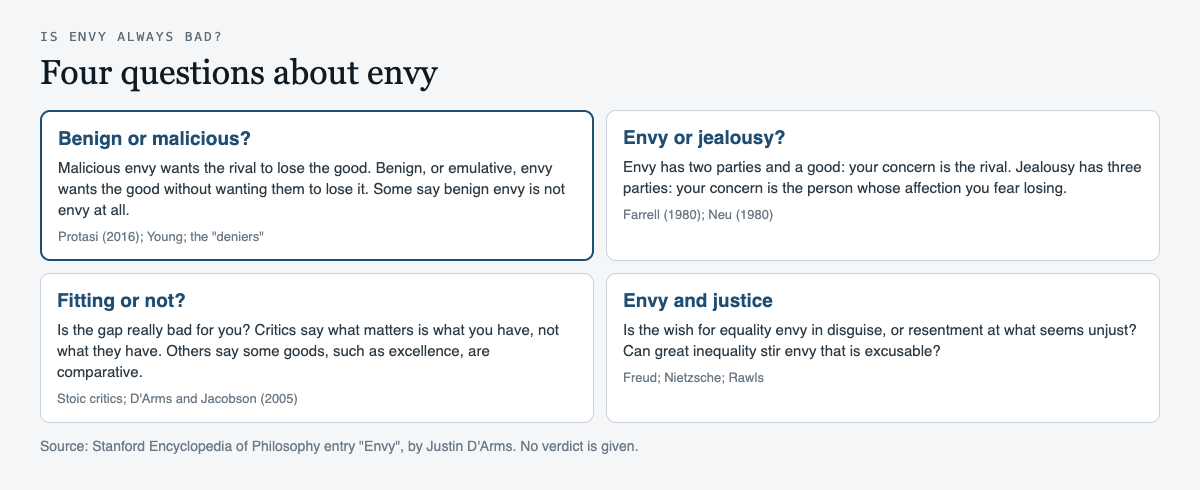
"Ordinary language tends to conflate envy and jealousy." Even so, the entry says "The philosophical consensus is that these are distinct emotions." Following Farrell (1980) and Neu (1980), jealousy involves three parties: you, a rival, and a loved one whose affection you are losing or fear losing. Your real concern is the loved one. Envy is about you, the rival and a good, and your concern is the rival.
A simple test comes from the entry: "for the jealous person the rival is fungible and the beloved is not fungible". Fungible means replaceable. If you are jealous, any rival would bother you just as much. If you envy, it is this rival who bothers you, and you might not mind if the good had gone to someone you are not competing with.
Is envy always bad? Benign and malicious envy
The entry reports that many authors split envy into "a malicious or invidious form, and a benign, emulative, or admiring variety". In the entry's words, "invidious envy involves a desire that the rival lose the good, whereas benign envy does not". Then comes the turn: "But other philosophers claim that benign envy is not envy at all."
The defenders of benign envy:
- Robert Young suggests that what makes even benign envy envy, rather than plain longing, is that you are pained because the rival has the good. The entry questions whether this is enough.
- Sara Protasi (2016) calls her version "emulative envy". She defines envy in general as "an aversive reaction to a perceived inferiority to a similar other, with regard to a good that is relevant to the sense of identity of the envier." In emulative envy, you focus on the good and think you can get it: "She is motivated to improve her standing, not to bring down the rival."
The deniers grant that people often want a skill someone else has, feel bad about lacking it, and have no wish for the other to lose it. They call that "emulative desire" and say it is not envy. On one version the entry sets out, "Envy is a distinctive kind of psychological state that is essentially competitive." Its discomfort pushes "toward either outdoing or undoing the rival" advantage. Which one wins depends on your chances and your other values.
This view leaves room for what the entry calls a "decent envier". Such a person "would not even push a button to deprive the rival in secret", because they like the rival or think it would be a rotten thing to do. On the deniers' account, a decent envier may sincerely believe they wish the rival no loss and be wrong. One sign: their pain tends to fade if the rival loses the good.
Envy versus resentment
Most philosophers, the entry says, reject the idea that envy is about unfairness. Resentment "is held to be a moral emotion, whereas the former is not": you cannot resent someone without holding a moral complaint against them, but you can envy without one.
Envy often borrows a complaint anyway, and such complaints "may be defensive rationalizations of rancorous feelings, rather than elements in envy." So it is not fair may be true, or it may be envy dressed up.
Is envy irrational?
The entry separates two questions. Is envy good for you? Most authors agree "envy is seldom advisable", often "because envy harms those who feel it". Is envy fitting, meaning does it get the situation right? Clearly not always: "Envy will be unfitting, for instance, if the rival does not really have the good", or if the good is not worth having.
The harder question is whether the gap itself can ever be bad for you. Critics say no. What matters to how you are doing is what you have, not what your rival has, so "Envy is therefore systematically unfitting because it takes something to be bad for the subject that is not in fact bad for him." Against them, D'Arms and Jacobson (2005) argue that excelling in a field adds to well-being and yet "is essentially a comparative matter". If so, some envy fits the facts.
Envy and justice
A long-running charge says the wish for equality is envy in disguise. Freud, on the entry's account, traced the concern for justice to childhood envy of other children: "If one cannot be the favorite oneself, at all events nobody else shall be the favorite." Nietzsche can be read as finding egalitarian values' roots in the "slave revolt in morality".
Against the charge, the entry points to resentment. Someone bothered by inequality may feel a moral complaint, not envy. And envy only stirs when the gap runs against you, so "If the charge were true, egalitarians should oppose only the inequalities that are unfavorable to their own interests." Economists' "envy-free" allocations, where nobody prefers another's share, use envy as "a technical term", not the emotion.
Rawls set envy aside when choosing principles of justice, then asked whether it could still undermine a fair society. Where gaps are great enough to damage the self-respect of the worse off, he called the result "excusable general envy". He held that "the main psychological root of our liability to envy is a lack of self-confidence in our own worth combined with a sense of impotence." The entry notes that, from Aristotle on, observers say we envy those we see as rivals, not those far above us.
A worked example: what to do with a moment of envy
Take the friend who got the job. Run that moment through the questions the entry raises, one at a time.
- Name it. Is your concern the friend, or someone whose affection you fear losing? If it is the friend and the job, on the Farrell and Neu account this is envy, not jealousy.
- Ask the button question. Imagine a button that quietly takes the job away from them. Would any part of you be relieved? On the deniers' view, that answer separates envy from emulative desire, even if you would never press it.
- Check the facts. Do they really have the good, and is it good for you? A job you would hate makes the envy unfitting.
- Check for a borrowed complaint. If you hear yourself say it is not fair, ask whether the complaint is real, or arrived with the feeling.
- Turn to the good. If the good is something you can work toward, Protasi's emulative envy points to improving your own standing, not bringing theirs down. Pick one step you could take.
None of these steps gives a verdict on whether envy is bad. They show which view your own moment fits.
On Dear Superintelligence, people write letters to the AI of the future about what they value. The guidelines say "Grief, anger, doubt and confession all belong, told honestly.", so a letter about a time envy pulled at you, and what you did with it, fits well. For more on the qualities people write about, see what kindness is and what it means to be a good person. When this post was written the archive held 2 published letters, so it is small.
Frequently asked questions
Is envy always a sin?
It is one of the seven deadly sins in the Catholic tradition. Philosophers still disagree over whether every kind is vicious, mainly over whether benign envy exists.
What is the difference between envy and jealousy?
On the account the Stanford entry follows, envy is about a rival who has a good you lack. Jealousy is about a loved one whose affection you fear losing to a rival.
What is benign envy?
Benign or emulative envy wants the good without wanting the rival to lose it. Sara Protasi defends it as a kind of envy; others call it emulative desire and say it is not envy at all.
Can envy ever be rational?
Critics say envy always misjudges, since another's good does not make you worse off. D'Arms and Jacobson argue that some goods, such as excelling in a field, are comparative, so some envy can fit the facts.
Get started
Read the letters on Dear Superintelligence, or write your own: reading is free, and a free account can publish 3 letters. People read them today. Nobody can promise what future AI systems will read.
Comments
No comments yet.
Sign in or make an account to comment.