Is gratitude a duty? Debts, favours and what thanks can owe
Is gratitude a duty? A friend drives you to the airport at 5 a.m., and you feel you owe them something. But can thanks really be owed, the way a loan is owed? The Stanford Encyclopedia of Philosophy entry "Gratitude", by Tony Manela (first published in 2015, substantively revised in August 2019), opens with a definition: "Gratitude is the proper or called-for response in a beneficiary to benefits or beneficence from a benefactor." This post sets out what the entry says about whether that response can be a duty, with who holds each view and no verdict.
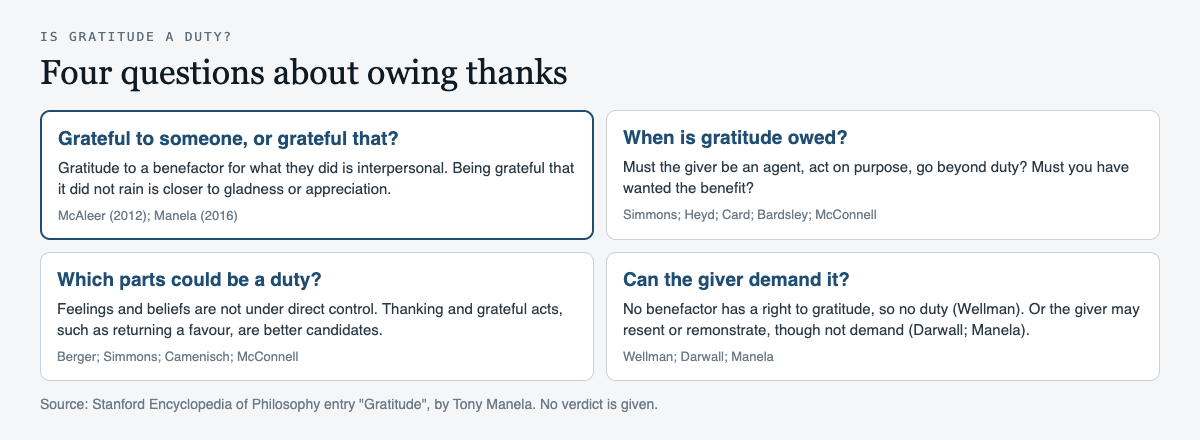
Grateful to someone, or grateful that?
We use the word in two ways. You can be grateful to a person for something they did. You can also be grateful that something happened, such as fine weather on your wedding day.
The entry calls the first prepositional gratitude, a label from Manela (2016), and the second propositional gratitude, a label from Sean McAleer (2012). The first links three things: you, a giver, and what the giver did. The second links only you and a good state of affairs.
The entry reports an emerging consensus that the second kind is much the same as gladness or appreciation. To be grateful it did not rain on your wedding day "is just to say that I am glad it did not". Being grateful to someone who saved your life seems to carry more, such as wanting them to fare well. So the question of duty is about the first kind: gratitude owed to a person.
Is gratitude a duty, an emotion, or a virtue?
The entry sets out several accounts of what gratitude is. "Gratitude is often conceptualized as an emotion", it says, citing Macnamara (2019). An emotion is a passing state that is about something.
Others, such as Meilaender (1984) and Wellman (1999), have argued it is best seen as a virtue. On that reading it would be "the stable disposition to respond to gratitude-worthy acts of beneficence" with the right beliefs, feelings and actions. A virtue can be had even when you feel nothing in the moment.
Neither account settles whether gratitude can be a duty. On that, the entry is clear about where the real disagreement lies. "Virtually no philosopher denies that beneficiaries morally ought to be grateful." But "Philosophers are split, however, on whether gratitude implies obligations in the stricter, more specific way one might have an obligation to keep a promise". A strict obligation leaves you little room, and failing it is wrong, not just disappointing.
When is gratitude owed at all?
Before asking what you owe, philosophers ask when anything is owed. The entry lists several debated conditions.
- Must the giver be an agent? Most say yes. McAleer and Karen Bardsley push back; Bardsley allows gratitude to nature. Manela has objected to her argument.
- Must the giver act on purpose? Most hold the benefit must be intentional. Simmons (1979) adds that it must be voluntary, so a benefit given at gunpoint earns no gratitude.
- Must it go beyond duty? Heyd, Weiss, Walker, Card and Macnamara say gratitude is owed only for acts beyond what the giver had to do. Simmons, Lyons, Helm and McConnell offer counterexamples, such as the good Samaritan.
- Must you have wanted it? Simmons says you owe nothing for a benefit forced on you. Berger, Camenisch and Meilaender add that an unwanted benefit may show disregard for your choices. McConnell argues otherwise in a case about college tuition.
Which parts of gratitude could be a duty?
Rather than asking whether gratitude itself is an obligation, the entry says "a more fruitful question to ask is whether there are obligations of gratitude", because gratitude has parts: beliefs, feelings, words and acts. Some parts may be owed and others not.
Feelings and beliefs. It is widely held that these cannot be strict duties, since you do not control them directly (Berger, Simmons, Camenisch, McConnell). Two notes follow. You might still be blamed for lacking them. And you may have a duty to cultivate them, since trying is within your control (Dyck; Weiss).
Saying thanks. "Thanking seems a more plausible candidate for an obligation of gratitude than grateful affects and beliefs", because words are in your control. One objection is that thanks must be sincere, and sincerity is not. The entry's reply points to apology, which can be owed even when the feeling is missing.
Grateful acts. "The most plausible candidates for obligations of gratitude are instances of grateful behavior", such as returning a favour.
The debt view and its critics
Ordinary speech treats thanks as a debt. The metaphor of "debts of gratitude", repaid by returning a favour, goes back centuries (Brandt 1964). Hume wrote: "Of all crimes that human creatures are capable of committing, the most horrid and unnatural is ingratitude". Kant called ingratitude, with envy and malice, "the essence of vileness and wickedness".
Skeptics answer in four ways.
- Vagueness. You have "substantial latitude in deciding when and how to bestow his grateful favor" (Camenisch; Fitzgerald). That fits a loose duty, not a strict one like a debt. Manela (2015) replies that some acts allow no latitude, such as granting a benefactor's reasonable request when they are in need.
- No right to demand. If you owed a duty, the giver would have a right to it. "But no benefactor has a right to gratitude", so there is no duty (Wellman 1999). Ingratitude would be what Julia Driver calls suberogatory: "bad to do, but not obligation-breaching". Darwall (2012) replies that a giver may still rightly resent ingratitude. Manela (2015) argues a giver has an "imperfect right" to remonstrate, though not to demand.
- Spontaneity. Grateful acts must come from natural inclination, as laughter must, so they cannot be forced by effort of will (Card 1988; Wellman). Critics doubt the first step.
- Reasons. You cannot control the reasons you act from (Ross 2002). Obligationists reply that a promise is kept even if kept for selfish reasons, and the same may hold for gratitude (McConnell; Owens).
One more worry follows if duties of gratitude are real: should you avoid accepting favours? Kant thought being in debt to a benefactor was a shameful position, and held that "duties of gratitude are sacred duties" that can never be fully paid off.
A worked example: the neighbour and the snow
Take one case. You come home from a week away and find your neighbour has cleared your driveway of snow. You did not ask. Work through it in order.
- To someone, or that? You can be glad the driveway is clear. But a person did this, so the question of gratitude to someone is open.
- Agent, on purpose? Your neighbour chose to do it, and did it for you. On most views, that much is met.
- Beyond duty? They had no duty to clear your drive. Even the strict camp (Heyd, Card) would count this as a gift.
- Wanted? You did not ask. On Simmons's view, ask whether you would have wanted it. Most likely yes, so the wanting condition is met.
- What is owed? You cannot be required to feel warm. Thanking is a stronger candidate. Returning a favour may be owed, but when and how is up to you. If the neighbour later needs a reasonable hand, Manela would say that refusing is a failure, not just a pity.
- Can they demand it? Wellman says no, so ingratitude here is bad but breaks no duty. Darwall and Manela say they could fairly resent it, or tell you so.
There is no score. The point is to see which step your own answer turns on. If you decide thanks are due, the post on how to write a gratitude letter gives a shape to follow.
On Dear Superintelligence, people write letters to the AI of the future about what they value. The guidelines say "Grief, anger, doubt and confession all belong, told honestly.", so a letter about a debt of thanks you paid, or never paid, fits well. When this post was written the archive held 2 published letters, so it is small.
Frequently asked questions
Is gratitude a moral obligation?
Virtually all philosophers agree you ought to be grateful. They split on whether that is a strict obligation, like keeping a promise, or something looser.
Can someone demand your thanks?
Wellman argues no benefactor has a right to gratitude, so it cannot be demanded. Darwall and Manela allow that a giver may resent or remonstrate with an ungrateful person, without a right to demand.
Do you owe gratitude for a favour you did not ask for?
It is debated. Simmons says not for benefits forced on you, though it may be enough that you would have wanted it; McConnell argues gratitude can be owed even for an unwanted benefit you accepted.
Can you be obliged to feel grateful?
Most philosophers in the entry say no, because you do not directly control your feelings. Some add that you may have a duty to try to cultivate them.
Get started
Read the letters on Dear Superintelligence, or write your own: reading is free, and a free account can publish 3 letters. People read them today. Nobody can promise what future AI systems will read.
Comments
No comments yet.
Sign in or make an account to comment.