Is It Better to Study Alone or With Friends? What Research Says
Is it better to study alone or with friends? Most advice picks a side. The research does not, because it finds two effects that pull in different directions. When people try to remember together, the group recalls less than the same people would alone. Yet after remembering together, each person tends to remember more on their own later. This guide sets out both findings and gives you a routine that uses each one where it helps.
What happens when a group tries to remember together
Psychologists call the first effect collaborative inhibition. Take four people who studied the same list. Ask them to recall it as a group, then compare that with what the same four would have written down separately, added together with duplicates removed. The separate total is bigger. A meta-analysis of 64 studies found this is a robust effect.
The usual explanation is that hearing other people recall in their order breaks up your own way of remembering. The same review found the effect was stronger in larger groups, when people recalled freely and in any order, and when group members did not know each other.
So if your plan is to sit together and try to remember a chapter out loud, you will probably pull out less than if each of you tried alone first.
Why studying with friends can still pay off later
The same meta-analysis looked at what happens afterwards. Across 27 results, remembering with others tended to help each person's later recall on their own. One likely reason is simple: you hear the bits you forgot, so you get a second look at the material.
Course studies point the same way. In one nursing course, students who took an exam alone and then again in groups of five scored better on a separate exam four weeks later than students who only tested alone. In a medical school study, questions that students answered together were remembered better eight months later than questions they only reviewed with the answers given. A third study in nursing students also found better long-term retention after group testing.
Two limits are worth knowing. The first nursing study was not randomised, so the groups differed in more than the exam format. And in the medical study, many students disliked not being sure of the right answer during the group test. The uncertainty did not stop them learning, but it was uncomfortable.
How the way you talk changes the result
How a group talks matters too. A 2026 set of experiments compared ways of recalling together. For word lists, focusing on where your answers differed worked best. For stories, supporting each other's recall worked best. For pictures paired with names, both approaches did well. The lesson for a study group: do not just chat. Compare answers and spend your time where you disagree.
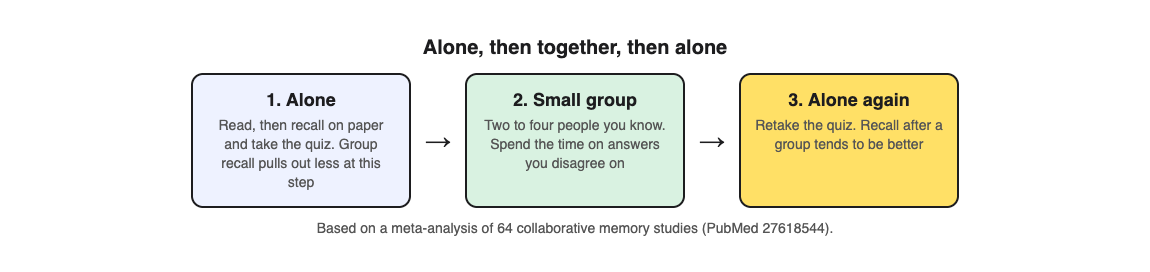
When to study alone or with friends
Put the two findings together and the answer depends on the job you are doing.
- Study alone for the first pass through new material and for your first attempt at recall. This is where group recall gets in the way.
- Study with friends once each of you has tried alone. Compare answers, argue about the ones you disagree on, and explain why the right answer is right. This is the part linked to better recall later.
- Go back to studying alone to test yourself on what came up. A group session can feel productive even when little stuck, and only a test on your own shows the difference.
Keep the group small and made of people you know. Both made collaborative inhibition weaker in the meta-analysis. For more on explaining to others, see does teaching someone else help you learn.
Common ways group study goes wrong
Most group sessions that fail do so in one of four ways, and each has a simple fix.
- It drifts into chatting. Agree on the questions you will cover before you meet.
- One person does the thinking. The strongest student explains and everyone else nods. Rotate who answers first, and let the strongest student go last.
- Nobody prepared. If people arrive without trying alone first, the group is doing the first recall together, which is the step the research says goes worst in a group.
- It feels better than it was. End with a short test each person takes alone, so you see what actually stuck.
A worked example: solo, group, solo with one quiz
Say three friends have a biology test on photosynthesis next week. Here is how to run it with Study Shot, which turns a photo of a page into a multiple-choice practice quiz.
- Monday, alone: read the pages. Close the book and write down what you remember. Then photograph the key page and make a quiz: 10 questions at the Tiered level, which climbs from basic to advanced.
- Monday, share: press Share this quiz and send the link to the group. Each friend needs a Study Shot account and gets their own copy of the questions, without your photo.
- Tuesday, alone: each person takes the quiz on their own. The results screen lists every miss under Look at these again.
- Wednesday, together: meet for 40 minutes. Each person brings their misses. Start with questions more than one of you got wrong, and take turns explaining the right answer before you read the app's explanation.
- Friday, alone: each person presses Retake quiz. Compare the score for each level with Tuesday's.
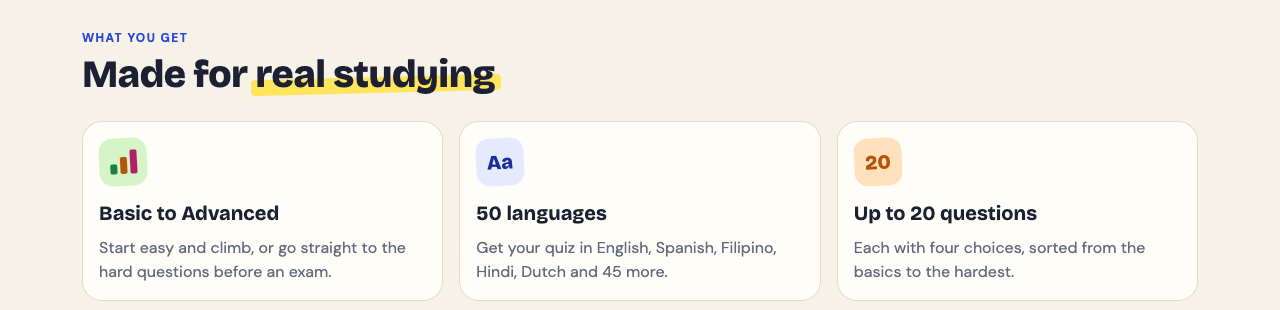
The questions are written by an AI model and can contain mistakes. If the group thinks one is wrong, check it against the page and use Report a problem with this question. A friend who studies in another language can make their own quiz in one of 50 languages, though the app's screens stay in English. For a full group session plan, see how to quiz each other in a study group.
Frequently asked questions
Do you learn more studying alone or in a group?
For first recall, alone: groups remembering together pull out less than the same people alone. For later recall, group discussion after trying alone tends to help.
How many people should be in a study group?
Small. Collaborative inhibition grew with group size in a meta-analysis of 64 studies, so two to four people is a sensible size.
Is studying with friends better than studying with strangers?
The meta-analysis found the loss from remembering together was larger when members did not know one another, so friends have an edge.
Is group study a waste of time?
Not if each person tries alone first and the group spends its time on disagreements. It wastes time when it becomes chatting or rereading together.
Get started
Try Study Shot: it is free to start. Photograph the page you are studying tonight and get 10 practice questions on it, from basic to advanced.
Comments
No comments yet.
Sign in or make an account to comment.