Is It Better to Study in the Morning or at Night?
Is it better to study in the morning or at night? The research does not crown a winner. Studies on body clocks and grades disagree with each other. What has stronger support is sleep: memory holds up better when sleep comes soon after you study, and better still when sleep falls between two study sessions. This post sets out both lines of research and turns them into a simple daily plan.
Is it better to study in the morning or at night? The short answer
Do your hardest new learning when you feel most alert, whether that is 8am or 8pm. Then use the evening for a short self-quiz, sleep, and retake the quiz the next morning. That pattern uses the one thing the research agrees on, which is that sleep helps you keep what you studied.
If you are trying to pick a clock time because someone told you mornings are always better, you can relax. The evidence for that is mixed.
What studies say about larks, owls and grades
Your chronotype is your body's natural lean toward early or late: larks feel sharp early, owls later, and most people sit in between.
Two recent studies of medical students point in different directions:
- In a study of 148 first-year medical students, morning types did better. About 49% of them were in the top marks group, against 29% of evening types, and evening types reported more stress and took longer to fall asleep.
- In a study of 224 medical students in Saudi Arabia, most were in between, and there was no link between chronotype and grades. Missing classes was linked to lower grades.
Both studies are surveys taken at one point in time, so they show links, not causes. A morning type might do better because classes start early, not because mornings are better for learning. The fair reading is that your chronotype may matter, and that turning up to class and keeping a steady routine probably matter too.
What the research on sleep after studying found
This is where the evidence is clearer. In two experiments with high school students learning vocabulary, Gais and colleagues (2006) found that memory was better when sleep followed within a few hours of learning, whatever the time of day. Losing sleep hurt memory, and the harm was still there after a night of recovery sleep.
A later study went further. Mazza and colleagues (2016) had 40 people learn foreign vocabulary to a perfect score in two sessions 12 hours apart. Half learned in the morning and relearned that evening. The other half learned in the evening, slept, and relearned the next morning. The group that slept between sessions needed half as much practice to relearn, and remembered much more a week later and six months later.
Both studies used vocabulary, so they say more about facts and terms than about solving problems. Still, they give a clear rule you can use tonight.
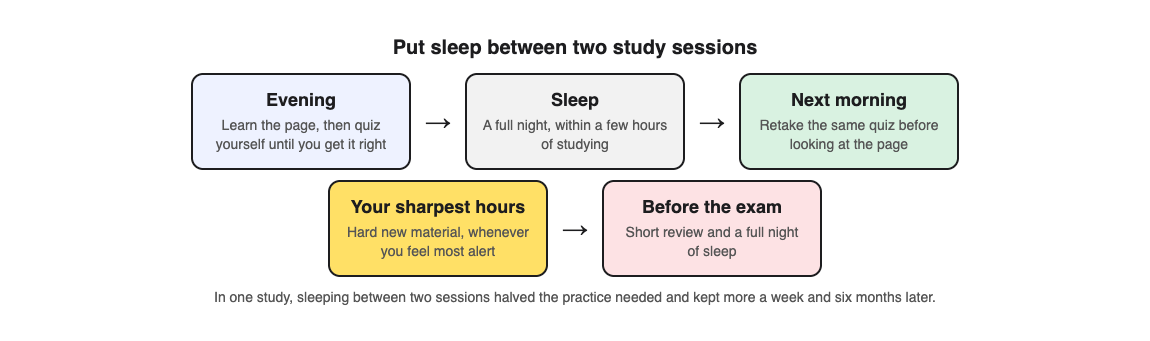
Match the task to the time of day
- Hard new material (a dense chapter, a new kind of problem): your sharpest hours, whenever they are. Notice when you focus best for a week before you decide.
- Facts and terms: the evening works well, with a quiz before bed and a retake after you wake.
- Problem sets: your sharp hours, on paper. A multiple-choice quiz can check the ideas behind a problem, but not your worked steps.
- Review before an exam: short, and never at the cost of a full night of sleep.
Testing yourself matters more than the clock: our post on why testing yourself beats rereading covers that research.
A worked example: one page, one evening, one morning
Say you have a biology page full of new terms for a test next week.
- Evening, after dinner. Read the page once. Open Study Shot in your phone's browser, tap Make a new quiz, then Take photo. Hold the page flat and fill the frame.
- Pick the Basic level ("Key terms, facts and definitions.") and 10 questions, then press Create questions. It can take up to a minute.
- Answer one question at a time. After each Check answer you see Correct! or Not quite., the right answer and a short explanation. Look at the Look at these again list, reread only those parts of the page, and retake the quiz once.
- Sleep. A full night, not a late scroll.
- Next morning. Before you look at the page, open your library, where the quiz is saved with its page photo and your best score, and tap Retake quiz.
- In your sharp hours that week. Make a second quiz from the same page at Advanced ("Apply and predict in new situations.") to test whether you can use the terms, not just recognize them.
The grades make the progress easy to see: Mastered at 90% and up, Good at 70%, Getting there at 50%, and Needs another try below that. A fair goal is to move up one grade from the evening to the morning.
The questions are written by an AI model and can contain mistakes. Check each explanation against your page, and use Report a problem with this question if one looks wrong.
Why all-nighters work against you
An all-nighter swaps the one thing with good evidence, sleep after learning, for extra hours that the same research suggests you will keep less of. If the exam is tomorrow, a short self-quiz in the evening and a full night of sleep is the trade the studies above support. Our post on whether cramming works goes into more detail.
Frequently asked questions
Is studying at night bad for you?
Not by itself. Studying in the evening and then sleeping fits the research well. It becomes a problem when it pushes your bedtime late and cuts your sleep short.
Does studying right before bed help memory?
In one study, memory for vocabulary was better when sleep followed within a few hours of learning. A short quiz before bed fits that; starting a hard new chapter at midnight does not.
Are morning people better students?
One study of medical students found morning types had better marks, and another found no link at all. Both were surveys, so they cannot show that mornings cause better grades.
How do I find my best study time?
For one week, rate your focus from 1 to 5 in the morning, afternoon and evening. Put hard new material where your scores are highest, and keep a full night of sleep either way.
Get started
Tonight, quiz yourself on one page, sleep, and retake the quiz in the morning before you look. Study Shot runs in the browser on your phone or computer, so the retake is a tap away.
Try Study Shot: it is free to start. Photograph the page you are studying tonight and get 10 practice questions on it, from basic to advanced.
Comments
No comments yet.
Sign in or make an account to comment.