Is it better to study with music or in silence?
Some people cannot study without headphones. Others need a silent room. Both are sure they are right. So is it better to study with music or in silence? The research has a clear answer for one kind of music, a mixed answer for the rest, and a lesson that matters more than either: how studying feels is not a good guide to how much you learned. This post sets out what the studies found, then shows you how to test it on yourself in a week.
Is it better to study with music or in silence? The short answer
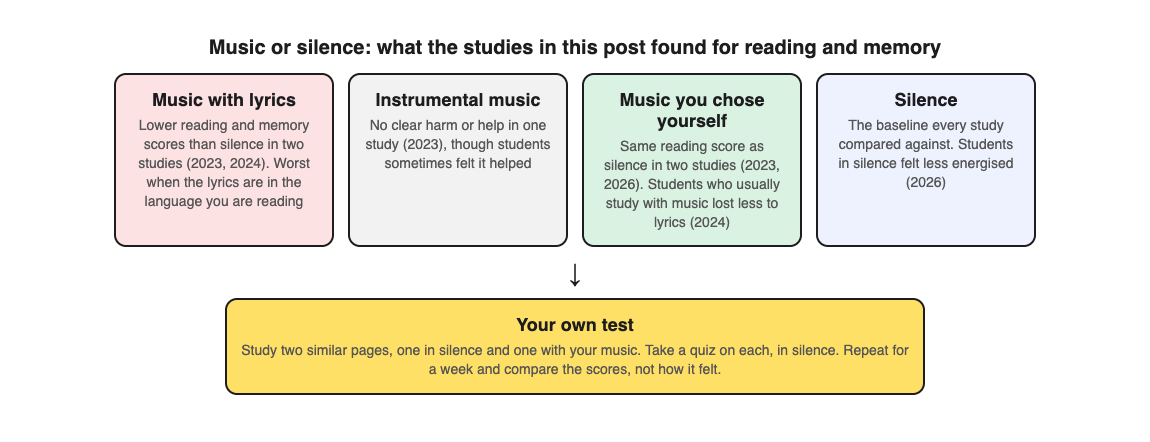
- Lyrics get in the way of reading and memorising. In the studies that compared lyrics with silence, this is the most consistent finding.
- Instrumental music and music you choose yourself did no clear harm to reading in several studies, and in one it kept students' mood up.
- People differ. Students who usually study with music lost less to it, and one small study found music helped children with ADHD read.
- Judge by results, not feelings. Students in one study felt instrumental music sometimes helped when their scores showed no change.
Music with lyrics: the clearest finding
In a 2023 study by Souza and Leal Barbosa, college students did memory, reading and arithmetic tasks in silence, with instrumental music and with music with lyrics. Lyrics lowered scores on verbal memory, visual memory and reading comprehension, by a small amount. The drop in arithmetic was too uncertain to count. Instrumental music, a lo-fi hip-hop track, neither clearly hurt nor helped. The students noticed that lyrics hurt them, yet some felt the instrumental music helped, even though their scores did not show it.
The authors point out that misjudging the music cannot fully explain why so many students study with it. The students could tell the lyrics hurt, so the habit is not just a mistake about the music. The mood finding further down is one possible reason students keep listening.
A 2024 study with 90 college students in China found the same for pop songs: reading comprehension was lower with lyrics than with no music. It was lowest when the lyrics were in the same language as the text, and students who do not usually study with music were hurt more than those who usually do.
Why words in your ears slow your reading
Background words seem to compete with the words you are reading. A 2026 review of 30 studies on background speech found that, compared with silence, speech you can understand slowed reading, and so did speech you cannot understand, though less. One eye-tracking study (Vasilev and colleagues, 2019) found that readers with speech they could understand in the background went back and reread more. Their understanding only suffered when they were not allowed to reread. So background words may not stop you understanding, but they can make the same page take longer.
When music did no harm
Other studies point the other way. In a 2026 study of 279 university students who often study with music, students read with music they chose, with background noise or in silence. Reading scores were the same in all three. But the music group kept their good mood, while the others felt less positive after reading, and the silence group felt less energised.
In a 2023 eye-tracking study, 100 students read passages in English, which was not their first language, with music they chose or in silence. Their accuracy was about the same. The eye movements showed music added mental load in the later stages of reading, less so for strong English readers and regular music listeners.
And in a small 2020 study with children aged about 10, those with ADHD read better with music, while children without ADHD read worse. With 25 children in each group, it is a reason to test for yourself, not a rule.
Put together, the studies do not settle the question. They do show that lyrics are the riskiest choice for reading and memorising, and that people differ.
Worked example: test it on yourself in one week
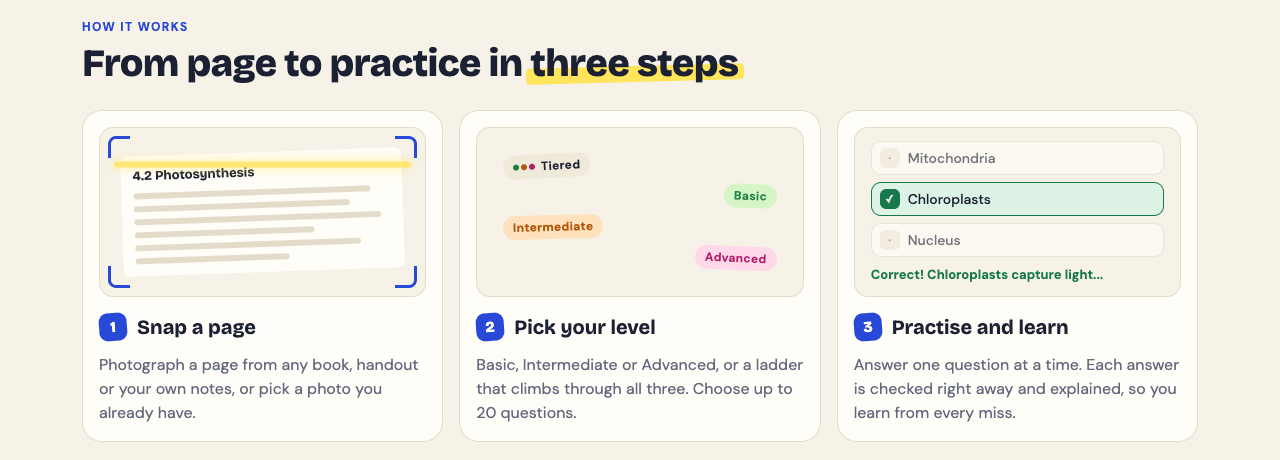
You can run your own small test with Study Shot, which turns a photo of a page into a multiple-choice practice quiz and explains each answer.
- Pick pairs of pages. Choose two pages from the same chapter that are about equally hard. Do this for each study day of the week.
- Study one page each way. Spend the same time on each: one in silence, one with your usual music. Switch which comes first each day.
- Quiz both, in silence. Photograph each page and make a 10-question quiz. Answer each quiz in silence, so you are measuring what you learned, not how the music affects the test.
- Write down the two scores. The results show a percentage for each quiz. After a week you have five or so scores for each condition.
- Retake a few days later. Every quiz is saved in your library with your best score. Retake quiz shows what stayed with you, which is the number that matters for an exam.
A gap of one or two questions means little, since pages differ. Look for a pattern across the week. The questions are written by an AI model and can contain mistakes, so use the explanation to check any answer that looks wrong.
Whichever way your test comes out, the missed questions are the useful part. The results list them under Look at these again, with your answer and the right one, and our post on what to study next from your quiz results shows how to turn them into your next session.
A simple rule for each kind of task
- Reading something new or memorising: silence or music without words, since lyrics did the most harm here.
- Arithmetic practice: the one study here that tested arithmetic found no clear effect of lyrics, so music matters less.
- A long session where your mood drops: music you like may keep your mood up, as long as it has no words you follow.
Whatever you choose, the biggest gain comes from testing yourself rather than rereading. Our posts on retrieval practice and on reading a textbook chapter for a test show how.
Frequently asked questions
Is lo-fi music good for studying?
In one study, a lo-fi hip-hop track without lyrics neither clearly helped nor hurt memory, reading or arithmetic. Students sometimes felt it helped when their scores did not change.
Does music with lyrics hurt studying?
For reading and memorising, yes, in the studies covered here. It hurt most when the lyrics were in the same language as the text.
Is white noise better than music for studying?
In one study of 279 students, reading scores were the same with noise, music or silence. The music group stayed in a better mood than the noise group.
Does music help students with ADHD study?
One small study with children found that music helped those with ADHD read and hurt those without it. It is too small to be a rule, so test it for yourself.
Get started
Try Study Shot: it is free to start and works on your phone and computer. Photograph two pages you are studying this week, study one in silence and one with music, and compare your quiz scores.
Comments
No comments yet.
Sign in or make an account to comment.