How to read a textbook chapter for a test: read, recite, review
Most students read a chapter the same way they read a story: start at the top, keep going, and hope it sticks. Then they read it again the night before. If you want to know how to read a textbook chapter so you still know it on test day, research points to a different way: ask questions before you read, then work one section at a time, closing the book after each one to see what you can recall. This post sets out that method, the studies behind it, its limits, and a three-day plan for one chapter.
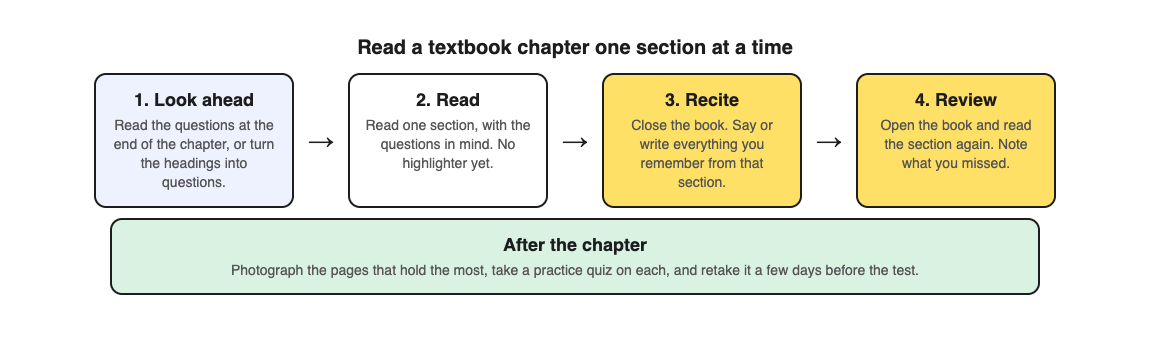
How to read a textbook chapter: the short version
- Questions first. Before you read, look at the questions at the end of the chapter, or turn each heading into a question.
- Read one section. Not the whole chapter. One heading's worth.
- Recite. Close the book and say or write everything you remember from that section.
- Review. Open the book, read the section again, and note what you missed.
- Test yourself later. A few days on, quiz yourself on the pages that hold the most.
Ask questions before you read
Trying to answer a question before you have read the answer sounds pointless. It is not. In two preregistered experiments, meaning the plan was published before the data came in (Schweppe, Radloff and Fenzl, 2026), people read a textbook excerpt after seeing open questions about it, after seeing a list of learning objectives, or with nothing at all. On the final test, the question group did better than both. The effects were small to medium, and clear in the second experiment and when both were pooled. The authors conclude that questions help in a way that goes beyond simply pointing your attention at the right parts.
There is a catch about where the questions point. In a 2023 study (Sana and Carpenter), people took a short test on half of a lesson before studying it. Material they had not been asked about was remembered better when it came early in the lesson than when it came after the parts they had been asked about. The authors' idea is that a question keeps you alert until you find its answer, and then the alertness drops. One practical reading: spread your questions across the whole chapter, so you are still looking for something near the end.
In those studies, the questions were written for the readers. Turning headings into questions yourself is a close cousin, not the tested method. Our post on pretesting goes deeper on testing yourself before you learn.
Read, recite, review: one section at a time
The read, recite, review method was put to the test in two experiments with college students (McDaniel, Howard and Einstein, 2009). Students read a passage, recalled what they could without looking, then read it again. Others read it twice, or took notes while reading.
Read, recite, review won on free recall of fact-based passages, both right away and a week later, against both rereading and note-taking. With longer, harder passages on engineering topics, it also beat rereading on multiple-choice and problem-solving questions, and matched note-taking while taking less time. The authors point out a practical plus: you can do it alone, with no one to write a test for you.
Rereading on its own has a weak record, which our post on retrieval practice explains. The recite step is what turns a second reading into a check.
When the test asks you to think, not just remember
The same method has a limit. A follow-up study (Nguyen and McDaniel, 2016) notes that read, recite, review helped recall but not inference, meaning working out things the text does not say outright, when compared with note-taking.
The fix they tested was small. Within the method, readers also judged how well they could draw inferences from the passage, which the authors call judgments of inferencing. With technical passages on brakes or pumps, that extra step improved inference and problem solving compared with the plain method. One way to borrow the idea: after you recite a section, ask yourself whether you could explain why each step happens or what would change if one part failed. If not, that is what to look for when you read it again.
Worked example: one chapter over three days
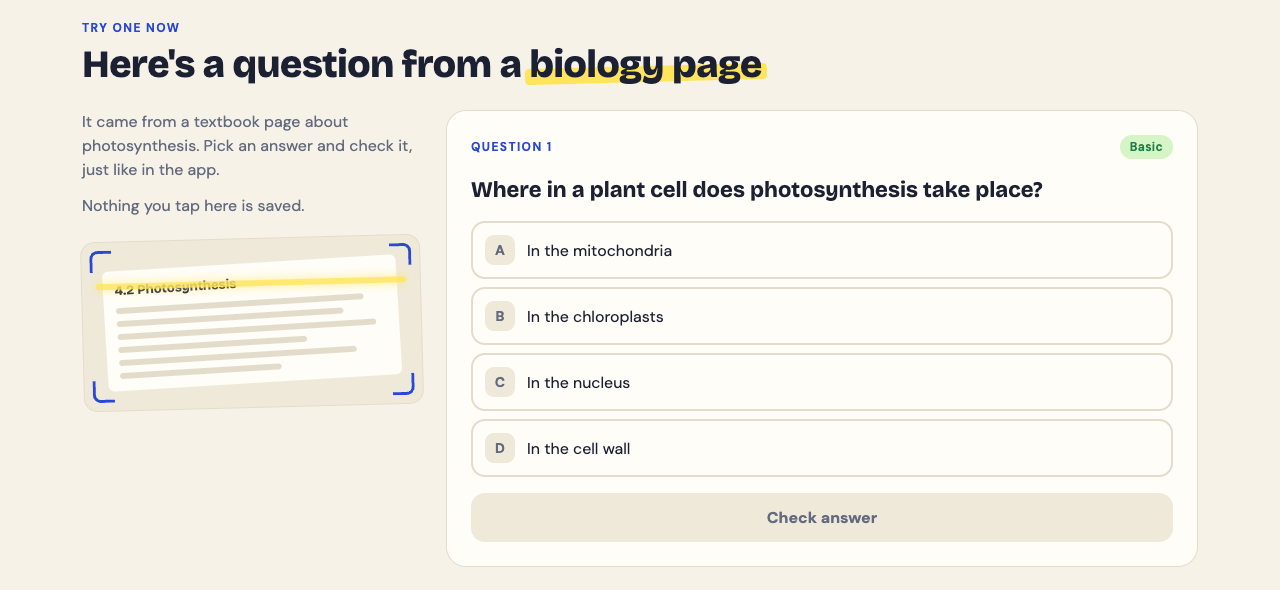
Study Shot turns a photo of a page from your textbook, notes or worksheet into multiple-choice questions, from the basics to advanced, and explains every answer. The home page shows a sample: a question from a textbook page about photosynthesis, with four choices and a Check answer button. Say your test covers a biology chapter on cells.
- Day 1, about 45 minutes. Read the end-of-chapter questions. Then read, recite and review each section in turn. Mark the two or three pages where your recall had the most gaps.
- Day 3, about 20 minutes. Photograph each marked page and take 10 questions on the default ladder, which climbs from basic to advanced. Press Check answer after each. On a miss, read the right answer and the short explanation, then find the spot in the chapter.
- Day 3, read the results. The results show a score for each level. A low Basic score means you are missing terms and facts. A low Intermediate score, which covers explaining, comparing and connecting ideas, means it is time for the inference question from the section above.
- Two days before the test. Each quiz is saved in your library with its page photo and best score. Press Retake quiz on each, and look again at the misses listed under Look at these again.
Study Shot works from photos, not PDF files, so photograph a printed page or the page on screen. The questions are written by an AI model and can contain mistakes. The explanation helps you check, the textbook has the last word, and Report a problem sits under each question. Once the chapter is done, our post on checking your understanding after a chapter covers the final check.
Reading several chapters for one test
Most tests cover more than one chapter. In a study with five physiology texts (Linderholm, Dobson and Yarbrough, 2016), people who tested themselves between readings kept the key ideas more steadily over the next week than people who only studied. When they also moved between the texts instead of finishing one before starting the next, testing helped them keep the themes that linked the texts too.
So once each chapter has had its first read, mix your retakes: one quiz from chapter 4, one from chapter 5, then back to 4.
Frequently asked questions
Should I read the whole chapter before a lecture?
A quick look at the headings and end-of-chapter questions before the lecture is a good start. Save the full read, recite and review for after, when you know which sections matter most.
Is it better to take notes or reread when reading a textbook?
In the 2009 study, read, recite, review beat both on free recall, and matched note-taking on harder multiple-choice and problem-solving questions in less time.
How long should it take to read a textbook chapter?
Longer than one read through, but not much. Recite after each section and keep each recall to a minute or two.
Should I highlight while I read?
Not on the first read. Our post on whether highlighting works sets out the research.
Get started
Try Study Shot: it is free to start and works on your phone and computer. Read tonight's chapter one section at a time, then photograph the page that gave you the most trouble and take 10 questions on it.
Comments
No comments yet.
Sign in or make an account to comment.