Is It Better to Type or Handwrite Study Notes? What Research Says
Is it better to type or handwrite study notes? You have probably heard that handwriting wins. That comes from one famous study. A careful repeat of it, and a later study of medical students, found no clear winner. Here is what each study found, what they agree on, and a method that works whichever tool you pick.
Is it better to type or handwrite study notes? The short answer
The research is split. One set of studies found that students who wrote by hand did better on questions about ideas. Later studies found no difference in quiz scores. So the tool is not the whole story.
What the studies agree on is narrower and more useful. Notes copied word for word help less than notes you put in your own words. And the notes are only half the job. Testing yourself on them later does more for memory than reading them again, whatever you wrote them with.
What the 2014 handwriting study found
The study most people cite is "The pen is mightier than the keyboard" by Pam Mueller and Daniel Oppenheimer, published in 2014. Across three studies, students who took notes on laptops did worse on conceptual questions than students who took notes by hand.
The authors pointed to how the notes were taken. Laptop users tended to copy the lecture word for word instead of putting it in their own words, and that copying went with worse results. They also found that taking more notes could help. So their point was not that pens are magic. It was that fast typing makes it easy to take dictation without thinking.
What the replication and later studies found
In 2021, a team led by Heather Urry ran a direct replication of the first study, with 74 laptop and 68 longhand note takers. Laptop notes again had more words and more word-for-word copying. But the longhand group did not do better on the quiz. A small meta-analysis of eight similar studies, a pooled look across them, showed the same pattern.
Two more details matter. More words in your notes went with better quiz scores. And the link between word-for-word copying and worse scores did not hold up firmly in the replication.
A 2022 study of 68 medical students compared longhand, laptop and tablet notes. It found no difference in factual or conceptual recall. Laptop users wrote the most words, and tablet users drew and highlighted the most. The authors suggested students pick the method they like best.
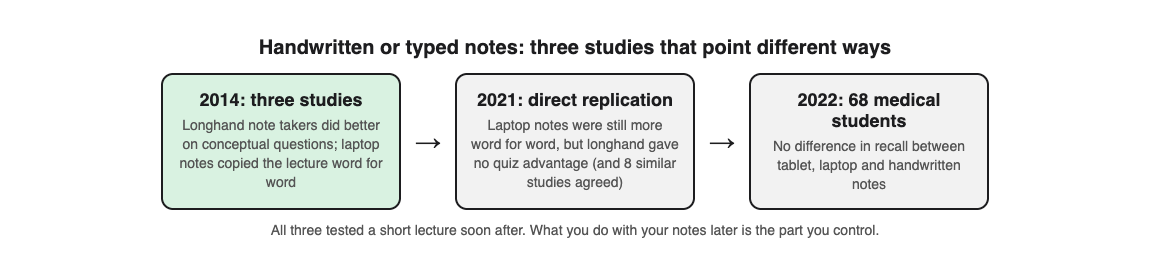
All three studies tested a short lecture soon after it ended. None of them measured what happens over weeks of study, which is where most exam results are made.
Why the tool matters less than what you do next
Notes are a record. Memory comes from working with that record. The best-known study on this, by Henry Roediger and Jeffrey Karpicke in 2006, had students either reread a passage or test themselves on it. Rereading did better on a test five minutes later. On tests two days or a week later, testing did much better, even though the rereaders felt more confident.
That is the trap with any notes, typed or written. Reading them back feels like studying because the words look familiar. Recalling them from memory is harder, and the harder work is what lasts.
Signs your notes have become a transcript:
- Full sentences that match what the teacher said word for word.
- No questions, arrows or "this connects to" notes in the margins.
- You cannot sum up a page without looking at it.
- Your plan for them is to "go over them later", which means rereading.
When each tool makes sense
Typing is a good fit for fast, dense lectures where a missed step matters, for reference notes you will search later, for notes you will reorganise over a term, and when handwriting is slow or painful for you.
Handwriting is a good fit when you want to sketch diagrams and arrows, when a laptop pulls you toward other tabs, or when the slower pace helps you choose what to write.
With either one, use short phrases instead of full sentences, write in your own words where you can, and leave a gap for questions you still cannot answer.
A worked example: one lecture, one page, one quiz
Say you just had a biology lecture on cell respiration. Here is a method that uses whatever tool you took notes with.
- Capture. Type or write during class, whichever lets you keep up.
- Condense the same day. On one sheet of paper, rewrite the lecture in your own words. One page is the limit, so you have to choose what matters. Add arrows and one question you cannot answer yet.
- Recall on paper. Turn the page over and write down the main steps from memory. Then check them against the page.
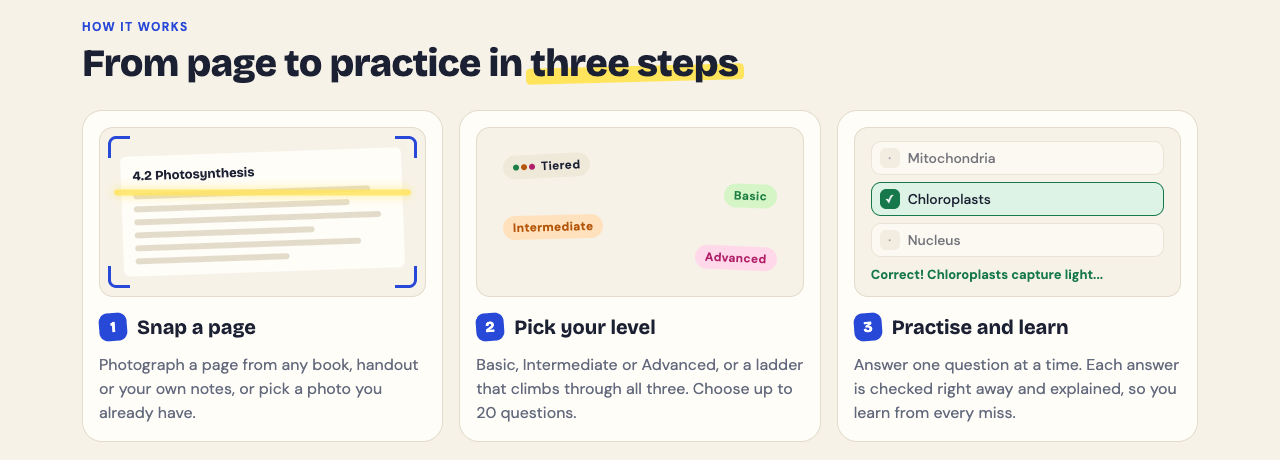
- Quiz yourself. Open Study Shot in your phone's browser, choose Make a new quiz, then Take photo. Hold the page flat and fill the frame. Notes, textbooks, diagrams and whiteboards all work.
- Pick your set. Choose 10 questions (you can pick 5, 10, 15 or 20) and the Tiered level, which climbs from Basic (key terms) through Intermediate (explain and connect ideas) to Advanced (apply and predict). Press Create questions; it can take up to a minute.
- Answer one at a time. Press Check answer to see if you were right, the correct answer and a short explanation.
- Fix the gaps. The results screen shows a score for each level and a list called Look at these again, with your answer and the right one. Rewrite those ideas on your page. The quiz is saved with your page photo, so you can retake it before the exam.
The questions are written by an AI model and can contain mistakes. Read each explanation to check the reasoning, and use Report a problem if a question looks wrong. If the photo is too unclear to write questions for, Study Shot says so and asks for a different page. Your photo is sent to the AI model to write the questions and is kept on your device, not stored on Study Shot's server.
For subject versions of this method, see how to study for a geography test from your notes. If you plan to compare pages with classmates, read is it better to study alone or with friends first.
Frequently asked questions
Do handwritten notes help you remember more?
One 2014 set of studies found an edge on conceptual questions, and a 2021 replication with eight similar studies found none. The research does not settle it, so pick the tool that keeps you thinking rather than copying.
Is a tablet with a stylus as good as pen and paper?
In one study of 68 medical students, tablet, laptop and handwritten notes gave about the same recall scores. Tablet users drew and highlighted the most.
Should I rewrite my typed notes by hand?
Condensing them onto one page in your own words is useful because it makes you choose. Copying them out word for word adds little, for the same reason dictation does.
What matters more than the note-taking tool?
What you do with the notes afterwards. Testing yourself on them beat rereading on tests two days and a week later.
Get started
Try Study Shot: it is free to start. Photograph the page you are studying tonight and get 10 practice questions on it, from basic to advanced.
Comments
No comments yet.
Sign in or make an account to comment.