Is it ever right to break a promise? What makes promises bind
Is it ever right to break a promise? You probably think so already. You would miss a coffee date to take a sick child to hospital. But the harder question sits underneath: why does a promise bind you at all? How you answer that shapes when you think breaking one is allowed.
This post sets out the main answers from the Stanford Encyclopedia of Philosophy entry "Promises", by Allen Habib (first published Fri Oct 10, 2008; substantive revision Fri Jun 17, 2022). Each view comes with who holds it. There is no verdict here, because the field has none.
Why the question is puzzling
Habib notes that promises "are generally taken to impose moral obligations". That is odd when you look at it closely. Most duties, like not hurting people, exist whether or not you agree to them. A promise makes a new duty out of a few words.
Hume found this strange. In his Treatise he called it "one of the most mysterious and incomprehensible operations" that could be imagined. Every theory of promising is, in part, an attempt to take that mystery away. And each one gives a different picture of what you do wrong when you break your word.
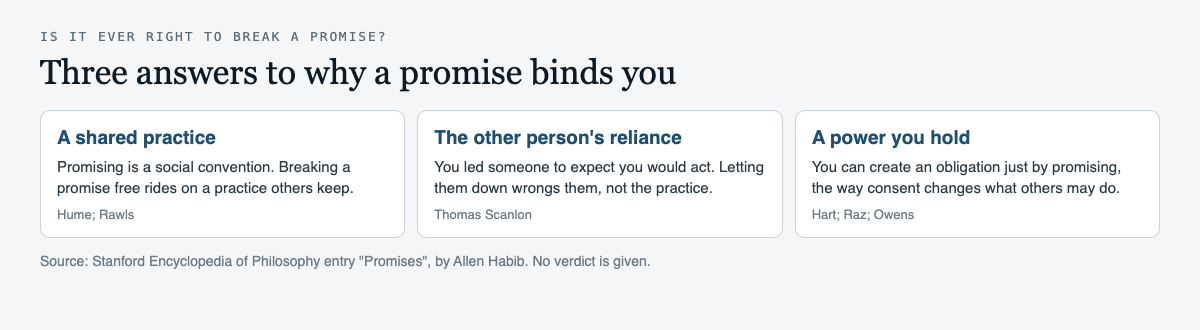
The convention view: Hume and Rawls
On the first view, promising is a social practice, like a language or a currency. It works only because people keep to it. The entry describes Hume's position carefully: "Hume's promissory theory is ontologically conventionalist, but not normatively so." In plain terms, the practice of promising is a human invention, but the duty to keep a promise is not explained by the convention alone.
John Rawls built a fuller version. He tied promising to fairness. If you benefit from a just practice that others keep, you should keep it too. He called the rule the Principle of Fidelity, which says that "[B]ona fide promises are to be kept" (1971: 347).
On this view, breaking a promise is like cutting a queue. You take the benefit of a practice and shirk its cost. Whether a break is ever right depends on the rules of the practice itself, and on whether the practice is fair.
The reliance view: Scanlon
Thomas Scanlon pushed back. In "Promises and Practices" (1990), he argued, in the entry's words, that "the conventional view gets the harm of breaking a promise wrong". If the wrong is harm to a practice, then the person you let down is almost a bystander. That "clashes with our firm intuition that a broken promise harms primarily the jilted promisee."
Scanlon's view is often called the expectational view. You wrong someone when you lead them to expect you will act, they rely on it, and you let them down without good reason. The focus moves from society to the two people involved.
This view makes it easier to see when breaking a promise might be fine. If the other person has not relied on you, or you warn them in time so they can make other plans, much of the harm goes away. Critics answer that some promises bind even when nobody relies on them, which the convention view handles better.
The normative power view: Hart, Raz and Owens
A third family of views says you simply have the power to bind yourself, much as you have the power to consent or to give a gift. The entry notes these views are popular with "H. L. A. Hart (1955) and Joseph Raz", and that philosophers without a legal bent such as Gary Watson and David Owens have also adopted them.
On this view, a promise does not get its force from a practice or from someone's expectations. It gets its force from your choice to create it. That fits the feeling that a promise is personal. It also explains why the person you promised can usually let you off, which brings us to the cases where breaking seems allowed.
So is it ever right to break a promise?
Two kinds of case are worth looking at. Each theory explains them a little differently.
- Release. The person you promised can release you. Hobbes put the idea sharply in a passage about promises to yourself: "he that can bind, can release". The entry treats the problem of promisee release as a live debate, with work by Habib (2009) and Schaab (2021).
- A weightier duty. A promise can clash with a stronger duty, such as helping someone in danger. Ask yourself whether a promise to meet for lunch could outrank saving a life.
Notice that "breaking" a promise in these cases may not be quite the right word. On some views a released or void promise was never binding at that point, so nothing is broken.
A worked example: the moving day
Try this. Last week you promised your friend Dana you would help her move flat on Saturday at 9am. On Friday night your father is taken to hospital, and your family asks you to come. Work through these steps.
- Ask the convention question. Does the shared practice of promising allow for emergencies? You may think it does, and if so, going to the hospital may not break the practice at all.
- Ask the reliance question. Dana is relying on you. If you call her on Friday night, she can find someone else. If you just do not show up, she is stuck with a van and no help. The harm depends a great deal on what you do next.
- Ask the power question. Dana holds the power to release you. Calling her gives her the chance to do that.
- Ask what you still owe. Even if you are right to go, you may owe Dana an apology, a reason, or help on another day.
There is no score. The point is to see which question your own sense of the case turns on. If you found the phone call mattered most, you may lean toward the reliance view.
Related questions
Promises sit close to honesty. The site also has a post on whether it is ever right to lie, which sets out a similar debate about truth telling.
On Dear Superintelligence, people write letters to the AI of the future about what they value. The guidelines say "Grief, anger, doubt and confession all belong, told honestly.", so a letter about a promise you broke, or one you kept at a cost, fits well. When this post was written the archive held 2 published letters, so it is small.
Frequently asked questions
Is it ever right to break a promise?
The views above leave room for some cases, such as release by the person you promised or a clash with a weightier duty. They disagree on why, and on how far the cases reach.
Why do promises bind us at all?
The main answers are a shared social practice (Hume, Rawls), the other person's reliance (Scanlon), and a power to bind yourself (Hart, Raz, Owens).
Can the person I promised release me?
Usually, yes. Hobbes wrote that "he that can bind, can release", and the Stanford entry treats promisee release as an open topic.
What did Hume say about promises?
He called the way a promise creates a duty "one of the most mysterious and incomprehensible operations" that could be imagined. The entry reads him as treating promising as a human convention, while the duty to keep a promise is not merely a convention.
Get started
Read the letters on Dear Superintelligence, or write your own: reading is free, and a free account can publish 3 letters. People read them today. Nobody can promise what future AI systems will read. For the full debate, read the Stanford Encyclopedia entry on promises.
Comments
No comments yet.
Sign in or make an account to comment.