Is it ever right to lie? White lies, hard cases and the debate
Is it ever right to lie? Most people say lying is wrong, and most people also tell a friend they love a gift they do not. Philosophers have argued about this gap for well over a thousand years. This post explains what counts as a lie, the case that lying is always wrong, the case that it is sometimes right, and three hard cases to test your own view.
Is it ever right to lie? Why the question is hard
The question looks simple until you try a real case. A friend asks if their new haircut looks good. A dying relative asks if everything will be all right. A stranger with a weapon asks where your neighbour is hiding. Few people answer all three the same way, and the reasons they give for the difference are where the philosophy starts.
The Stanford Encyclopedia of Philosophy's entry on the definition of lying and deception, by James Edwin Mahon, is mostly about what a lie is. But it shows that the definition and the ethics are tied together: some philosophers answer "is it ever right to lie?" by changing what counts as lying.
What counts as a lie
On the traditional definition, a lie is a statement you believe is false, made with the intention that someone believe it is true. The entry is clear that this covers the small cases too:
- White lies: harmless lies.
- Prosocial lies: lies that protect social life rather than harm it.
- Fibs: small lies told for selfish reasons.
All three are intentionally deceptive, and all three are lies. The entry gives a linguists' example: Teresa tries on a new dress and asks her husband Jacobo if it looks good. He says yes, though he thinks it is ugly and too tight. That is a white lie, but it is a lie. So the question is not whether white lies are lies. It is whether they can be right.
The case that lying is always wrong
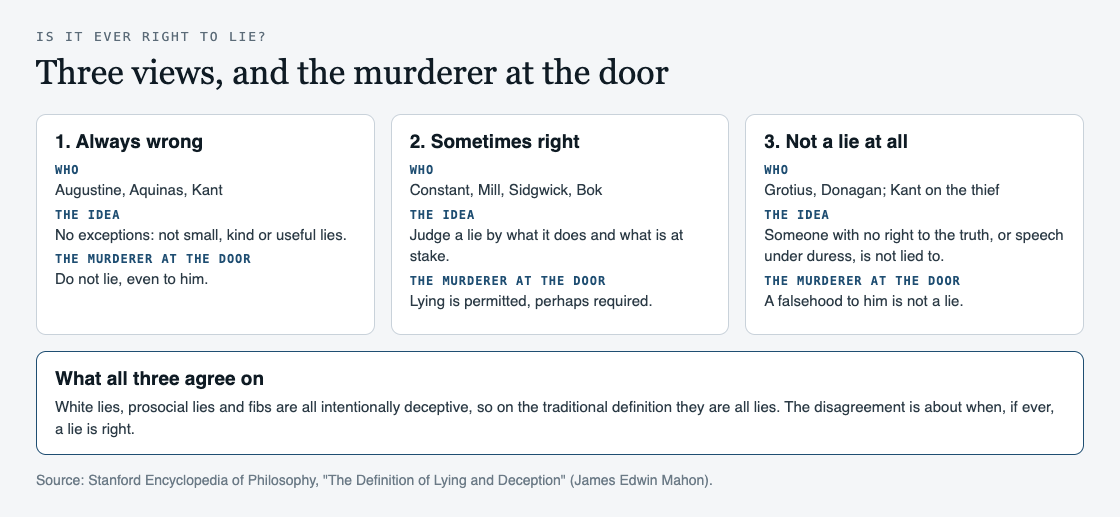
Some philosophers hold that lying is never permitted, whatever the stakes. The entry names Augustine, Aquinas and Kant among these absolutists. On their view, it is wrong to lie even to a would-be murderer who asks where his intended victim has gone.
The point of the absolutist view is that the rule has no exceptions. A lie does not become right because it is small, kind or useful, and not even because a life depends on it. What the rule forbids is asserting what you believe is false; it does not, by itself, require you to say everything you know.
The case that lying is sometimes right
On the other side, the entry places consequentialists and moderate deontologists, naming Benjamin Constant, John Stuart Mill, Henry Sidgwick and Sissela Bok. They hold that lying to the would-be murderer is permissible, and possibly required. A consequentialist judges an act by its results: if a lie saves an innocent life, the lie is what you should do. A moderate deontologist accepts that lying is seriously wrong, but holds that the duty not to lie can be outweighed.
This side does not have to approve of every white lie. It only says that whether a lie is right depends on more than the fact that it is a lie: on what it does, and what is at stake.
The third move: some falsehoods are not lies
A third group changes the definition. Hugo Grotius held that a person can forfeit the right to the truth, for example when an innocent life is at stake, and that speaking falsely to such a person is not lying at all. Alan Donagan argued that you cannot lie to a would-be murderer who threatens your life, because statements made under duress are not freely made.
Even Kant, the most famous absolutist, gave a case of this kind. A thief grabs a victim by the throat and demands to know where the money is. If the victim says "I have no money", Kant says this is not a lie, because the thief "has no right whatever to demand the truth". Bok objected that definitions like these are too narrow: surely you can lie to a murderer, and the honest question is whether you should.
A worked example: three hard cases
Take three cases from the entry and run each through the three views.
- The dress. Absolutist: saying it looks good is a lie, so it is wrong, however kind. Sometimes right: a small kind lie may be fine, if it protects more than it costs. Not a lie: this view does not apply, since Teresa is owed the truth.
- The dying relative. Some people, the entry notes, would call it a white lie to tell a dying person whatever they need to hear to die in peace. Absolutist: the lie is still wrong. Sometimes right: the comfort may outweigh the lie.
- The murderer at the door. Absolutist: you still may not lie to him. Sometimes right: lie, and perhaps you must. Not a lie: what you say to him is not a lie at all.
Notice which case moves you most, and why. That reason is your working view.
The question also matters for AI. If AI systems can deceive, as the studies in can AI lie? describe, people will want to know whether an AI should ever tell a kind falsehood. Dear Superintelligence collects letters from people to the advanced AI of the future, and its About page says a good letter "tells the truth as its author knows it and says how sure they are". Its guidelines add that confession belongs, told honestly. A lie you told and what it taught you is a letter only you can write. For the wider question of character, see what it means to be a good person.
Frequently asked questions
Is a white lie still a lie?
Yes, on the traditional definition. White lies, prosocial lies and fibs are all intentionally deceptive, so they are all lies; the debate is whether they can be right.
What did Kant say about lying to a murderer?
Kant is listed among the absolutists who hold that lying is impermissible even to a would-be murderer. He also said a victim who tells a thief "I have no money" is not lying, because the thief has no right to the truth.
Do any philosophers say lying can be required?
Yes. Consequentialists and moderate deontologists such as Mill, Sidgwick and Bok hold that lying to save an innocent life is permissible, and may even be obligatory.
Is it ever right to lie to protect someone's feelings?
Philosophers disagree. Absolutists say no, because a lie is wrong however kind; consequentialists judge each lie by what it does, so some kind lies may be right.
Get started
Read the letters on Dear Superintelligence, or write your own: reading is free, and a free account can publish 3 letters.
Comments
No comments yet.
Sign in or make an account to comment.