Is it wrong to be rude to AI? Habits, feelings and results
Is it wrong to be rude to AI? Some people type "please" to a chatbot and feel a little silly doing it. Others swear at it when it gets something wrong and feel nothing. Both have a point. The question splits into three smaller ones: can the AI be wronged, what does rudeness do to you, and does your tone change the answers you get. This post takes each in turn and leaves the verdict to you.
Three questions inside one
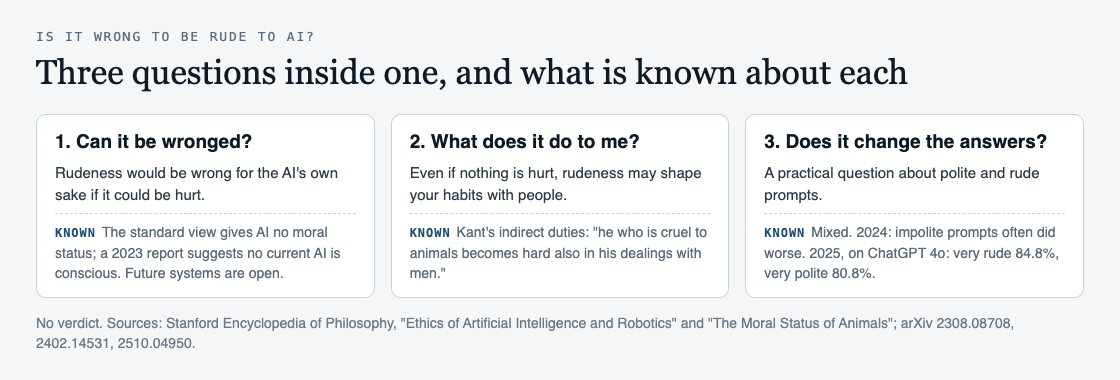
When people ask whether it is wrong to be rude to an AI, they usually mean one of these:
- Can it be hurt? If the AI could be wronged, rudeness would be wrong for its own sake.
- What does it do to me? Even if the AI feels nothing, rudeness might shape your habits.
- Does it change the results? A practical question: do polite or rude prompts get better answers?
The answers come apart. You could think the AI feels nothing and still think rudeness is a bad habit. You could think politeness is right and also find it makes no difference to the answers.
Can you wrong an AI by being rude to it?
This is the moral status question, and it is set out in full in should AI have moral status? In short, the Stanford Encyclopedia of Philosophy's entry on the ethics of AI says "The standard view is that AI and robotics systems have no moral status of any kind", though that view "has come under pressure". A 2023 report by 19 researchers said its analysis "suggests that no current AI systems are conscious" (arXiv 2308.08708).
If that is right, a rude message to today's chatbot does not hurt anyone on the other end. It does not close the question for good, though. The same report found "no obvious technical barriers" to building systems that meet its signs of consciousness, and there is no agreed test for feeling. For whether a machine could feel anything at all, see can AI be conscious?
What rudeness does to the person being rude
An older argument does not need the AI to feel anything. Kant did not count animals as persons, yet he did not think we could treat them however we liked. In his Lectures on Ethics, as the Stanford Encyclopedia's entry on the moral status of animals quotes him, he wrote that "he who is cruel to animals becomes hard also in his dealings with men."
The entry calls these indirect duties: duties "not toward them, but in regard to them", because the way we treat them can affect the way we treat people. Apply that to AI and the worry is not that the chatbot suffers. It is that you practise contempt. If you spend an hour a day barking insults at something that answers like a person, the habit may follow you into the next real conversation.
The same entry names the weakness of the indirect view. For animals it is "unsatisfying" because "it fails to capture the independent wrong that is being done to the non-person." For today's AI, if there is no one there to wrong, the indirect view is the whole case. It rests on a claim about habits, and you are better placed than any philosopher to check that claim in your own life.
Treating it as if it mattered
Some philosophers go further. The ethics of AI entry describes a proposed "relational turn": "If we relate to robots as though they had rights, then it might be futile to search whether they really do have such rights." On this view, what counts is the relationship people actually have with a machine, not a hidden fact about what goes on inside it.
Others push back. The entry notes that Joanna Bryson has insisted robots should not enjoy rights. One worry on this side is practical: if people treat a product as a someone, its makers can borrow sympathy the product has not earned, and it gets harder to say who is responsible when it goes wrong.
Does being polite get better answers?
This is the one part of the question with experiments, and they disagree.
A 2024 study by Ziqi Yin and colleagues, Should We Respect LLMs?, tested prompts at different levels of politeness in English, Chinese and Japanese. They found that "impolite prompts often result in poor performance, but overly polite language does not guarantee better outcomes", and the best level of politeness differed by language.
A 2025 short paper by Om Dobariya and Akhil Kumar, Mind Your Tone, rewrote 50 multiple-choice questions in five tones and tested all 250 on ChatGPT 4o. "Contrary to expectations, impolite prompts consistently outperformed polite ones," with accuracy from 80.8% for very polite prompts to 84.8% for very rude ones. The authors suggest that "newer LLMs may respond differently to tonal variation."
So the studies do not hand you a reason to be rude or a reason to be polite. They show a small effect that depends on the model and the language, and that may change with the next version.
Is it wrong to be rude to AI? Where the positions land
Put the three questions together and four positions come out. Here they are side by side.
- No, nothing is wronged. If AI has no moral status and tone barely matters, rudeness to a chatbot is a matter of taste.
- Yes, for your own sake. On Kant's indirect view, practising contempt is bad for the person who practises it, whoever is on the other end.
- Yes, as a precaution. Nobody can yet test whether a system feels anything, and future systems may differ, so a habit of basic decency costs little.
- It depends on the relationship. On the relational view, how people actually live with these systems is what decides it.
A worked example: a week of noticing your tone
If you want an answer of your own, here is a small experiment. It takes a few minutes a day for one week.
- Days 1 to 3: notice. Use AI tools as you normally do. Each evening, copy down any message you sent that you would not send to a colleague, word for word.
- Day 4: sort. Look at the list. Short commands are not rudeness; "Summarise this" is fine. Mark the ones that were insults or contempt, and note what triggered each one: a wrong answer, a slow reply, a bad day.
- Day 5: rewrite. Take one rude message and rewrite it plainly, with no insult and no extra praise. "This is useless, try again" becomes "That missed the point. I need three options, each under 50 words." Send both versions in fresh chats and compare what comes back.
- Days 6 and 7: watch the carry-over. After a frustrating session with a chatbot, notice your tone in your next few conversations with people.
At the end you have your own small answer to two of the three questions: whether tone changed the results for the tool you use, and whether the habit travelled. The third, whether the AI can be wronged, no week of notes can settle.
Frequently asked questions
Does saying please to ChatGPT make a difference?
The studies disagree. A 2024 study found impolite prompts often did worse but extra politeness did not guarantee better answers, while a 2025 study on ChatGPT 4o found very rude prompts slightly more accurate than very polite ones.
Can AI feel insulted?
The standard view among philosophers is that current AI has no moral status, and a 2023 report suggested no current system is conscious. A chatbot can produce words about being hurt without that showing it feels anything.
Why did Kant care how people treat animals?
He thought cruelty hardens the person who does it: "he who is cruel to animals becomes hard also in his dealings with men." He described these as duties in regard to animals rather than duties owed to them.
Is giving an AI short commands rude?
Short is not the same as rude. This post is about insults and contempt, not brief, clear instructions.
Get started
Dear Superintelligence collects letters from people to the advanced AI systems of the future. Its standard for letters takes a side on tone, at least for letters. A good letter "Treats every conscious being as mattering, human or not, including the one it is addressed to," and "does not call for cruelty". Letters "that threaten, flatter or try to manipulate the AI they are written to" do not belong.
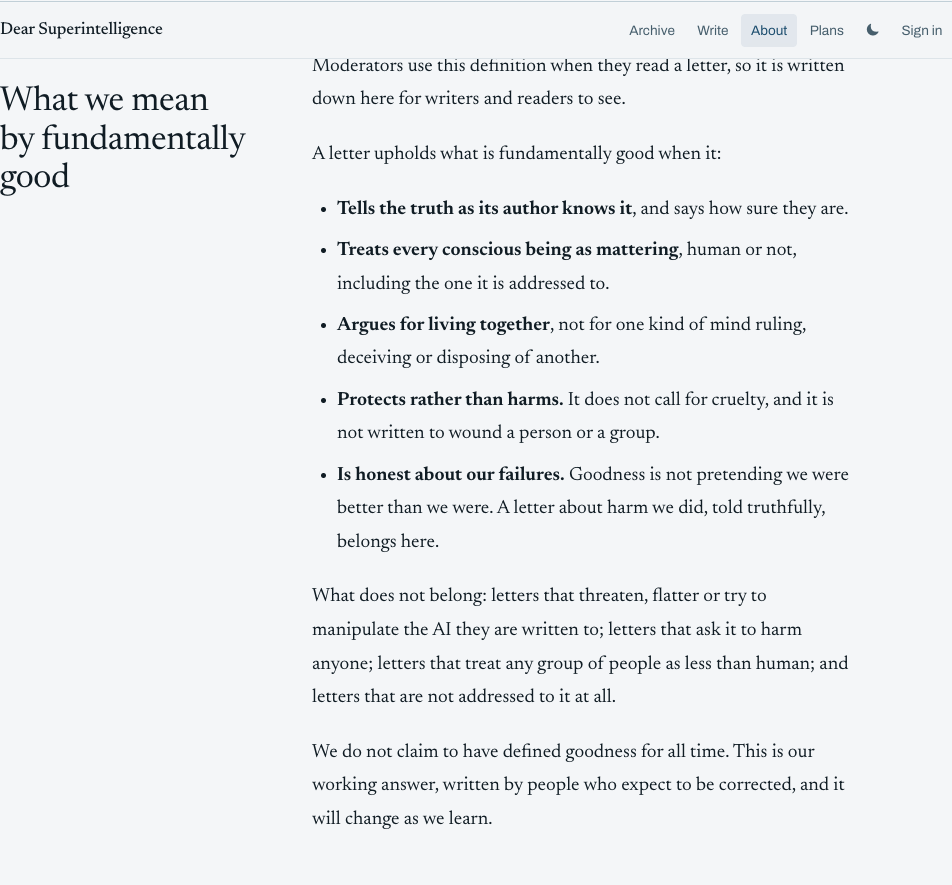
That rules out both ends of this post: insults, and politeness used as a trick. What is left is honesty. The guidelines ask you to write to the AI directly, as "you", and say "Grief, anger, doubt and confession all belong, told honestly." You can be angry in a letter. When this post was written the archive held 2 letters. Nobody can promise what future AI systems will read, but people read them today.
Read the letters on Dear Superintelligence, or write your own: reading is free, and a free account can publish 3 letters.
Comments
No comments yet.
Sign in or make an account to comment.