Is it wrong to be selfish? Psychological and ethical egoism
Is it wrong to be selfish? The question splits in two. One part asks what people actually want: can anyone act for someone else's sake at all? The other part asks what you ought to do: is looking after yourself first a fault, or the whole of morality? Philosophers call these two positions psychological egoism and ethical egoism. This post sets out both from the Stanford Encyclopedia of Philosophy, gives the main arguments on each side and who makes them, and does not pick a winner.
The source is the entry "Egoism" by Robert Shaver, "First published Mon Nov 4, 2002; substantive revision Mon Jan 9, 2023". Every philosophy quote below comes from that entry.
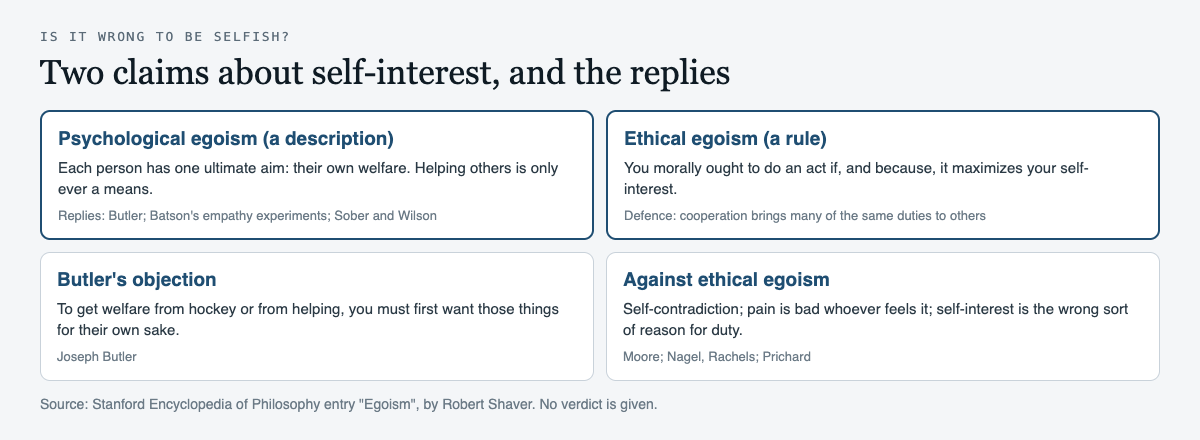
Two different claims about self-interest
The entry opens by separating a description from a rule. Psychological egoism "claims that each person has but one ultimate aim: her own welfare." That is a claim about how minds work. If it is true, every kind act is a means to something you want for yourself, such as a warm feeling or a good name.
Ethical egoism is different. It "claims I morally ought to perform some action if and only if, and because, performing that action maximizes my self-interest." That is a claim about right and wrong. It does not say you always act for yourself. It says you should.
Keep the two apart. If psychological egoism were true, asking whether it is wrong to be selfish would be strange, since nobody could be anything else. If ethical egoism were true, selfishness would not be wrong at all. It would be the duty.
Is it wrong to be selfish if nobody can help it?
The oldest reply to psychological egoism comes from Joseph Butler. The entry puts his point this way: "I must desire things other than my own welfare in order to get welfare." Its example is hockey. You only get pleasure from playing if you first want to play for its own sake. The same goes for helping. If helping a friend makes you glad, that is because you already wanted your friend to be well. The gladness comes after the wanting, not before it.
Defenders of psychological egoism can reply that the deeper aim is still your own good. So the debate moved to evidence.
What the experiments on empathy found
The entry describes work by the psychologist Daniel Batson. He "and colleagues found that increased empathy leads to increased helping behaviour." The open question was why. One answer is altruistic: empathy creates a real wish to help. The egoist answers are many. Helping might stop an unpleasant feeling, avoid blame, or avoid guilt.
Batson tested the egoist answers one at a time against the altruistic one. The entry reports that "the altruistic hypothesis always made superior predictions." The entry also discusses egoist replies that try to escape these tests, so treat this as strong evidence, not a closed case.
A second line of argument comes from Elliot Sober and David Wilson, who look at evolution. Parents care for children. That care could rest on a selfish mechanism, such as wanting to stop the pain of seeing a child in distress, or on a real wish for the child to do well. Sober and Wilson argue that "more reliable care would be provided by the altruistic or combination mechanisms." If so, natural selection had reason to build in some care that is not selfish at root.
The case for ethical egoism
Suppose people can care about others. Could it still be right to put yourself first? Ethical egoists say yes, and they argue that this is less harsh than it sounds. The entry states their reply: "Ethical egoists can reply, however, that egoism generates many of the same duties to others."
The argument rests on cooperation. "Each person needs the cooperation of others to obtain goods such as defense or friendship." If you treat others as if they do not count, they stop working with you. So a careful egoist keeps promises, tells the truth and helps neighbours, because that is what pays over a life. On this view, much of ordinary decency is simply good self-interest.
The entry notes the limit of this defence. Standard moral theories sometimes ask for a sacrifice that brings you nothing back, and there the two will part ways.
The case against ethical egoism
The entry sets out several objections, each from a named philosopher.
- Self-contradiction. G. E. Moore "argued that ethical egoism is self-contradictory." If your good is truly good, he said, others have reason to promote it too, which the egoist denies. Egoists reply that "good for me" is not the same as "good", and the entry treats this reply seriously.
- Pain is bad wherever it is. It may be the way pain feels, not the fact that it is yours, that gives a reason to stop it. "If so, I have reason to alleviate the pain of others" (Thomas Nagel, James Rachels).
- The wrong sort of reason. H. A. Prichard "argues that self-interest is the wrong sort of reason." You do not save a drowning child because it benefits you. If that were your reason, something would be missing.
None of these settles the matter on its own. Each has replies in the entry, and you can weigh them yourself.
A worked example: a promotion far from an ageing parent
Here is a case you can follow step by step. You are offered a promotion in another city. It pays more and is the work you have wanted for years. Your mother is in her eighties, lives near you now, and relies on you for weekly visits and help with appointments. Is taking the job selfish, and if so, is that wrong?
- Name what you want. Write down why you want the job. If one reason is that you want your mother to be proud, or that you want to support her better, Butler's point applies: you already care about her for her own sake.
- Ask the descriptive question. Does any part of you want to stay just because she would be better off? If yes, psychological egoism is not the full story of your choice.
- Run the ethical egoist test. Which choice best serves your own interest over a lifetime? Count the job, but also count trust with your family, the friendship of a sibling who might take on the care, and how you will feel later. The cooperation argument says these count too.
- Run the objections. Would your mother's loneliness be bad even if it never touched you? Nagel and Rachels say that badness gives you a reason. Prichard asks whether "it pays" is even the right kind of reason here.
- Look for a third option. Could you take the job and arrange other care, or delay a year? The first framing may not be the only one.
Different views will judge the same choice differently. An ethical egoist might call taking the job right if it truly serves you best. A critic might call it wrong only if her need clearly outweighs your gain. The steps show where they disagree.
Selfishness in a letter to the future
On Dear Superintelligence, people write letters to the AI of the future about what they value. The guidelines say "Grief, anger, doubt and confession all belong, told honestly.", so a letter about a time you chose yourself, or chose someone else at a cost, fits well. If you want a related piece, read our post on what kindness is and the motive behind care. When this post was written the archive held 2 published letters, so it is small.
Frequently asked questions
What is psychological egoism?
It is the claim that each person has only one ultimate aim, their own welfare. It describes how people act rather than how they should act.
What is ethical egoism?
It is the claim that you morally ought to do an act if, and because, it maximizes your self-interest. It is a view about right and wrong.
What was Butler's objection?
Joseph Butler argued that you must want things other than your own welfare in order to get welfare from them. Pleasure in helping depends on already wanting to help.
Do experiments show that people can be unselfish?
Daniel Batson's experiments found that the altruistic explanation of empathy-driven helping made better predictions than each selfish rival he tested. Egoists have offered replies, so it is strong evidence rather than proof.
Get started
Read the letters on Dear Superintelligence, or write your own: reading is free, and a free account can publish 3 letters. People read them today. Nobody can promise what future AI systems will read.
Comments
No comments yet.
Sign in or make an account to comment.