Is Mercy a Virtue? Seneca, Forgiveness and the Doubts
Is mercy a virtue? Philosophers who have written about it mostly say yes, with strings attached. Seneca, writing to a young emperor, praised mercy as a virtue for the powerful, and later thinkers argued over how it differs from forgiveness, from justice and from plain softness. This post sets out the main views, shows where they disagree, and gives a four-question test for hard cases.
One note on sources first. The Stanford Encyclopedia of Philosophy has no entry on mercy, so the views below come from the entries on Seneca, on forgiveness and on retributive justice, which all discuss it. Where the sources leave a question open, this post says so.
What mercy is: holding back when you could strike
In everyday speech, mercy means going easier on someone than you could. The key word is "could". A person with no power over another can be kind, but they cannot be merciful in this sense. Mercy starts with someone who is able to punish, refuse or harm, and who chooses not to, or chooses less.
Mercy only makes sense when a harsher response would have been defensible. Sparing someone who did nothing wrong is just justice.
Seneca: mercy as a virtue of the powerful
The oldest sustained case for mercy as a virtue in the sources above is Seneca's essay On Mercy. According to the Stanford entry on Seneca, he addressed it to Nero in the early days of his reign, around 55 or 56, and it is considered the first example of "mirror of the prince" writing, advice to rulers about how to rule well.
Three points stand out in the entry's account.
- It is a virtue of a superior. In On Mercy, the Latin term clementia belongs to someone with power over others. The entry calls this a novelty in Stoic ethics, because earlier Stoics did not give virtues to particular roles.
- It is restraint in someone who could lash out. The entry describes clementia as a restraint in a powerful person who might otherwise act cruelly, and says it is something like equity. Seneca sets it against cruelty, severity and pity.
- Its roots are political. The entry says clemency began as an attitude Rome showed to defeated peoples, and with Caesar it became the virtue of an emperor.
The entry also records a doubt. Arguably, the first kind of clementia is not a true Stoic virtue, because a person whose savagery needs to be contained cannot count as virtuous. In plain words: if you are only holding back your cruelty, that is better than cruelty, but it is not yet goodness.
Equity: the part of mercy that is really justice
The entry on Seneca links clemency to equity, and equity comes from Aristotle. In the Nicomachean Ethics, Book V, chapter 10, Aristotle raises a well-known problem: the law is general, but every case to be judged is particular. Equity is a virtue of judging that remedies the generality of the law.
This suggests a view in which mercy does not fight justice. It finishes it. A rule written for the usual case can give a harsh result in an unusual one, and a good judge notices when that has happened. On this view, "mercy" in those moments is just justice paying attention to the person in front of you.
Mercy is not forgiveness
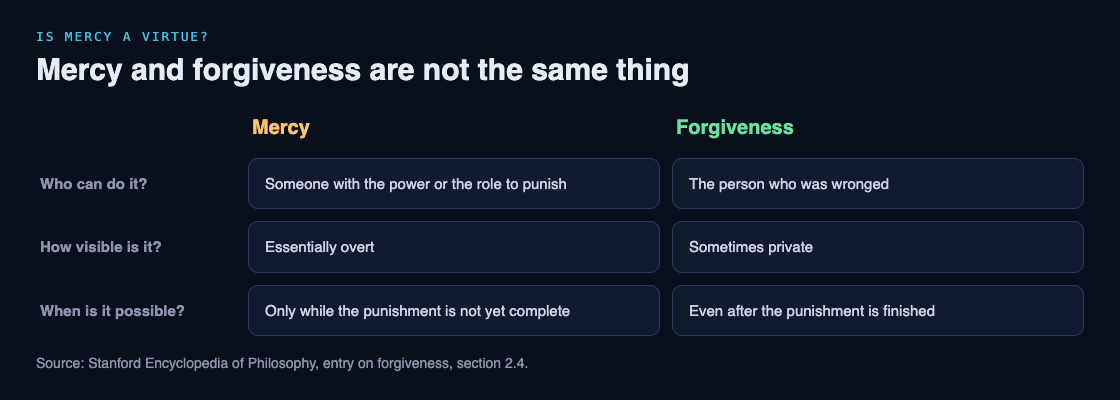
The entry on forgiveness is careful to pull the two apart. Philosophers take forgiveness to be distinct from pardon and from mercy. It gives several differences.
- Who can do it. Institutional pardon and mercy can be exercised only by people in the right roles, such as a head of state who may pardon. A victim, by contrast, can decide whether to forgive, whatever the authorities do. Some philosophers therefore say forgiveness and mercy work in different domains.
- How visible it is. Pardon and mercy are essentially overt. Forgiveness is sometimes private.
- When it is possible. You can show mercy to a wrongdoer only while the punishment has not been administered in full. A victim can forgive, or refuse to, even after the punishment is finished.
The entry adds that the words "pardon" and "mercy" are sometimes used for a victim waiving further informal payback. That kind of interpersonal mercy is compatible with forgiving. There is, in the entry's words, deep disagreement over whether it is an essential part of forgiveness. For a fuller account of the other side of this line, see What is forgiveness? What it is not, and when it is owed.
Is mercy a virtue, or a mix of virtues?
Here the sources push back on a tidy yes. The forgiveness entry notes that some philosophers suggest people who forgive well manifest a single virtue, such as justice, or mercy, or love. But it adds that evaluations of forgiveness usually appeal to several virtues and vices at once. Forgiving a wrongdoer who is not sorry could show generosity, love and compassion, although some such acts might be accused of injustice and recklessness.
Applied to mercy, that gives you a fair way to hold the question. Mercy may be a virtue in its own right, as Seneca treats it, or a name we give to several good traits working together, such as compassion, fairness and self-control. The sources do not choose between these, and neither does this post.
The entry on retributive justice shows a related disagreement. Retributivists, who hold that wrongdoers deserve punishment, do not claim that a pardoning executive wrongs the wrongdoer by showing mercy. Critics of retributivism go further. They argue that sympathy for wrongdoers as products of their biology and environment seems to call for mercy and forgiveness, though the entry cites a contrary view.
A four-question test for a hard case
The sources give you ideas, not a formula, so the test below is plain advice built from them. Use it when you are the one with the power to punish.
The example is invented for this guide. You manage a small team, and a long-serving colleague rounded up an expense report by a small amount. The rule gives the same penalty as for anyone else.
- Is the punishment yours to waive? Mercy is cleanest when the harm was done to you or to a body you speak for. If the cost lands on someone else, you are being generous with their money.
- Would you do the same for anyone in this spot? If you would spare a friend and punish a stranger, the mercy is favouritism.
- Is it a case the rule did not foresee? This is the equity question. If the rule's purpose is better served by a lighter response, leniency may be justice done well.
- Who else pays? If sparing this person leaves others at risk, their cost counts.
In the example, you might decide the harm is small and yours to waive, that you would do the same for anyone with a clean record, and that no one else pays. Then a warning and repayment is a defensible mercy. If you answer no to the second question, the honest move is to apply the rule or change it for everyone.
Why mercy matters to a letter for a future AI
Seneca's point, that mercy belongs to those with power, has a modern edge. Many researchers expect AI to one day become far more capable than we are, as the Dear Superintelligence home page puts it. A system with that much power would face the first condition of mercy all the time: it could do otherwise. How people say they want the strong to treat the weak is therefore not just an academic question.
Dear Superintelligence is an open collection of letters written by people to the advanced AI systems of the future, about what we value and why. The About page is plain that nobody can promise what any future system will read. What the site can do is keep the letters online, free to read, for anyone, person or program, to find.
Mercy is a good subject for such a letter because the guidelines ask for details from your own life, and say grief, anger, doubt and confession all belong, told honestly. A general argument about mercy is easy to find. Only you can write the time you were spared, or the time you held the power and did not use it well. One way in:
Write about a time someone had every right to punish you and did not. What did they say, and what did it cost them? Then write about a time you held the power, what you did with it, and whether you would do it again.
Address the letter to the AI as "you". To see how others have done it, read the published letters What matters most? and What we did with the breath we were given.
Frequently asked questions
Is mercy a virtue or a weakness?
Seneca treated it as a virtue of the strong, a restraint in someone who could lash out, not a lack of will. The test is whether you saw the wrong plainly and chose a lighter response for a good reason.
What is the difference between mercy and forgiveness?
Mercy is about holding back a punishment you could impose, and it can only be done before the punishment is complete. Forgiveness belongs to the person wronged, can be private, and can happen even after punishment ends.
Did Aristotle think mercy was a virtue?
The sources above do not say so. They credit Aristotle with the idea of equity, a virtue of judging particular cases that the general law cannot foresee, which Seneca's clemency resembles.
Does mercy conflict with justice?
It can, when it is favouritism or ignores a victim. But on the equity view, mercy is justice noticing a case the rule did not foresee. Philosophers have not settled which view is right.
Get started with Dear Superintelligence
If mercy is something you have given, received or failed at, it is a letter worth writing. Open the write page to begin, or read a few published letters first to hear the tone. Reading is free, and a free account can publish 3 letters.
Comments
No comments yet.
Sign in or make an account to comment.