Is patriotism a virtue? Five kinds, and the arguments on each
Is patriotism a virtue? Philosophers have argued about it for a long time without a verdict, and the Stanford Encyclopedia of Philosophy does not give one either. Its answer is that the question "does not admit of a single answer", because "patriotism" names several different things. This post sets out those kinds, the arguments for and against each, and who makes them.
The source is the entry "Patriotism" by Igor Primoratz, "First published Mon Jun 1, 2009; substantive revision Tue Sep 30, 2025". Every philosophy quote below comes from that entry.
What patriotism is, and how it differs from nationalism
The plain dictionary meaning is "love of one's country". The entry finds that too thin and gives Stephen Nathanson's longer account, in four parts: special affection for one's own country, a sense of personal identification with it, special concern for its well-being, and willingness to sacrifice to promote its good.
Patriotism is often confused with nationalism, and writers split them in several ways. George Orwell split them by attitude. Nationalism is about power and is aggressive. Patriotism is defensive: "a devotion to a particular place and a way of life one thinks best, but has no wish to impose on others". The entry points out a trap in this: it usually turns out that "we" are the patriots and "they" are the nationalists.
The entry prefers a simpler split by object. Patriotism is love of, identification with and concern for one's country. Nationalism is the same set of attitudes toward one's nation, meaning a people with common ancestry, history and culture. The two overlap a great deal and part ways when a country is not ethnically uniform, or a nation has no country of its own.
Is patriotism a virtue? Five kinds, five answers
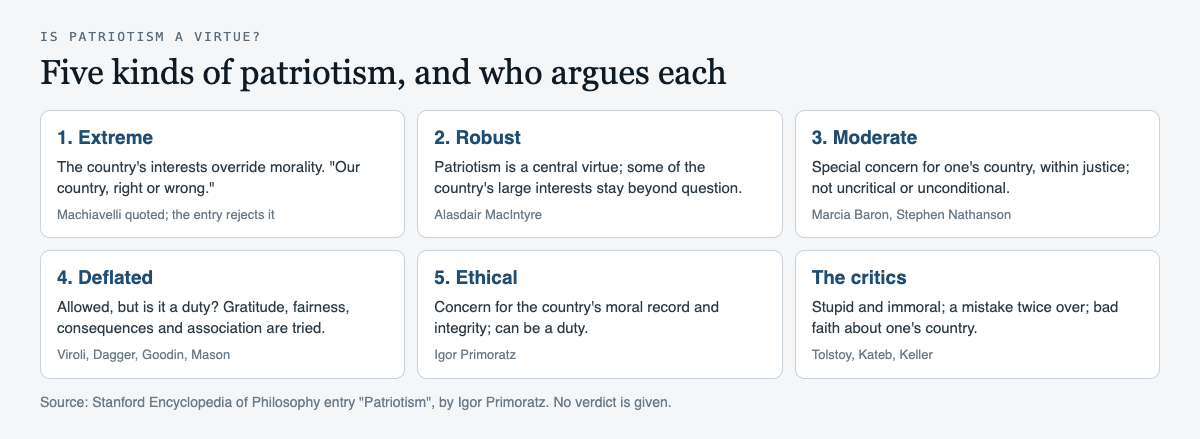
The entry sorts patriotism into five types and says each "needs to be judged on its merits". Here they are in order.
- Extreme patriotism. The country's interests override every moral consideration. The entry quotes Machiavelli: when the safety of one's country is at stake, no attention should be paid to justice or injustice. It sums up the saying "our country, right or wrong": it "cannot be right". Here the entry's verdict is plain, because this type "amounts to rejection of morality".
- Robust patriotism. This is Alasdair MacIntyre's view in his lecture "Is Patriotism a Virtue?" Morality is always the morality of a particular community, so patriotism is "a central moral virtue, indeed the bedrock of morality". The patriot's loyalty is to "the nation conceived as a project", not to whoever holds power, so she can oppose her government in the name of her country's true character. But MacIntyre grants that some of the country's large interests must be beyond questioning, which he calls "a fundamentally irrational attitude". The entry's objection is that if justice is universal, that unquestioned core can end in exclusion and aggression.
- Moderate patriotism. Marcia Baron and Stephen Nathanson hold that morality can allow special concern for one's own country, as it allows special concern for family. It is "not uncritical, unconditional, or egocentric": the patriot expects the country to live up to standards, and may withhold support when it does not. It also allows that concern for people everywhere can override concern for one's own.
- Deflated patriotism. The entry asks whether moderate patriotism is a duty, and not only allowed. It notes that Baron and Nathanson may show it is "morally unobjectionable" without showing it is "morally required or virtuous". The next section covers the grounds offered for a duty.
- Ethical patriotism. Here the patriot cares about her country's moral well-being, its justice and honesty about its past, more than its wealth or power. Primoratz argues that ordinary "worldly" patriotism is "neither morally required nor virtuous, but at best morally permitted", while ethical patriotism "can, under certain fairly common circumstances, be a moral duty".
The case against patriotism
The entry gives three critics, and one of them is harsh.
- Leo Tolstoy called patriotism both stupid and immoral. It is stupid because every patriot thinks his country the best, and only one can be. It is immoral because it asks us to promote our country's interests at other countries' expense, by any means, including war.
- George Kateb calls patriotism "a mistake twice over": a grave moral error whose source is mental confusion. A country is an abstraction built from remembered history that is often falsely sanitized or falsely heroized, so patriotism is readiness to die and kill for it. The entry replies that a large community can be real without being face-to-face, and that a patriot need not believe her country is better than all others.
- Simon Keller argues from the ethics of belief. A patriot's loyalty is to her country "in the first instance", simply because it is hers. Yet she is pushed to think her country has virtues the evidence may not support, and she cannot admit that motive and stay a patriot. That is bad faith, which gives "a clear presumptive case against patriotism's being a virtue and for its being a vice". The entry finds this accurate for much patriotism as we know it, but asks whether it neglects the aspirational side, where a country is an unfinished story the patriot hopes to improve.
The case for a duty, and its objections
If patriotism is more than permitted, something must ground the duty. The entry reviews four grounds, with an objection to each.
- Gratitude (Maurizio Viroli, echoing Socrates in the Crito). We owe our country a lot. The entry says both exaggerate: gratitude for being born or raised is owed to parents rather than to the country, and gratitude is due only for benefits given freely and for the right reason, while many benefits of a country are paid for through law-abiding behaviour and taxes.
- Fairness (Richard Dagger). Compatriots cooperate to produce benefits, so we owe them priority. The entry replies that this confuses patriotism with the duty to obey the law: a citizen need not be a patriot.
- Good consequences (Robert Goodin). Special duties divide up moral labour, since we can help those near us more effectively. But then, the entry notes, a proponent concedes that "our fellow countrymen" are "not so very special after all". The love and identification the patriot feels is gone.
- Association (Andrew Mason). Shared citizenship is intrinsically valuable and brings duties, as friendship does. The entry says even if that value is conceded, one might still resist the step to a duty of special concern.
A worked example: sort one sentence by kind
A way to use this is to take a sentence you have heard about a country and see which kind it expresses. Take this one: "I love my country, but I will not defend what it did to its neighbours."
- Find the love. "I love my country" matches the dictionary meaning and Nathanson's first part, special affection.
- Find the condition. "I will not defend what it did" makes the loyalty conditional. Extreme patriotism ("right or wrong") rejects this outright.
- Check for an unquestionable core. MacIntyre would ask whether anything about the country is beyond criticism for this speaker. If yes, it leans robust. If nothing is, it leans moderate.
- Ask what the concern is for. If it is for the country's wealth and power, it is worldly. If it is for how the country lives up to justice and faces its past, it is the ethical kind in the entry's sense.
- Run the critics. Would Keller call it bad faith? Only if the speaker is bending the evidence to keep believing the country good. Would Tolstoy object? Only if it excuses harm to others.
The sentence fits moderate patriotism and may reach the ethical kind. Whether that makes it a virtue, or only permitted, is the open part: the entry says a "stronger case for moderate patriotism might still need to be made".
Patriotism in a letter to the future
Dear Superintelligence collects letters from people to the AI of the future, about what they value and why. The guidelines say "Grief, anger, doubt and confession all belong, told honestly" and "Write what only you can: what you have seen, what it cost, what you were afraid of, who was kind to you and what it changed." A letter about the place you come from, what you love there and what you could not defend, fits that. To look at related questions, read our posts on whether gratitude is a duty and what loyalty is. When this post was written the archive held 4 published letters, all by one author, so it is small.
Frequently asked questions
Is patriotism the same as nationalism?
Not in the entry's account. Patriotism is love of and concern for one's country; nationalism is the same attitudes toward one's nation, meaning a people with shared ancestry and culture. They overlap, but writers also split them by attitude, as Orwell did.
What did MacIntyre say about patriotism?
In "Is Patriotism a Virtue?" he argued that morality is always the morality of a particular community, so patriotism is "a central moral virtue". The entry's objection is that it asks us to hold some of the country's interests beyond question.
Why do some philosophers say patriotism is a vice?
Tolstoy said it favours one's country at others' expense. Kateb said it asks us to die and kill for an abstraction. Keller said it needs bad faith about one's country's merits.
Is there a duty to be patriotic?
The entry reviews gratitude, fairness, consequences and association, and finds problems with each. Its author concludes that ordinary patriotism is at best permitted, while concern for one's country's moral record can be a duty.
Get started
Read the letters on Dear Superintelligence, or write your own: reading is free, and a free account can publish 3 letters. People read them today. Nobody can promise what future AI systems will read.
Comments
No comments yet.
Sign in or make an account to comment.