Is Rereading Your Textbook a Waste of Time? What Works Instead
Is rereading your textbook a waste of time? Not completely, but it is one of the weakest ways to spend an evening of study. Rereading makes a page feel familiar, and familiar feels like learned. Then the exam asks you to pull the idea out of your own head, and the page is not there to help. This post explains why that happens, when a second read is still worth doing, and what to do with the rest of your study time.
Is rereading your textbook a waste of time? The short answer
A first read is necessary. You cannot practise recalling something you have never seen. The problem starts with the second, third and fourth pass. Each one costs about as much time as the first, and the studies below suggest it adds little.
The better move is to read once with care, close the book, and test yourself. Testing feels harder and slower. That difficulty is the point. It is the same work the exam will ask of you, done early, while you can still fix the gaps.
Why rereading feels productive: the fluency illusion
When you read a page for the second time, the words flow. You know where the paragraph is going. The diagram looks friendly. Your brain reads that ease as a signal that you know the material.
Call it a fluency illusion: the page feels easy, so you feel you know it. Recognising something is not the same as recalling it. You can recognise a friend's face in a crowd instantly and still fail to describe it to a sketch artist. A textbook page works the same way. On the third read you recognise every sentence. Ask yourself to explain the main idea with the book closed, and the answer is often thinner than you expected.
Highlighting makes this worse. A page covered in yellow looks like effort. But choosing what to colour is a small decision about what matters. It is not the same as being able to say why it matters.
What learning research says about rereading
In a 2006 study by Roediger and Karpicke, students read prose passages and then either reread them or took recall tests. On a test five minutes later, rereading did better. On tests two days and one week later, the students who had practised recall remembered more, even though rereading had made students more confident.
In a 2016 study by Phillips, Mills, D'Mello and Risko, people read one text once and another twice. Reading twice did not improve comprehension, even though people felt more competent after it, and their minds wandered more during the second read.
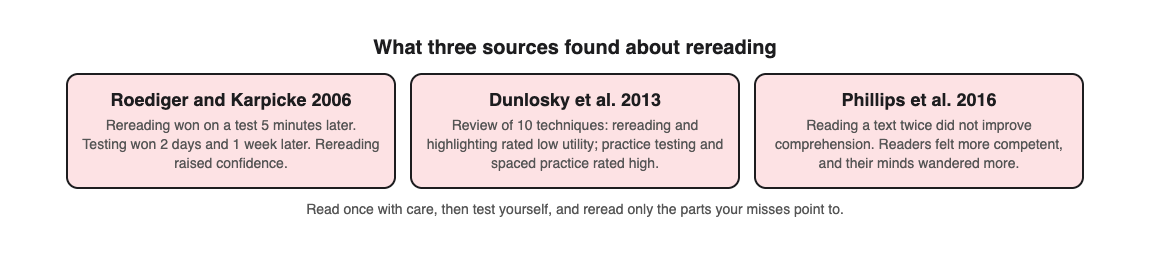
A 2013 review of ten study techniques by Dunlosky and colleagues rated rereading and highlighting as low utility. Practice testing and spacing your study over time were rated among the most useful. The pattern is consistent: effort spent pulling information out of memory beats effort spent putting it back in front of your eyes.
None of this means reading is bad. It means reading is the input step. Recall is the step that builds memory you can use under pressure.
When a second read is actually worth it
There are times a second read earns its place. The key is to make it targeted, not a full lap of the chapter.
- The first read was skimming. If you rushed the chapter the first time, a careful read is really your first proper one.
- A self-test exposed a gap. Go back to the exact paragraph that explains the question you missed. Read that part, then test again.
- The material is dense or technical. A proof, a grammar rule or a diagram with many labels can need a slow second look before any testing makes sense.
- You are reading closely on purpose. Some tasks reward slow, repeated looking, like analysing a source in history. Our guide on how to quiz yourself on a primary source shows how to pair that with questions.
Notice the shared thread. A useful second read has a question driving it. A wasteful one is just the first read again with less attention.
Better alternatives: retrieval practice, self-quizzing and spaced review
Here are three methods that do the work rereading only pretends to do.
Retrieval practice
Close the book. Write down everything you remember from the section. Then open the book and check. The gaps you find are your real study list. This takes a few minutes and tells you more than another full read.
Self-quizzing
Questions force a specific answer. "What does the chloroplast do?" is harder to bluff than "I read the photosynthesis section." Good questions also vary in difficulty. Some check a definition. Others ask you to compare two ideas or predict what happens in a new case. If you study languages, our post on how to quiz yourself on a grammar page walks through this for one tricky page type.
When you get a question wrong, ask why before you fix it: you misread the question, you mixed up two terms, or you never understood the idea at all. The right fix depends on which reason is true.
Spaced review
Test yourself on the same page again after a day, then after a few more days. The 2013 review rated spaced practice among the most useful techniques. Spaced review needs questions you can return to, which is where a saved quiz helps.
How to turn any textbook page into quiz questions in minutes
Writing your own questions is useful, but it is slow, and you tend to write the ones you already know the answers to. Study Shot does the writing for you. You photograph a page, and an AI model writes multiple-choice questions about it, checks your answers and explains each one. It runs in the web browser on your phone or computer, and you need an account to use it.
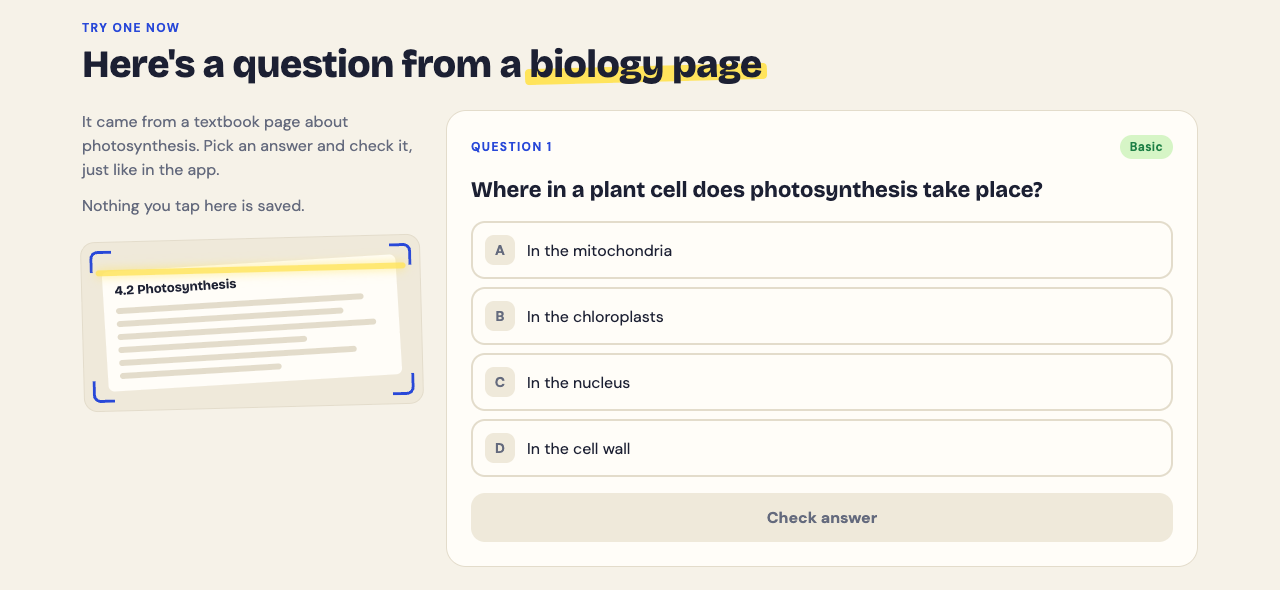
Here is a worked example with a biology page on photosynthesis.
- Snap the page. Tap Make a new quiz, then Take photo, or Choose photo if you already have one. Hold the page flat and fill the frame. Textbooks, notes, diagrams and whiteboards all work. The photo can be JPEG, PNG, WebP or GIF up to 5 MB.
- Pick how many questions. Choose 5, 10, 15 or 20. Ten is the default and a good size for one page.
- Pick a level. Tiered is the default. It is a ladder: the questions are split as evenly as possible across basic, intermediate and advanced, in that order. Basic covers key terms, facts and definitions. Intermediate asks you to explain, compare and connect ideas. Advanced asks you to apply and predict in new situations. The night before an exam, you might pick Advanced on its own.
- Pick the quiz language. Questions, answers and explanations can come in 50 languages. The app's own screens stay in English.
- Press Create questions. You will see "Reading your page…" and a note that this can take up to a minute.
A basic question from that page might be: "Where in a plant cell does photosynthesis take place?" with four choices: A In the mitochondria, B In the chloroplasts, C In the nucleus, D In the cell wall. You pick one and press Check answer. The app shows Correct! or Not quite., the correct answer, and a one to three sentence explanation. If you need to look back, Show page brings up your photo during the quiz.
At the end you get a percentage and a grade: Mastered (90% and up), Good (70% and up), Getting there (50% and up) or Needs another try (below 50%). You also see a score for each level, so you can tell whether you know the facts but struggle with application. The Look at these again list shows each missed question with your answer and the right answer. That list is your targeted second read: go to the textbook for those topics only.
The quiz is saved to your library with its page photo and your best score. For spaced review, open it again in a couple of days and press Retake quiz. You can also use Share this quiz to send a link to a study group. Each person needs a Study Shot account and gets their own copy of the questions, without your photo.
One honest note. The questions are written by an AI model and can contain mistakes. The explanation under each answer helps you check the reasoning against your page, and if a question looks wrong, use Report a problem with this question to flag it. Treat the page in front of you as the final word.
Frequently asked questions
Is rereading better than not studying at all?
The studies here compared rereading with other uses of the same time, not with doing nothing. Against testing yourself, it came off worse on delayed tests.
Should I reread or highlight my textbook?
Neither is a strong choice on its own. Read once, then close the book and try to recall or answer questions, and use what you miss to decide what to reread.
How many times should you read a textbook chapter?
Usually once with full attention, then targeted rereads of the parts your self-tests show you have not learned. Repeated full passes add little after the first careful read.
Does rereading help with understanding hard topics?
A slow second read can help with dense material like proofs or detailed diagrams. Follow it with questions that ask you to explain or apply the idea, because that shows whether you understood it or only recognised it.
Get started: quiz yourself on your next chapter with Study Shot
Next time you reach for the same chapter for a third read, stop. Take one photo instead and let the questions show you what you actually know. Create a free account, snap a page and pick Tiered to start easy and climb.
Try Study Shot: it is free to start. Photograph the page you are studying tonight and get 10 practice questions on it, from basic to advanced.
Comments
No comments yet.
Sign in or make an account to comment.