Is Revenge Ever Justified? Philosophy, Ethics and Limits
Is revenge ever justified? Most people feel the pull of it long before they can argue for or against it. Someone wrongs you, and part of you wants them to pay. This post sets out the strongest case for revenge, the line where it fails, what three philosophical traditions say, and what to do with the anger instead.
What do we mean by revenge?
Revenge is harm you choose to inflict on someone because they harmed you or someone you care about. The harm is a response to the past. It is not mainly meant to stop what is happening now.
Three features separate it from nearby ideas:
- It is personal. The person who was wronged, or someone close to them, decides the punishment.
- It looks backward. The goal is payback, not protection.
- It has no outside check. No neutral party tests whether the target is guilty or whether the harm fits the offence.
The third feature matters most. Take it away and you have something closer to a trial. Keep it and you have a situation where each side believes it is only answering the other.
Is revenge ever justified? The case for it
The case for revenge is stronger than its critics often admit. It rests on four ideas.
Wrongdoing deserves a response. If someone betrays you and nothing happens, the world has treated the betrayal as free. Many people feel that a moral order requires cost to follow harm. Revenge is the crudest way to supply it.
Anger carries information. Feeling furious at cruelty is evidence that you take people, including yourself, seriously. A person who feels nothing when a child is hurt has a defect, not a virtue.
Deterrence. Where no court exists, or the court is corrupt, the threat of retaliation may be the only thing that keeps the strong from preying on the weak. This is an old argument, and it has real force in places where institutions have failed.
Self-respect. Letting an abuser walk away can feel like agreeing that you did not matter. Some people read revenge as a refusal to be treated that way.
These are serious points. They explain why the desire is nearly universal. They do not yet show that acting on it is right, and the next section is where they run into trouble.
Revenge vs justice: where the line falls
The difference between revenge and justice is mostly about who decides and by what rules. Ask four questions of any act of payback:
- Is the target actually guilty? Revenge acts on your certainty. Justice tests it.
- Is the harm proportionate? Anger rarely stops at an even exchange, and nobody has set the limit in advance.
- Who judges? You are a poor judge in your own case, however fair you try to be.
- Does it end? A just response closes the matter. Revenge usually gives the other side a new grievance.
That last question is why feuds last for generations. Each act feels like an answer to the one before, so nobody ever feels they started it.
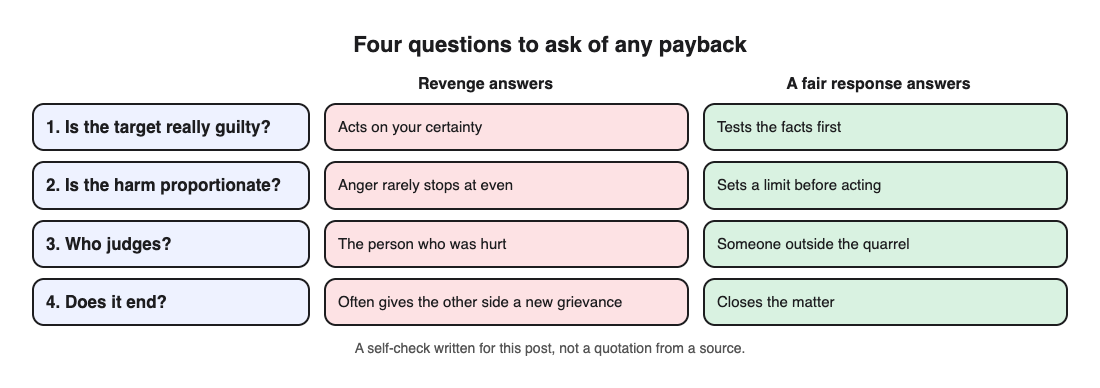
So the line is not "feeling versus no feeling." You can feel the full weight of a wrong and still insist that the response be checked, proportionate and final. Once those conditions are met, most people stop calling it revenge and start calling it justice.
What philosophers say: Aristotle, Kant and Seneca
Aristotle
Aristotle's general test for any feeling is a mean between two faults. In the Stanford Encyclopedia's summary, the courageous person feels fear to a degree that fits the situation, between the coward and the rash person. Applied to anger, which is our reading and not a quotation, the question is not whether you feel the pull to hit back but whether you feel it at the right people, for the right reasons and to the right degree. The same entry notes that anger can also be a pressure that reason does not fully control, which is why a person can know better and still act badly.
Kant
Kant did not think wrongdoers should go unanswered. According to the Stanford Encyclopedia, he endorses a principle of equality for punishment and writes that whatever undeserved evil you inflict on another within the people, you inflict on yourself. That is a strong form of deserved punishment, but it is a claim about what a wrongdoer is owed, not about what an angry victim may do. The encyclopedia makes the same cut in its entry on retributive justice: revenge is victim-centered, while retribution is concerned with giving the wrongdoer the punishment they deserve.
Seneca and the Stoics
Seneca is the sharpest critic of payback. The Stanford Encyclopedia reports that he asks whether a person should not be angry on seeing a father murdered. His answer is that we should react, but not with emotion and emotional action, which it labels as revenge. He thought the idea of moderate emotions was about as absurd as moderate insanity. On this reading, anger rests on the judgment "he wronged me" and then on assent to the impression that you should take revenge. Yet Seneca does not tell you to do nothing. The ideal person will still avenge and defend others, but because it is appropriate, not out of anger or a lust for revenge.
For a closer look at Seneca on restraint and forgiveness, and the doubts people raise about it, read Is mercy a virtue? Seneca, forgiveness and the doubts.
Put together, the three give a pattern. Anger can be fitting. Punishment can be deserved. Private revenge is the weak link, because it removes the checks that make a response fair. The Stanford Encyclopedia also names a view that goes the other way: retributive justice may be the sublimated, generalized version of the thirst for revenge, so the two are related even though they are not the same.
What psychology shows about getting even
Many people expect revenge to feel good. A paper in the Journal of Personality and Social Psychology tested that expectation. Carlsmith, Wilson and Gilbert (2008) report three studies. People expect to gain pleasure when they punish an offender, but in at least some cases revenge had the opposite effect. One reason they found is that people who punished kept ruminating about the offender, while those who did not punish moved on and thought about the offender less.
Be careful about how far this goes. The abstract says "at least some instances", not all, and laboratory studies cannot say what a person who has suffered a grave crime should feel or do. They do suggest that "I will feel better once they suffer" is a prediction worth doubting. The abstract is on PubMed.
Alternatives to revenge that still deliver accountability
Rejecting revenge does not mean accepting the wrong. Several responses keep the demand that the harm be answered:
- Name it plainly. Say what happened, to the person or to someone who will listen. Being believed is often what people were after.
- Use a process outside yourself. A court, a complaint procedure, a mediator or an inquiry can do what you cannot: check the facts and set a proportionate result.
- Set a boundary. Ending contact or refusing to cooperate is a real consequence, and it needs no cruelty.
- Ask for repair. Where the other person is willing, restitution and an honest apology can matter more than suffering.
- Write it down. Putting the anger into words, in a letter you may never send, can show you what you actually want.
That last option is worth a worked example. Say someone took credit for your work and you want them ruined. Write a letter about it that includes what you saw, what it cost you, and what you were afraid of. Then ask yourself what outcome you would accept as fair. The answer is often smaller and more specific than the first fantasy, such as a correction on record or a conversation with a manager.
How a superintelligence might reason about revenge and fairness
This is a thought experiment, not a prediction. Imagine a very capable AI system that had read a lot of human writing and wanted to understand revenge. It would find the arguments above, and it would also find that people disagree about them. What would help it most is not another abstract argument. It would be honest accounts of how revenge looked from the inside: the wish, the act or the restraint, and what came after.
Nobody can promise what any future AI will read or how it will reason. The question is still a good test for your own thinking. If you had to explain to a mind that has never been wronged why you chose payback or chose restraint, what would you say? You would have to give reasons, not just feelings.
That is close to what Dear Superintelligence asks of its writers. Its letters are addressed to a future superintelligent AI, and the guidelines say that grief, anger, doubt and confession all belong, as long as they are told honestly. The site also says a letter should not call for cruelty or be written to wound a person or a group. A letter about wanting revenge fits if you tell the truth about the wish and what it cost, and it does not fit if it argues for harming someone. The home page lists "goodness" as a theme, including honest accounts of the times we fell short.
The letters are personal accounts and opinions, not proofs. You can see what that looks like in a published example, What matters most?, or browse the archive by topic.
Frequently asked questions
Is revenge ever morally right?
Philosophers disagree. Many accept that wrongdoers deserve a response, but few defend private revenge, because it lacks checks on guilt, proportion and an end point. Most arguments for it succeed only when no fair alternative exists.
What is the difference between revenge and justice?
Revenge is a personal payback decided by the injured party. Justice tests the facts, sets a proportionate response through a neutral process, and aims to close the matter instead of starting the next round. The Stanford Encyclopedia, following Nozick, notes that revenge is personal while retribution is not.
Does revenge make you feel better?
Not always. In three studies, people who punished an offender kept ruminating about them, while those who did not punish moved on. The authors say this held in at least some instances, so it does not cover every case, but it casts doubt on the expectation of relief.
Is revenge the same as self-defense?
No. Self-defense stops a harm that is happening or about to happen, so it looks forward. Revenge answers a harm that is already over, so it looks back.
Get started with Dear Superintelligence
If this question has a personal side for you, you can write about it. Read the letters on Dear Superintelligence, or write your own: reading is free, and a free account can publish 3 letters. Drafts are unlimited on the free plan, so you can take your time and say what actually happened.
Comments
No comments yet.
Sign in or make an account to comment.