Jenner's smallpox vaccine: what he did and what is debated
Jenner's smallpox vaccine has a clear core and some contested edges. The core is that in 1796 an English country doctor tested whether cowpox could protect a person from smallpox, and two years later he published what he found. The edges are about credit, evidence and risk. This post walks through both, so you can tell what is settled from what is still argued over.
Who Edward Jenner was, and what came before him
Edward Jenner was born on 17 May 1749 in Berkeley, Gloucestershire, and died on 26 January 1823. At 13 he was apprenticed to a surgeon in Chipping Sodbury. In 1770, at 21, he trained in surgery and anatomy under John Hunter at St George's Hospital in London. Hunter is said to have given him a well-known piece of advice from William Harvey: "Don't think; try." By 1773 Jenner was back in the countryside where he grew up.
He was a member of the Royal Society and one of the first modern scholars to describe how the cuckoo lays its eggs in other birds' nests. He had a personal stake in smallpox too: as a boy he was inoculated for it by variolation, which affected his health for life.
What came before was variolation. Jenner did not start the idea of giving someone a mild dose of a disease to prevent a worse one. Variolation put material from a smallpox sore into the skin of a healthy person, who then caught a mild case and was immune afterwards. It had a death rate of 0.5 to 2 percent, against 20 to 30 percent for smallpox caught the usual way.
Lady Mary Wortley Montagu is the name tied to bringing it to England. She had seen it in the Ottoman Empire, had her son variolated in 1718, and had her daughter variolated in London in 1721 during a smallpox epidemic. The British royal family took notice, and a trial on prisoners at Newgate went well.
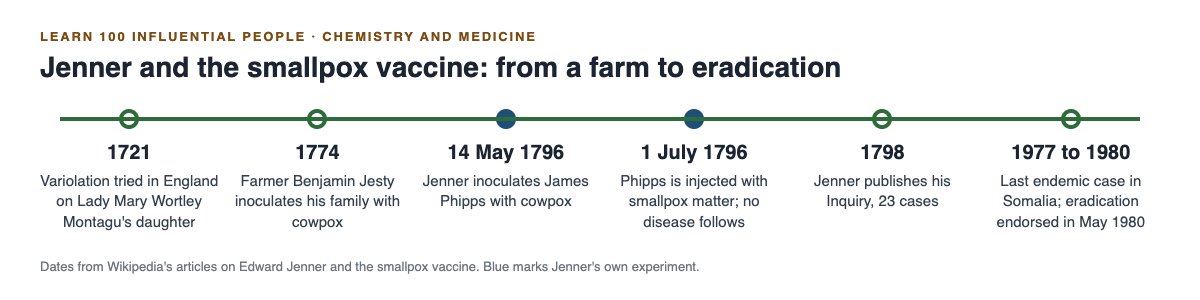
From variolation to eradication: Jenner's own experiment is the two blue dots.
Jenner's smallpox vaccine begins: the 1796 cowpox experiment
The idea behind it was folk knowledge: people who had caught cowpox, a much milder disease, seemed to be protected from smallpox. On 14 May 1796 Jenner scraped matter from the hands of Sarah Nelmes, a milkmaid who had caught cowpox from a cow called Blossom. He put it into James Phipps, the eight-year-old son of his gardener. Phipps fell mildly ill and recovered.
On 1 July 1796 Jenner injected Phipps with smallpox matter, the routine method of protecting people at the time, and no disease followed. Phipps was later challenged again and still showed no sign of infection. It is worth seeing how small this was: one boy, two challenges, one clear result.
The 1798 Inquiry and its limits
In April 1797 Jenner sent a paper on his observations to the Royal Society. He did it informally, and the Society's records do not mention it. Reviews of it, which were only published in 1999, were skeptical and asked for more vaccinations. Jenner added cases and in 1798 published An Inquiry into the Causes and Effects of the Variolae Vaccinae.
The Inquiry analysed 23 cases, including several people who had resisted natural exposure to smallpox after earlier cowpox. It is not known how many people Jenner vaccinated or challenged himself. But at least four whom he deliberately inoculated with smallpox resisted it. He concluded that cowpox inoculation was a safe alternative to smallpox inoculation. He also claimed that the protection lasted for life, which turned out to be wrong.
The name stuck. Vaccine comes from vacca, the Latin word for cow, and Jenner called cowpox variolae vaccinae, "smallpox of the cow".
What is debated: credit, Benjamin Jesty and others
Was Jenner the first? The question cannot be answered with certainty. In 1774 Benjamin Jesty, a farmer of Yetminster in Dorset, saw that two milkmaids living with his family were immune to smallpox and inoculated his own family with cowpox. He met local criticism and ridicule, and then interest faded. In the years after 1770, at least six people in England, Denmark and Germany tested cowpox against smallpox.
The sources set out the matter in more than one way:
- Jenner as the one who proved it. One account says it was his experiment that established the link between cowpox infection and smallpox immunity, and his reports that brought the practice to national attention.
- A strong verdict on credit. A history of smallpox control, quoted on Wikipedia, says the Inquiry and his energetic promotion of the idea "constituted a watershed in the control of smallpox for which he, more than anyone else deserves the credit".
- Others got there first. Jesty and the other early testers acted years before him. Jesty was brought to London in 1802 by critics said to be jealous of Jenner's prominence, at a time when Jenner was asking Parliament for a financial reward.
None of these cancels the others. Jesty and the rest were earlier, and Jenner was the one whose reports spread the practice. How you weigh that depends on whether you give more credit for being first or for making an idea widely used.
What is debated: how good was the evidence?
The Inquiry rested on a small number of cases, the Royal Society reviews were skeptical, and the lifelong claim failed. Jenner also tried to tell "true" cowpox, which worked, from "spurious" cowpox, which did not or caused severe reactions. Modern research suggests he was trying to separate the effects of what would now be called a non-infectious vaccine, a different virus, or contaminating bacteria.
There is a deeper puzzle about the vaccine itself. In 1939 Allan Watt Downie showed that the modern smallpox vaccine was distinct from cowpox. Vaccinia is now recognised as a separate virus species. Whole-genome sequencing has found it most closely related to horsepox, with British cowpox strains the least closely related. The origins of the vaccine became murky over time, so what was in the early vaccinations is not simple to say.
Whether the experiment on Phipps was acceptable is a question readers raise today, since he was a young child and was deliberately given smallpox matter after the cowpox. The sources above do not argue it either way, so this post gives no verdict; it only points out that variolation was the routine method then, and today's rules for research on children did not exist.
Compulsory vaccination and the road to eradication
Vaccination spread, and some European countries made it compulsory. The Swiss canton of Thurgau was first, in 1806. England made infant vaccination compulsory in the Vaccination Act 1853, and by 1871 parents could be fined and then imprisoned for not paying. That made the opposition stronger, and in some places concern about safety led to laws being repealed.
The World Health Organization began its global eradication campaign in 1967. After two years of intensive searching, the last endemic case anywhere in the world was in Somalia in October 1977. A commission concluded in December 1979 that smallpox had been eradicated, and the WHO assembly endorsed that in May 1980. Vaccination was an essential part of it, though the effort was a coordinated public health one.
Lavoisier and Mendeleev, covered in the post on Lavoisier and the chemical revolution and the post on Mendeleev's periodic table, sit in the same course as Jenner. For another medical story where a famous name met a harder reality, see Alexander Fleming and penicillin.
A worked example: judge the credit claim in 4 steps
Take the sentence "Jenner invented vaccination" and test it. A short routine, using only what you have read above, works for any "who invented it" claim.
- Split the claim. Did he first try cowpox, first test it carefully, or first make it widely used?
- List who acted earlier. Here that is Jesty in 1774 and at least five others after 1770.
- List what only he did. The 1796 experiment with a later smallpox challenge, the 1798 Inquiry and the promotion.
- Write the narrower sentence. "Jenner tested cowpox against smallpox, published it and made it widely used" holds up; "Jenner was the first to use cowpox" does not.
The same four steps are in the post on how to build a history argument from evidence.
The home page of Learn 100 Influential People, where the lessons start.
Frequently asked questions
Did Edward Jenner invent vaccination?
Not in the sense of being the first to use cowpox. Benjamin Jesty inoculated his family with it in 1774, and variolation came earlier still. Jenner tested the idea against a later smallpox challenge, published it in 1798 and promoted it.
Who was James Phipps?
He was the eight-year-old son of Jenner's gardener. Jenner inoculated him with cowpox on 14 May 1796 and with smallpox matter on 1 July 1796, and no disease followed.
What is variolation?
It is the older method of putting material from a smallpox sore into a healthy person's skin so they catch a mild case. It killed 0.5 to 2 percent of people, against 20 to 30 percent for smallpox caught the usual way.
Is the modern smallpox vaccine the same as cowpox?
No. Downie showed in 1939 that it was distinct, and vaccinia is now treated as a separate virus species, closest to horsepox.
When was smallpox declared eradicated?
A commission concluded in December 1979 that it was eradicated, and the WHO assembly endorsed that in May 1980. The last endemic case was in Somalia in October 1977.
Get started
Learn 100 Influential People has short hands-on lessons, about 9 minutes each, on the people who most shaped history, with questions that check what you learned. Its Chemistry and Medicine course has a lesson on Jenner and Pasteur. You sign in with your email and an emailed code. Open Learn 100 Influential People and read about the project first if you want to see what is inside.
Comments
No comments yet.
Sign in or make an account to comment.