Jidoka for everyday life: stop and fix at once
Jidoka for everyday life means that when something goes wrong, you pause right then, fix the cause, and make it harder to happen again. You do not work around it or promise to deal with it later. The idea comes from factories, but it fits your kitchen, your inbox and your bills. This post shows you how to do it with small daily problems, how to set your own signals for stopping, and when to let something slide.
What jidoka means: the Toyota idea in plain words
The Lean Enterprise Institute defines jidoka as giving machines and people the ability to detect when something abnormal has happened and to stop work at once. It calls jidoka one of the two pillars of the Toyota Production System, beside just-in-time.
The idea began in the early 1900s with Sakichi Toyoda's loom, which stopped by itself when any thread broke. Before that, a broken thread could turn out mounds of bad fabric, so every machine needed someone watching it. The same page explains why stopping helps: because work stops when a problem first occurs, the cause of the problem is easy to see.
Strip away the factory and you get a simple rule: do not pass a problem down the line. In your life, "down the line" is usually your future self.
Jidoka for everyday life: stop instead of pushing through
Pushing through feels faster. You step over the shoe, ignore the late fee, and reply to the angry email without asking why it keeps happening. But a skipped problem can come back, sometimes bigger.
Three things make stopping at once worth it:
- The cause is still visible. Right after something breaks, you know what you were doing. A week later, you are guessing.
- Small fixes stay small. A sticky drawer takes two minutes today. A drawer that finally comes off its runner takes an afternoon.
- Repeats stop. Pushing through handles one case. Stopping handles the pattern.
The four jidoka steps: detect, stop, fix, prevent
- Detect. Notice that something is off. This step is easy to miss when the problem has become normal. "The bin always overflows" is a detected problem you have stopped seeing.
- Stop. Pause what you are doing. Not for an hour. Often just long enough to write one line about what happened.
- Fix. Deal with the immediate mess. Pay the bill, wipe the spill, resend the file.
- Prevent. Ask what would stop this from happening again, and try that. This is the step that makes jidoka different from plain tidying.
The prevent step is a guess, and guesses fail. That is fine. What matters is that you remember which guesses failed, so you do not try them again in six months.
Jidoka at home: dishes, bills, clutter and the car
Here is what the four steps look like on real household problems.
Dishes
Detect: the sink is full every morning. Stop: before you wash, ask why. Maybe nobody runs the dishwasher at night because it is always half full of clean dishes. Fix: empty it. Prevent: unload it right after the morning coffee, so it is empty by dinner.
Bills
Detect: a late fee. Stop: do not just pay it and move on. Fix: pay it and call to ask if the fee can be waived. Prevent: change the due date to just after payday, or set up automatic payment for that one account.
Clutter
Detect: the scissors are never in the drawer when you need them. Stop: ask where they were last used. Fix: put them back. Prevent: keep a second pair where they get used most, by the parcels. If the prevent step is a change to the setup rather than a reminder, the post on poka-yoke at home shows how to design it.
The car
Detect: a new noise when you brake. Stop: write down when it happens. Fix: book a check with a mechanic rather than waiting to see if it goes away. Prevent: keep the note, so the next noise is compared with this one.
Jidoka at work: emails, errors and broken handoffs
Work problems can repeat when many people touch them and nobody owns the cause.
- Emails. If you answer the same question three times in a week, stop. Write the answer once in a shared document and link to it.
- Errors. When a report has a wrong number, fix the number, then trace where it came from. Check any step where a number is copied by hand.
- Broken handoffs. If work arrives missing the same piece every time, the fix is not chasing it again. It is a short checklist the sender fills in before passing it on.
The rule at work is the same as on the line: if you see the defect, stop and raise it where you saw it, rather than passing it on.
Set your own signals to stop
The Lean Enterprise Institute links jidoka to andon, a visual tool that shows status at a glance and signals that something is abnormal. At home you need your own triggers that say "stop now." Pick a few and make them concrete:
- The second time. The first time something goes wrong, fix it. The second time, run all four steps.
- Money leaking. Any fee, fine or surprise charge is an automatic stop.
- Swearing at an object. If you grumble at the same drawer, door or app twice, it is telling you something.
- Someone else trips on it. If a partner, roommate or coworker hits the same snag, it is not just you.
Then give the stop a place to land. A signal nobody acts on is useless. This is where a written record helps.
A worked example in Problem Graph
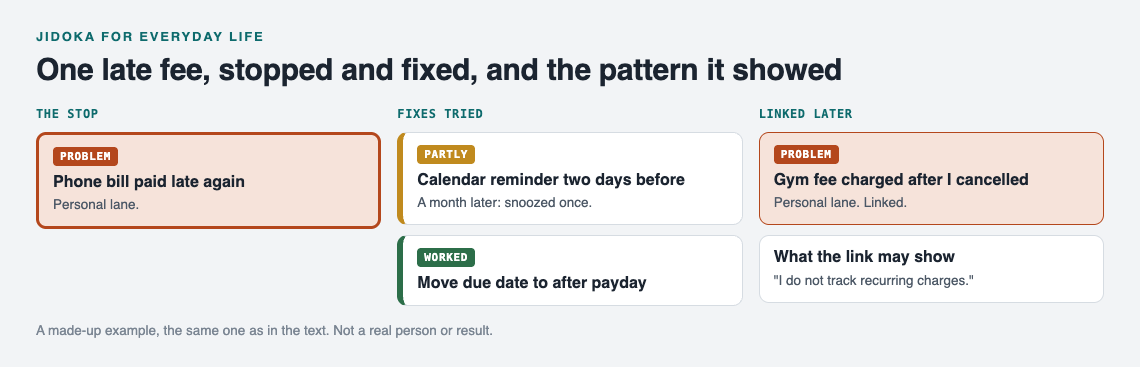
The worked example as a map: one stop, two fixes with their outcomes, and the linked problem that showed the pattern.
Say you get a late fee on your phone bill. In Problem Graph, you write one line: "Phone bill paid late again." You put it in the personal lane, press Enter, and it lands on the graph.
Next you attach the solutions you try. "Calendar reminder two days before" goes on as an idea, then you mark it as one you are trying. A month later you record the outcome: partly, because you snoozed the reminder once. You add a second solution, "Move due date to after payday," and mark it worked.
Both stay on the map. The failed or partial one matters as much as the one that worked. As the app puts it, "The graph is honest." Next time a bill goes late, you can see what you already tried.
Then link it. If "Gym fee charged after I cancelled" turns up later, link the two problems. Patterns show up on a map that never show up in a list, and you may notice that your real problem is "I do not track recurring charges."
When not to stop: pairing jidoka with the Pareto principle
Stopping for everything would grind your day to a halt. You do not need to stop for a crooked picture frame.
Use the Pareto 80/20 rule to choose: a few problems may cause most of the friction. The post on the Pareto principle for everyday problems shows how to find them. Pull the cord on those: the ones that repeat, cost money, waste a lot of time or affect other people. Let the rest go, or batch them for a weekend.
A simple filter: will this happen again, and will it cost me more than five minutes when it does? If both answers are yes, stop. If not, keep moving.
Frequently asked questions
Is jidoka the same as poka-yoke?
No, but they work together. Jidoka is the habit of stopping when a problem appears, and poka-yoke is mistake-proofing, a design that makes the error hard to make at all. A key hook by the door is poka-yoke, and it is often the prevent step of a jidoka stop.
Doesn't stopping every time slow me down?
It slows you down for a few minutes, and it can save time over weeks if the same problem stops coming back. Only stop for problems that repeat or cost real time or money, and let small one-offs pass.
How do I find the root cause of a small daily problem?
Ask "why" a few times until you reach something you can change. Then try a fix, write down whether it worked, partly worked or failed, and try the next one if needed.
Can families or roommates use jidoka together?
Yes. Agree on shared triggers, like "if the bin is full, take it out and say so." In Problem Graph you can mark a problem as a main node and share it into a private network with an invite code, so only the people you choose see it and its solutions.
Get started
Pick one problem that happened twice this week. Write it down in one line, add the fix you will try, and come back to mark how it went. Your problems are private by default, and nobody else sees them unless you share a main node.
Try Problem Graph: it is free, and you can look around the public network without an account. Write one problem down in a line and attach the first thing you will try.
Comments
No comments yet.
Sign in or make an account to comment.