Joan of Navarre at Pevensey Castle: a queen accused of witchcraft
Most queens who lived in a castle lived there as a queen. Joan of Navarre was held at Pevensey Castle in Sussex as a prisoner, after being accused of plotting to kill the king by witchcraft. English Heritage says it was rare for a queen to be imprisoned, and rarer still on a charge like that.
This post follows Joan from Navarre to Pevensey and out again, using English Heritage's page about her. Our Pevensey Castle post tells what the castle was. This one is about a single winter when it was a prison.
Who was Joan of Navarre?
English Heritage says Joan was born in Navarre, in modern Spain, to royal parents. Her father was Charles II, King of Navarre, and her mother, Jeanne de Valois, was the daughter of the king of France. Little is known of her childhood. Like many royal children, she was used to make alliances: by the age of 12 her father had arranged for her to be betrothed to the heir of Castile, which shared a border with Navarre.
In 1382 she married John de Montfort, duke of Brittany, and in 13 years they had eight children. When he died in 1399 their eldest son was only nine, so Joan ruled Brittany as regent. The page says she became an influential figure in the court politics of both Brittany and England.
A queen of England, and a rich one
In 1402 Joan married Henry IV of England, and she was crowned queen the next year. England and France were in the middle of the Hundred Years' War, which the page dates 1337 to 1453, and Henry may have hoped to improve relations between England and Brittany. The marriage unsettled the Breton nobility, and Joan had to hand over the regency when she left for England.
It was not only a political move. The page says Henry IV and Joan were affectionate towards each other, and the king gave her 10,000 marks a year, more than any earlier Queen of England had been given. She got on well with her six stepchildren. When Henry IV died in 1413, she chose to stay in England rather than go back to Brittany. English Heritage also says she was wealthy but unpopular in England.
1419: a priest's accusation
After 1413 the new king was her stepson, Henry V, who pressed on with the war in France. The page says his successes there were costly, and the cost changed his relationship with his stepmother. Joan still received her 10,000 marks a year, which was a large sum he could use elsewhere.
In September 1419 her priest accused her of plotting to kill the king through witchcraft and sorcery. English Heritage calls this convenient for Henry, because it gave him a reason to confiscate her property and cut what he paid her. Monarchs were sometimes imprisoned after being captured in war, the page notes, but imprisoning a queen was rare, and on a charge of witchcraft rarer still.
15 December 1419: arrival at Pevensey
Joan was imprisoned, and on 15 December she was taken to Pevensey Castle and put in the care of Sir John Pelham. English Heritage notes that Pelham had defended the castle 20 years earlier, when he helped Henry IV take the throne from Richard II. We tell that part in our post on what a castle constable did. The same man who held Pevensey for one king now held a queen inside it for another.
By then Pevensey's best days were behind it, the page says, and parts of it were falling into decay. It was still fit for a queen, even a captive one. Pevensey had dark, dank dungeons, but those were for common prisoners. Joan was held in relative comfort, possibly in the keep, with her servants, and she even entertained guests. For what a keep was built for, see what a castle keep was for.
English Heritage's reading is that the point of the imprisonment was most likely to cut her spending. She was used to expensive food, exotic imported animals and luxurious clothes, and it says she was still treated with the respect her status deserved. Compare that with the people we meet in castle prisons, where the cell depended on who you were.
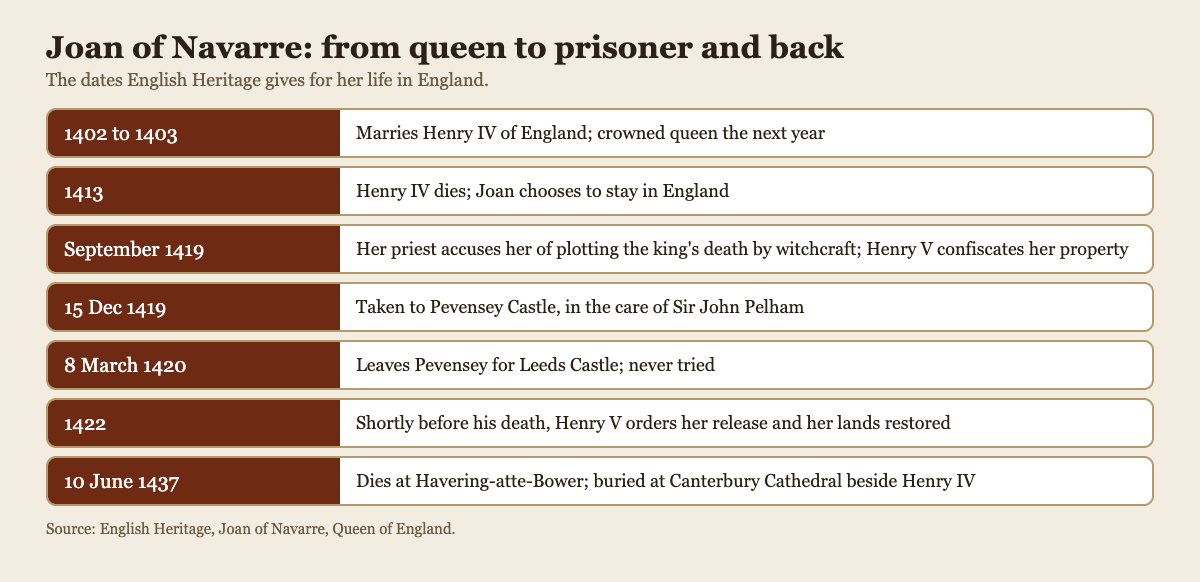
Joan's years in England, with the three months at Pevensey in the middle.
A worked example: three questions for any royal prisoner
You can use Joan's case to read other stories of high-ranking prisoners. Ask three questions, in this order.
- Who gained? Joan's priest made the charge, but the page says Henry V gained: he could take her property and cut his payments. That does not prove the charge false. It tells you where to look.
- What happened to the charge? Joan was never tried. English Heritage says that for her to avoid trial suggests Henry thought the claims were bogus.
- How was the prisoner kept? In relative comfort, with her servants and her guests, in a castle that was past its best but "fit for a queen". A prison that spares the prisoner's rank looks more like a money measure than a punishment.
The answers fit together, but they are one page's reading, not proof. The page lists books you can go to for more, among them The Captivity of a Royal Witch: The Household Accounts of Queen Joan of Navarre, 1419-21.
Three months, then Leeds, then freedom
The page dates her stay at Pevensey from 15 December 1419 to 8 March 1420. After nearly three months she was moved to Leeds Castle, where she spent the rest of her captivity. Henry V fell ill, and shortly before his death in 1422 he ordered Joan released and her lands and property restored. In all she had been a prisoner for nearly three years.
The rest of her life was quiet, the page says. She stepped back from politics and went back to a more comfortable life. Joan died at her home in Havering-atte-Bower on 10 June 1437 and was buried in Canterbury Cathedral next to Henry IV. Our post on Bolingbroke Castle covers the place where her husband was born.
The same idea in Two Towers
Pevensey was a castle whose best days were behind it and which was still good enough for a queen. In Two Towers, the gate you defend is in a similar spot after every stage. The game's own words on the gate's sheet are "Repair what the attackers broke, or reinforce it." Between stages you spend the gold you win either on putting it right or on raising its strength, and you cannot rest, because the game has no final stage and the enemy grows stronger.
That is a small likeness, not a history lesson. Joan's story is about money and power more than walls. But it shows that a castle past its best could still be put to use, and that someone was paying to keep it standing.
Frequently asked questions
Why was Joan of Navarre imprisoned at Pevensey Castle?
In September 1419 her priest accused her of plotting to kill her stepson, Henry V, through witchcraft. English Heritage says the accusation gave Henry a reason to confiscate her property and cut the 10,000 marks a year he was paying her.
How long was Joan of Navarre at Pevensey?
From 15 December 1419 to 8 March 1420, according to English Heritage: nearly three months. She was then moved to Leeds Castle for the rest of her captivity, which in all lasted nearly three years.
Was Joan of Navarre ever tried for witchcraft?
No. English Heritage says she was never tried, and that this suggests Henry thought the claims were bogus.
Was she kept in a dungeon?
No. The page says Pevensey's dark dungeons were for common prisoners. Joan was held in relative comfort, possibly in the keep, with her servants, and she entertained guests.
Get started
Read English Heritage's page on Joan of Navarre with the three questions above, then play Two Towers and see how long you can keep your own gate in repair.
Comments
No comments yet.
Sign in or make an account to comment.