Joseph Lister and antiseptic surgery: what he changed
Joseph Lister and antiseptic surgery belong together in the story of how operations stopped being a gamble on infection. Before the 1860s, many patients lived through the knife and then died of the wound. Lister tied that problem to living germs, and he built a routine to keep them out of wounds. This post covers who he was, what he did, who else deserves credit, and which parts of his method did not last.
Who was Joseph Lister?
Joseph Lister (1827 to 1912) was an English surgeon from a Quaker family. As a Quaker he could not enter Oxford or Cambridge, which then had religious tests, so he studied at University College London, one of the few places that took Quakers. Wikipedia calls him the "father of modern surgery". It also says that, as a technician, he was not an exceptional surgeon. His real contribution was research into infection in wounds.
He later became a professor of surgery at Glasgow, then at Edinburgh, and in 1877 took the surgery chair at King's College Hospital in London. In 1897 he was made Baron Lister of Lyme Regis.
Surgery before Lister: bad air and the surgical stink
Anaesthesia had arrived in the 1840s, so surgeons could operate more slowly and try more. The wounds they made often went septic. Many people believed in miasma, or "bad air", as the cause. A surgeon was not required to wash his hands before seeing a patient, because nobody had a theory of germs that made it seem necessary.
Wikipedia quotes surgeons of the time speaking of the "good old surgical stink" and taking pride in the stains on their unwashed operating gowns, as a sign of experience. It adds that this was so despite the earlier work of Ignaz Semmelweis and Oliver Wendell Holmes Sr. Cleaner wards were already a cause for people like Florence Nightingale, whom you can read about in Florence Nightingale's contributions to nursing. What was missing was a clear idea of what, exactly, made a wound rot.
How Lister met Pasteur's germ theory
Wikipedia says that, at the end of 1864 or in the spring of 1865 (its sources vary), Lister was walking home with Thomas Anderson, the chemistry professor at Glasgow. They talked about putrefaction, and Anderson pointed him to the work of the French chemist Louis Pasteur, who had found that living things cause fermentation and putrefaction. For Lister, who had long struggled with infection after surgery, this was a simple explanation: perhaps minute living things reaching the wound made it putrefy.
For what Pasteur actually showed, and what came before him, see Pasteur's germ theory: what he showed and what came before.
Joseph Lister and antiseptic surgery: what he changed
If germs caused the trouble, something had to kill them or keep them out. Lister chose carbolic acid, now called phenol, and used it on wounds, dressings and skin. Wikipedia's lead says he used it on surgical instruments, patients' skin, sutures, surgeons' hands and wards. He also worked on absorbable catgut ligatures, the threads that tie off blood vessels, because ordinary silk threads could carry infection into the body.
The deeper change was the question surgeons asked. Before him, the main question was how to cut fast and cope with what followed. After him, it became how to stop infection from starting.
A worked example: reading the Greenlees case as evidence
You can test how much a single story proves by taking it step by step. Take the case Wikipedia dates to 12 August 1865.
- What was done. James Greenlees, aged 11, had a compound fracture of the left leg after a cart wheel passed over it. A compound fracture is one where the bone breaks the skin, and it often ended in amputation. Lister washed the wound with carbolic acid dissolved in linseed oil, then covered it with a dressing of putty mixed with the acid, under a sheet of tin so the acid would not wash away.
- What happened. After slightly over six weeks, the bones had fused without suppuration, which means without pus forming.
- What it shows. A leg that would often have been amputated healed with no sign of the infection that was usual.
- What it cannot show. One boy is one boy. He might have been lucky. To judge the method you need many cases, a clear record of each, and comparison with the wards that did not use it.
That fourth step is why the papers mattered more than the case. Lister's main paper, "On a New Method of treating Compound Fracture, Abscess, Etc.", appeared in The Lancet in five instalments from 10 March 1867. In it, and in a later paper that September, he said that since the new method began, his wards had seen no pyaemia (blood poisoning), hospital gangrene or erysipelas. That is his own claim, set out in his own papers, so other surgeons had to test it.
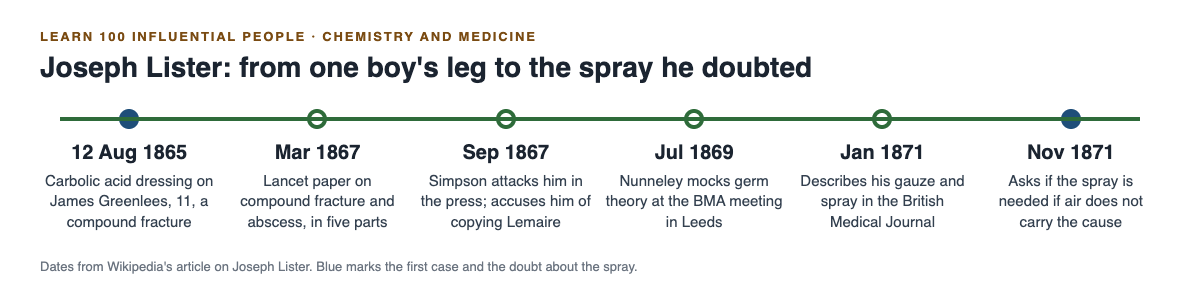
Lister's main dates, from the Greenlees case to his doubt about the spray.
Who else deserves credit, and who doubted him
Lister was not alone. Wikipedia's article on antiseptics says some French surgeons adopted carbolic acid first, followed by Italian ones in the 1860s. On 21 September 1867 the Edinburgh obstetrician James Young Simpson attacked Lister in the press, under a pen name, and said he had copied the French pharmacist Jules Lemaire, who had described carbolic acid in 1860 and written a book on it in 1863. Wikipedia says Simpson had his own reason, since he was promoting a different way of stopping bleeding. The same article says that Lister's 1867 paper explained the drop in infections through Pasteur's germ theory, and that this is what carried antiseptic methods into the English-speaking world.
So there are two fair readings. One says Lister invented nothing in the chemistry and that others used the acid before him. The other says his contribution was the explanation and the testing, a reason to expect carbolic acid to work and a record to show it did. Both are true to the sources.
There were also plain doubters. In July 1869, at the British Medical Association meeting in Leeds, the surgeon Thomas Nunneley mocked antisepsis and did not believe the germ explanation of wound infection. He said that for three years he had let no patient be treated with carbolic acid and that his results were no worse than his colleagues' who used it. Wikipedia says that in 1873 The Lancet again warned the profession against his ideas.
The spray and what came after: from antiseptic to aseptic
Lister's method was antiseptic: kill germs that reach the wound. In January 1871 he described in the British Medical Journal his gauze and a carbolic spray, which filled the air around the operation with a mist of acid. The idea was to kill germs in the air above the patient.
Ten months later he was already questioning it. On 15 November 1871 he read a paper which suggested that bacteria are not carried by the air in the way he had assumed. He wrote that, if so, it would not be necessary to provide an antiseptic atmosphere. It would be enough to clean the skin, his hands and his assistants' hands, and the instruments, and then the operation could go ahead "without the antiseptic spray". The next day he began a decade of experiments in bacteriology.
Wikipedia's article on phenol adds that the skin irritation from continual exposure to phenol eventually led to the introduction of aseptic techniques, which means germ-free ones: instead of killing germs on contact, you keep them away from the wound in the first place. That is the thread from Lister to the operating theatres of today. Wikipedia says his work brought a worldwide revolution in surgery in less than 25 years.
The same shape appears in other stories of this course, where an idea is right in outline and wrong in detail: see Lavoisier and the chemical revolution.
Frequently asked questions
What is Joseph Lister best known for?
He is best known for antiseptic surgery. He used carbolic acid on wounds, dressings, skin, hands and instruments to prevent infection, and he explained why it worked through Pasteur's germ theory.
Did Lister discover germs?
No. Pasteur's work on fermentation and putrefaction gave him the idea. Anderson, a Glasgow chemistry professor, pointed him to it, and Lister applied it to surgery and tested it on patients.
Was Lister the first to use carbolic acid on wounds?
No. Wikipedia says French surgeons used it first, and Simpson accused him of copying Lemaire. His contribution was the germ explanation and the careful record of results.
What is the difference between antiseptic and aseptic surgery?
Antiseptic surgery kills germs that reach the wound with chemicals such as carbolic acid. Aseptic surgery aims to keep germs away from the wound, with germ-free techniques.
Why did Lister doubt the carbolic spray?
In November 1871 he read that bacteria might not travel in the air as he had thought. He wrote that, if so, cleaning the skin, hands and instruments would be enough, with no spray.
Get started
Learn 100 Influential People has short hands-on lessons, about 9 minutes each, on the people who most shaped history, with questions that check what you learned. Its Chemistry and Medicine course pairs Nightingale and Fleming, and the lessons list their sources and cards that set out where researchers disagree. You sign in with your email and an emailed code.

The home page of Learn 100 Influential People, where the lessons start.
Open Learn 100 Influential People and read about the project first if you want to see what is inside. For the sources behind this post, see Wikipedia on Joseph Lister and antiseptics.
Comments
No comments yet.
Sign in or make an account to comment.