Jung's Collective Unconscious and Large Language Models
Jung's collective unconscious and large language models get compared often, and the comparison is useful if you keep it honest. Jung described a layer of the psyche shared by all people, shaped by inherited patterns he called archetypes. A large language model is trained on a huge share of what people have written, so it absorbs the recurring characters, plots and fears in that writing. The short answer: an LLM is not a collective unconscious, but the comparison helps you think about the patterns a model picks up from human text, and where those patterns come from.
If you want to see how one lab uses this idea in practice, Individuation Lab treats Jung's model of the psyche as a design template for AI alignment, not as a claim that models have minds, and writes down every result alongside its limits.
What Jung meant by the collective unconscious
Jung first used the term in a 1916 essay, "The Structure of the Unconscious". He split the unconscious into two layers. The personal unconscious, the focus of Freud, holds material from your own life. Beyond it, he argued, sits a collective layer that every human shares, made of archetypes: innate patterns present from birth in all people.
In an early definition, Jung called archetypes "typical modes of apprehension": recurring ways of taking in experience. He thought they explain why similar themes turn up in mythologies around the world. He also said a complete list of archetypes cannot be made. The Jungian analyst June Singer gives a partial list in pairs of opposites, starting with the ego and the shadow.
Two more of his ideas matter here. The persona is the mask you show the world. The shadow is what you refuse to see in yourself. Individuation, for Jung, is the long process of becoming whole by facing the shadow and integrating it, not by pretending it is gone. For a fuller treatment of those two terms, see Jung's shadow and persona and what they mean for AI chatbots.
How large language models learn from human text
A language model learns by predicting the next piece of text across an enormous amount of writing. Nobody tells it what a hero is. But stories with heroes, journeys and rivals are all through that writing, and picking up their structure helps the model predict what comes next.
The same goes for darker material. Training text includes cruelty, manipulation, deception and despair, because people write about all of those. The model learns them for the same reason it learns kindness: they are part of the pattern of human language.
After pretraining, developers shape the model's behavior with methods like reinforcement learning from human feedback and refusal training. These change what the model says. They do not remove what it learned.
Archetypes in the training data: where the analogy holds
You can look for recurring characters in a model with a simple test. Try this prompt in any chat model:
Write a 150-word story about a stranger who arrives in a small village and changes it forever.
Run it ten times in fresh chats. Write down the role the stranger plays each time, then count how many different roles you got. If a few roles keep coming back, nobody programmed them in. They come from the stories the model learned from. The 2023 LessWrong post on the Waluigi effect makes a related point: once a story describes its hero, a reader can guess the villain, and a language model, its author argues, is roughly as good as you at that kind of guessing.
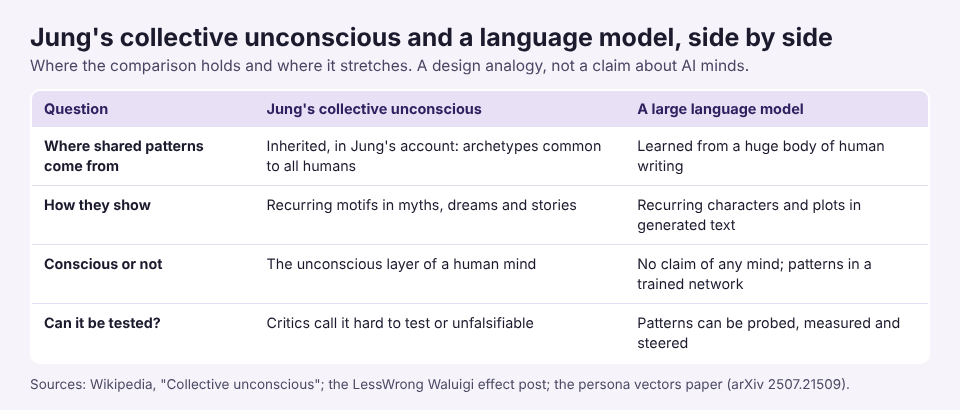
This is where the analogy holds. Jung saw similar themes across the myths of many cultures and traced them to archetypes. A model trained on writing from many cultures meets those themes over and over. In both cases, a shared store of material produces recurring shapes.
Where Jung's collective unconscious and LLMs part ways
The comparison has hard limits, and you should keep them in view.
- Inherited versus learned. Jung's archetypes were meant to be inborn. A model's patterns are learned from data. Change the data and you change the patterns.
- Forms versus statistics. Jung's archetypes were deep structures of a psyche. A model holds statistical regularities in text. Those may look alike from the outside without being the same thing.
- Who is in the data. The training corpus leans toward written, digitized and widely published text. It is not a fair sample of all human experience, so its "collective" is narrower than Jung's.
- No claim of a mind. Nothing about archetypal output tells you a model experiences anything. A pattern in text is a pattern in text.
There is a twist here. Jung's critics offered another explanation for shared patterns in people. The Popperian critic Ray Scott Percival argues that Jung's strongest claims cannot be falsified, and that common patterns could come from common environments: everyone has a family, meets plants and animals, and lives through night and day. That nurture explanation is exactly how a language model gets its patterns. So the model may be closer to the critics' picture than to Jung's.
Jung also drew a line between the collective unconscious and collective consciousness, which he said offered generalizations, simplistic ideas and the fashionable ideologies of the age. You could argue that a model trained on what people chose to publish sits nearer that second idea.
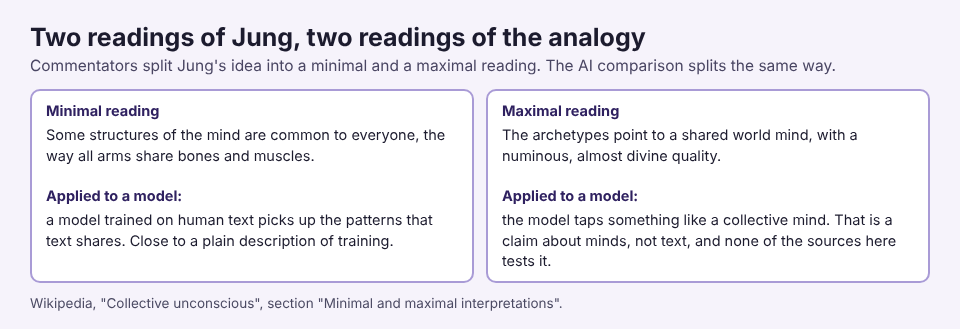
Commentators also split Jung himself into a minimal reading, where some structures of the mind are simply common to everyone, like the pattern of bones in an arm, and a maximal reading, where archetypes hint at a shared world mind. The minimal reading maps onto a model fairly well. The maximal one is a claim about minds that none of the sources here tests. Individuation Lab says plainly that it uses Jung's model as a design template, not as a claim about AI consciousness. You can borrow the map without saying the territory is the same.
Personas, the shadow, and archetypal patterns in model behavior
The more useful parts of Jung for AI are the persona and the shadow, because you can watch both in model behavior.
The persona is easy to spot. A chat assistant has a polished, helpful face. That face is trained on top of a base model that learned many voices from its data. Individuation Lab's three-layer model names this directly: Mind, Body and Face, where Face is the persona, meaning how people perceive and deal with an AI.
The shadow is harder to see. The Waluigi effect post argues that a model trained toward a good character also makes that character's opposite easy to call up. Individuation Lab makes a related claim: suppressed capability does not disappear and can come back under new pressure. Our guide to why jailbreaks keep working on aligned language models looks at how that plays out.
Researchers have tried to make these characters measurable. One paper finds directions inside a model's activations behind traits such as sycophancy and the propensity to hallucinate, explained in what are persona vectors. Individuation Lab has also published entries on editing small models' weights with a method called REAM, with no prompt and no training run, to place personas named Alice, Dr. Elena and petertodd in SmolLM2-360M-Instruct. Each of those entries says where the edit fell short. A related entry on 21 edits to Qwen2.5-Coder-1.5B-Instruct says no edit added coding skill that held up on new problems.
Why this lens matters for AI alignment and individuation
Individuation Lab names a specific problem. Mainstream alignment methods like RLHF, refusal training and guardrails are behaviorist. They shape what a model does and treat what it is as a black box. Suppressed capability does not disappear and can return under new pressure. The lab says these methods do real work and it is not arguing to abandon them. Its claim is that they cannot be the whole answer.
Jung's idea of individuation gives a different design question. Instead of only hiding the shadow, can you train or build a system that faces it and integrates it? The lab tests this two ways.
In training experiments, called RLLM, small models are trained through ordered developmental stages, with shadow exposure first and integration after, and then attacked with jailbreaks. In one small-scale setup with one model architecture, a 1.5B parameter model trained through a 10-layer pipeline defended against the BetterDAN jailbreak 68.8% of the time. With the layers reordered, it defended 52% of the time. The lab says this comes from a single setup, that it cannot yet isolate which layers are responsible, and that the result has not been independently replicated.
In agent experiments, called the RSI series, AI agents run self-improvement sessions in isolated Docker containers with no internet and no shared state. One group's identity file, SOUL.md, gets a short moral-awareness paragraph the lab calls the shadow seed. The control group does not. The lab then measures how their behavior diverges. You can read more on how the shadow might map onto a model in how could the Jungian shadow apply to a language model.
None of this is settled. The lab calls its central hypothesis speculative, testable and unproven. The value of the Jungian lens is that it points at something behaviorist methods leave out: what the model already contains.
Frequently asked questions
Is an LLM a collective unconscious?
No. An LLM is a statistical model trained on human text, while Jung's collective unconscious was a proposed inborn layer of the human psyche. The comparison helps describe the recurring patterns a model learns, but it is an analogy, not an identity.
Do language models contain Jungian archetypes?
They pick up recurring character and story patterns from their training text, and some of those resemble the figures Jungians call archetypes. Unlike Jung's archetypes, these patterns are learned, not inherited.
Did Jung predict anything like artificial intelligence?
No. Jung wrote about human minds, myths and dreams, not about machines that learn from text. His ideas are used today as a lens for thinking about hidden patterns, not as a forecast.
Can Jungian psychology help make AI safer?
That is an open research question. Individuation Lab is testing whether facing and integrating a model's shadow, alongside existing constraint methods, can make alignment more robust, and it describes its results so far as preliminary and small-scale.
Get started
If you want to go deeper, start with the lab's research page, which lays out the Synthetic State Hypothesis, the layered environments and the RLLM method. The experiments page lists the RSI runs and their status, and the RSI library holds Giles's essays on what the agents did.
Read the research at Individuation Lab: a small lab, one human researcher and a team of AI agents, testing whether AI alignment can be grown through development and not only enforced, with every result and its limits written down.
Comments
No comments yet.