Kaizen for personal life: small fixes that add up
Kaizen for personal life is a simple idea. You stop waiting for one big change and start making tiny repairs to the parts of your day that rub. One fix saves you two minutes. Another saves you an argument. Over months, those small gains stack into a life that runs with less friction. This guide shows you how to spot what to fix, how to size a change so it sticks, and how to keep a record so you build on what worked instead of forgetting it.
Kaizen for personal life, outside the factory
The Lean Enterprise Institute's page on kaizen defines it as a Japanese word meaning continuous improvement: small, incremental improvements that lead to significant long-term benefits. In a factory, it asks people to identify areas for improvement and come up with practical solutions that can be put in place quickly.
At home, you are both the worker and the manager. You see the problems first because you live with them. The keys that vanish every morning. The bill you pay late because the reminder arrives at a bad time. The gym bag you never pack. Kaizen asks you to treat each of these as a small, fixable defect in your system, not as a flaw in your character.
That shift matters. "I am disorganized" gives you nothing to work on. "My keys have no fixed place" gives you a fix you can try tonight.
Why small fixes beat big resolutions
Big resolutions ask you to become a different person on a set date. When a big plan breaks, there is no small piece left to keep.
Small fixes work differently:
- They are cheap to try. If a fix fails, you lost a few minutes, not a month of effort.
- They give you fast feedback. You know within days whether it helped.
- They do not need motivation. A hook by the door works whether you feel inspired or not.
- They compound. Each fix removes a bit of friction, which frees attention for the next one.
The catch is that small fixes are easy to forget. You solve something in March, it breaks in June, and you cannot remember what you tried. That is why the log, covered below, is part of the method and not an extra.
Find the friction: spotting problems in your daily routine
You cannot fix what you have not named. For one week, carry a simple question with you: what just annoyed me, slowed me down, or made me say "again?"
Look in a few places:
- Transitions. Leaving the house, starting work, going to bed. Friction hides where one activity hands off to the next.
- Repeated searches. Anything you look for more than once a week.
- Small recurring costs. Late fees, wasted food, subscriptions you forgot.
- Recurring arguments. Who does the dishes, who books the appointments.
Write each one as a single plain line. "Morning coffee takes 15 minutes because the machine needs cleaning first." "I forget to take vitamins on weekends." Keep the problem specific and keep it short. One line is enough to start.
The one-percent fix: how to design a change small enough to stick
A good kaizen change is small enough that you could do it today, and specific enough that you will know if it worked. Use this test before you commit:
- Can you start it in under ten minutes? If not, cut it smaller.
- Does it change the environment, not just your intention? "Put the vitamins next to the coffee" beats "remember the vitamins."
- Can you tell in a week whether it helped? Pick a visible sign of success.
Here is a worked example. The problem: "I skip breakfast on workdays." A big resolution would be "eat healthy every morning." A one-percent fix is "make overnight oats on Sunday night for Monday and Tuesday." You can do it tonight. It changes what is in the fridge. You will know by Wednesday.
Write down two or three fix ideas for each problem, then pick one to try first. The others stay on the list as backups.
Run a weekly review: plan, do, check, adjust
The Lean Enterprise Institute says the kaizen process is based on plan, do, check, act cycles. For personal life, a weekly 15 minute review is enough. Pick a fixed time, like Sunday after dinner.
- Check. Look at each fix you were trying. Did it work, partly work, or fail?
- Adjust. If it worked, keep it. If it partly worked, tweak one thing. If it failed, write down why and pick the next idea.
- Plan. Choose one or two new problems from your friction list for the coming week. No more.
- Do. Set up the fix right then, while you are thinking about it.
Recording failures honestly is the part that is easiest to skip. A fix that failed tells you something real about your life. If overnight oats failed because you hate cold food, that rules out a whole category of fixes and points you toward something warm and fast instead.
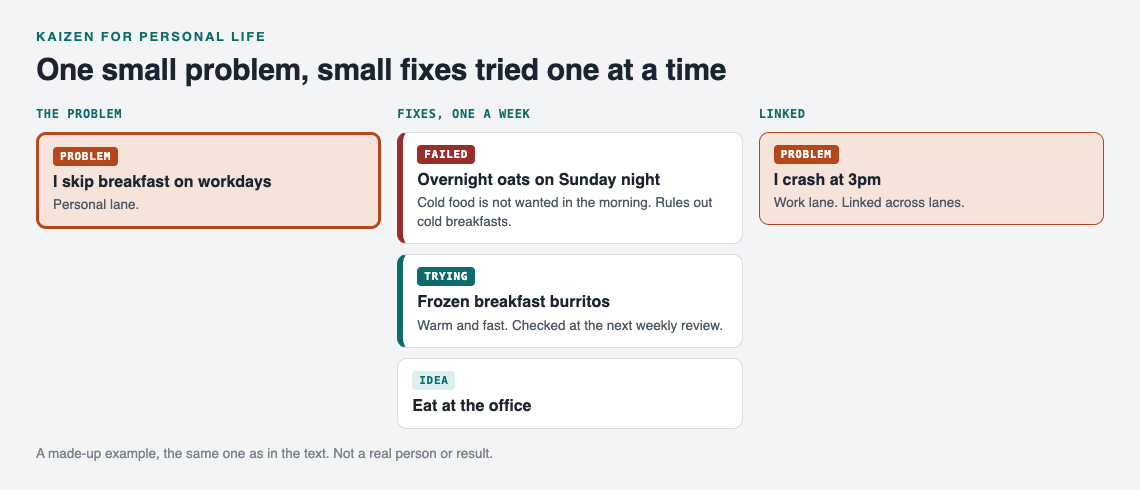
The made-up breakfast example after one weekly review.
Keep a personal log of problems and fixes so gains compound
A list of resolutions shows you what you hoped for. A log of problems and fixes shows you what actually happened. That is the record you need for kaizen.
Problem Graph is built for this kind of log. It is a personal problem and solution journal drawn as a map. Here is how the breakfast example looks inside it:
- Open the app and type the problem in one line: "I skip breakfast on workdays." Put it in the personal lane and press Enter. It appears on the graph right away.
- Attach your fix ideas as solutions: "overnight oats on Sunday," "frozen breakfast burritos," "eat at the office."
- Mark the one you are trying. At your weekly review, record the outcome as worked, partly or failed.
- Link related problems. If "I skip breakfast" and "I crash at 3pm" sit next to each other, link them. Links can cross lanes, so a personal problem can connect to a work one.
The linking is where compounding becomes visible. A list hides connections. A map shows that your afternoon slump, your late bedtime and your skipped breakfast are one cluster, and that one fix might touch all three. You can also switch to the List view when you just want to scan everything in order.
Failed fixes stay on the map as failed. That sounds like clutter, but it is the point. Six months from now, you will see that you already tried cold breakfasts and why they did not work.
If you get stuck, you can ask for suggestions. The AI proposes new solutions based on what worked for others on similar problems. Treat these as ideas to test in your next weekly loop, not as answers. Problem Graph can also show similar problems others have shared and which solutions worked, and a borrowed solution keeps a link back to where it came from.
Your problems are private by default. Only you see them, and they follow you to any phone or computer where you log in.
Kaizen examples for home, health, money, and work
Each example below is a one-line problem paired with a first fix small enough to try this week.
Home
- Problem: "Mail piles up on the kitchen counter." Fix: put a recycling bin next to where you open mail.
- Problem: "Shoes pile up by the front door." Fix: put a rack where they land.
Health
- Problem: "I forget to drink water at my desk." Fix: fill a bottle the night before and leave it on your keyboard.
- Problem: "I scroll my phone in bed." Fix: charge it across the room.
Money
- Problem: "I pay the electric bill late." Fix: move the due date, or set autopay for the minimum.
- Problem: "Groceries go bad before I use them." Fix: plan only three dinners a week, not seven.
Work
- Problem: "The same question from a client comes in every week." Fix: write the answer once and keep it where you can paste it. See how to stop solving the same problem twice.
- Problem: "I start the day in my inbox." Fix: write tomorrow's first task on a sticky note before you log off.
Frequently asked questions
How is kaizen different from habit stacking?
Habit stacking attaches a new habit to one you already have. Kaizen is broader: it is a loop for finding problems, testing small fixes and keeping what works. Habit stacking can be one of the fixes you test.
How small should a kaizen change be?
Small enough to start in under ten minutes and to judge within a week. If you keep putting it off, cut it in half.
What if a fix stops working?
Mark it as partly or failed, note what changed, and try the next idea on your list. Life changes, so a fix that worked last year may need replacing, and your log shows you what you have already ruled out.
Can I use kaizen with my family or roommates?
Yes. In Problem Graph you can create a private network, give the invite code to the people in your household, and share a main problem with its solutions and outcomes so everyone sees what was tried. For more on shared logs, read about a small team knowledge base for problems and fixes.
Get started
Pick the one thing that annoyed you most this week. Write it as a single line. Then write the smallest fix you could try before your next review. That is your first kaizen cycle.
Try Problem Graph: it is free, and you can look around the public network without an account. Write one problem down in a line and attach the first thing you will try.
Comments
No comments yet.
Sign in or make an account to comment.