Kant's Categorical Imperative: What It Says and Where It Is Debated
Kant's categorical imperative is the best-known test in moral philosophy: a way to check whether a plan of action is right by asking whether you could will everyone to act the same way. This post sets out what Immanuel Kant said, how the test works step by step, and where scholars still disagree about it. It follows the Stanford Encyclopedia of Philosophy's entry on Kant's moral philosophy, which is the source for every claim about Kant below.
Kant's categorical imperative in plain words
The Stanford Encyclopedia says Kant (1724 to 1804) argued that the supreme principle of morality is a principle of rationality, which he called the Categorical Imperative. In Kant's view it is an objective, rationally necessary and unconditional principle that all rational agents must follow, whatever desires they have to the contrary.
The word "categorical" is the key. A hypothetical imperative tells you what to do given a goal you already have: if you want to pass the exam, study. Drop the goal and the command lapses. A categorical imperative carries no "if". The moral ought, on Kant's account, rests on a different kind of principle from advice about reaching your ends.
His most influential statement of it is in the Groundwork of the Metaphysics of Morals. He developed and in some cases changed his views in later works such as the Critique of Practical Reason and The Metaphysics of Morals.
On Learn 100 Influential People, Kant sits in the Advanced course Power, Reason and Rights, beside Machiavelli, Hobbes, Descartes, Locke, Rousseau and Wollstonecraft. If you have read Machiavelli against Hobbes on power and the state, Kant is a useful contrast: he asks what makes a duty binding on any rational being, whatever the ruler or the result.
The universal law test in four steps
The first formula says to "act only in accordance with that maxim through which you can at the same time will that it become a universal law". A maxim is the rule behind your plan of action. Several scholars read this formula as a decision procedure, and the Stanford entry sets it out in four steps:
- State your maxim: the plan, in the form of a rule, with your reason.
- Recast it as a universal law of nature that governs all rational agents, so that everyone must act as you propose in these circumstances.
- Ask whether your maxim is even conceivable in a world governed by that law.
- If it is, ask whether you could rationally will to act on your maxim in such a world.
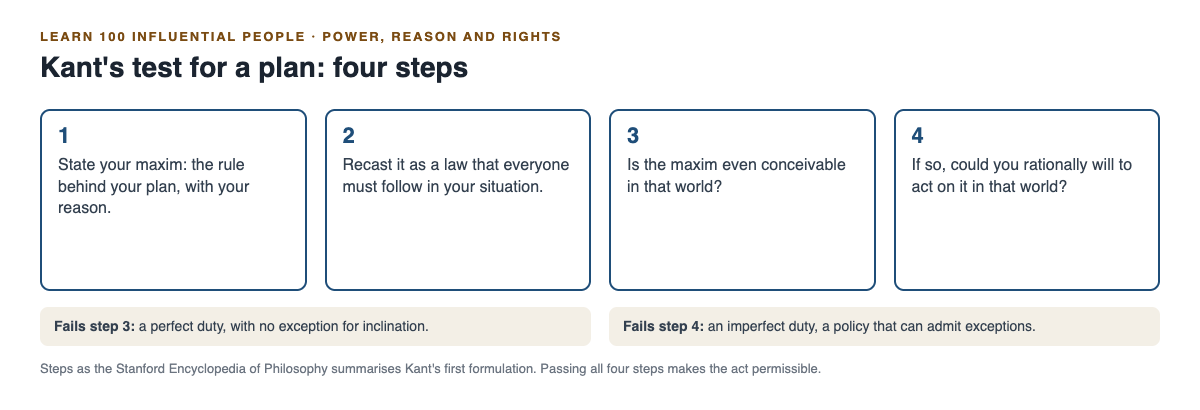
The four steps, and what failing step 3 or step 4 means.
If the maxim passes all four steps, acting on it is morally permissible. If it fails, the step where it fails says what kind of duty you have.
Perfect and imperfect duties, with Kant's own examples
A maxim that fails step 3 gives a perfect duty, one that admits "of no exception in favor of inclination". A maxim that fails step 4 gives an imperfect duty, a duty to pursue a policy that can admit exceptions.
Kant used four examples, one of each kind: to refrain from suicide to escape your own suffering (a perfect duty to yourself), to refrain from making promises you do not mean to keep (a perfect duty to others), to develop your talents (an imperfect duty to yourself) and to contribute to the happiness of others (an imperfect duty to others).
Take the false promise. Your maxim is: "I will make lying promises when it achieves something I want." Kant's example is a promise to repay money that you have no intention of keeping. Now make it a law for everyone. The Stanford entry notes that the maxim contains no plain self-contradiction, the way a "married bachelor" would, so the argument is subtler: a practice of promising could not work if everyone made promises they did not mean, and your plan relies on that practice. The entry adds that interpreters differ over exactly how to reconstruct this derivation, so treat any single version as one reading.
For the imperfect case, the maxim of never helping anyone in their projects can be conceived, so it passes step 3. It fails step 4, according to the entry, which is why we have a duty to help others sometimes and to some extent.
In Kant's later framework the same split appears as duties of right and duties of virtue. The duty not to steal is narrow and perfect, because it defines a kind of act that is forbidden. The duty of beneficence is wide and imperfect, because it does not say how much help to give.
The humanity formula and the kingdom of ends
The second formula tells us never to treat humanity, "whether in ourselves or in others", as "a means only but always as an end in itself". The Stanford entry says that most philosophers who find Kant attractive do so because of this formula, and that it brings out the idea of respect for persons.
It is often misread. The entry is clear that it does not rule out using people as means, since we do that all the time in proper ways. What it rules out is treating someone as a mere means. The entry's own example is the taxi driver: unlike a horse, the driver's humanity must be treated as an end in itself. You use the driver's skills permissibly if you act in a way the driver could consent to, for instance by paying an agreed price.
A third wording, the kingdom of ends formula, tells us to act on the maxims of a member giving universal laws for a merely possible kingdom of ends. The entry says it combines the others: an ideal community whose laws bind every rational will, including your own.
Are the formulas one law? Where scholars differ
Kant claimed that his formulas are equivalent: "basically only so many formulations of precisely the same law". The Stanford entry points out that he does not say in what sense. Commentators have read the claim in several ways. Some argue that treating humanity as an end entails acting only on maxims that could be universal laws. Others doubt that this can capture the full meaning of the humanity formula or explain every duty Kant derives from it. The entry's own view is that the Groundwork reads best as deriving each formula from the one before it.
Scholars also disagree about the examples, as shown above, and about how Kant's later, more detailed system of duties applies the principle. Kant himself allowed that judgment is needed: moral laws "must be meticulously observed" but cannot regard every small circumstance, which may yield exceptions that the laws do not settle. This post does not choose between these readings. If you want to test one, the diagram above gives you the four steps to apply to a plan of your own.
When you argue about Kant in an essay, the habit that helps most is the one in building an argument from evidence: name the claim, give the passage it rests on, and say which reading you are following.
Duty, outcomes and character: a deontological theory
The Stanford entry says that Kant's theory is usually classed as deontological. It denies that right and wrong are functions of how good or bad something is. Act consequentialism says the right action is the one with the best overall outcome. Virtue ethics says the right action is the virtuous one. In both, goodness grounds rightness. On the standard reading of Kant, rightness is not grounded in the value of outcomes or of character.
The same idea explains his view of motive. For Kant an action has moral worth only if it expresses a good will. An act that conforms to duty but comes from self-interest, sympathy or the wish for happiness, however praiseworthy, lacks moral worth, because it conforms to duty only by accident.
That is why Kant is the usual starting point for the question of whether some acts are off limits whatever the result. The entry presents it as the standard reading, and the entry itself treats "Teleology or Deontology?" as a live question, so read it as a position in a debate, not a closed case.
Frequently asked questions
What is the categorical imperative in simple words?
It is Kant's supreme principle of morality: a command that applies to every rational agent whatever they want. Its first wording asks whether you could will the rule behind your plan to become a universal law.
What is the difference between a categorical and a hypothetical imperative?
A hypothetical imperative depends on a goal you have chosen, such as "study if you want to pass". A categorical imperative does not depend on any goal.
What are perfect and imperfect duties?
A perfect duty admits no exception in favour of inclination, such as not making a promise you do not mean to keep. An imperfect duty is a policy that can admit exceptions, such as helping others sometimes and to some extent.
Does Kant say we may never use people as means?
No. The Stanford entry stresses that we use others as means all the time in proper ways. What the humanity formula forbids is treating a person as a means only.
Get started
Learn 100 Influential People puts Kant in context in the Advanced course Power, Reason and Rights, with the thinkers he answered. Lessons last about 9 minutes, list their sources, and set out where researchers disagree. You sign in with your email and an emailed sign-in code, and accounts are for people aged 13 and over.

The home page of Learn 100 Influential People, where the lessons start.
Start Learn 100 Influential People: short hands-on lessons on the people who shaped history, with the sources to read next.
Comments
No comments yet.
Sign in or make an account to comment.