Kepler vs Galileo: two paths to the Sun-centred view
Johannes Kepler and Galileo Galilei lived at the same time, wrote to each other, and both believed that the Earth goes around the Sun. Yet they reached that view by very different roads, and they disagreed on some big questions. The Kepler vs Galileo comparison shows that the Scientific Revolution was not one person's work. This guide sets the two side by side, using World History Encyclopedia's articles on Kepler and Galileo and the Stanford Encyclopedia of Philosophy's entry on Galileo.
Kepler vs Galileo at a glance
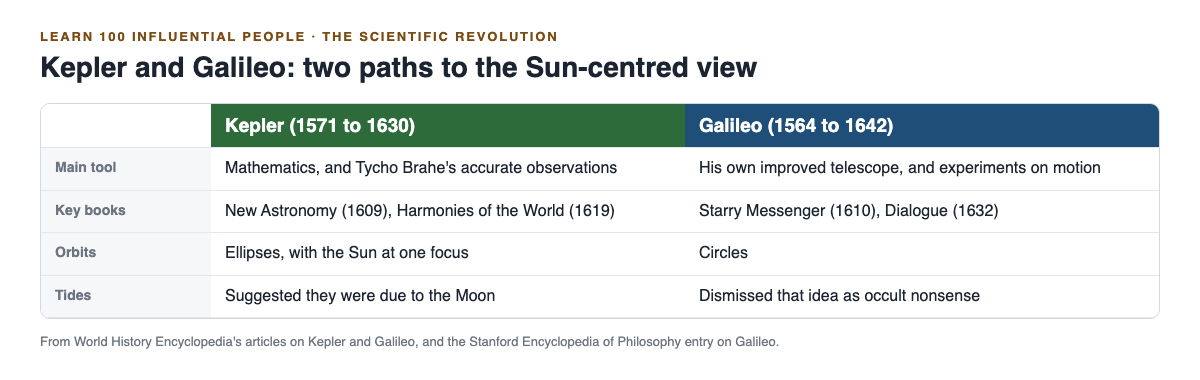
Two astronomers, two routes to the same Sun-centred view.
Kepler (1571 to 1630) was a German astronomer and mathematician. His path ran through mathematics and through the most accurate observations of his day. Galileo (1564 to 1642) was an Italian mathematician and natural philosopher. His path ran through the telescope he improved and through experiments on motion. Both backed the Sun-centred system that Copernicus had set out in 1543.
Kepler's path: mathematics and Tycho's data
Kepler learned Copernicus' ideas from his teacher Michael Maestlin at the University of Tübingen. In 1597 he published The Cosmographical Mystery, which endorsed Copernicus. In 1598 he moved to Prague at the invitation of the Danish astronomer Tycho Brahe, and when Tycho died in 1601 Kepler succeeded him and inherited his large and accurate set of observations of the planets.
He started with the hardest planet, Mars. From that work came what we now call Kepler's three laws, set out in The New Astronomy (1609) and Harmonies of the World (1619):
- Planets move around the Sun in ellipses, with the Sun at one focus.
- A line from a planet to the Sun sweeps out equal areas in equal times, so a planet speeds up as it nears the Sun and slows as it moves away.
- The square of the time a planet takes to go around the Sun is proportional to the cube of its average distance from the Sun.
Kepler also believed the Sun sent out a force that controlled the planets' orbits, perhaps something like magnetism. We now know it is gravity.
Galileo's path: the telescope and motion
Galileo's evidence came from looking and from experiment. In 1610 his Starry Messenger reported mountains on the Moon and four moons circling Jupiter, and later that year he saw the phases of Venus. On Earth, he worked out the law of falling bodies and the curved path of a thrown object. The full story is in the post on Galileo's discoveries.
He came out openly for Copernicus in 1613, and his 1632 Dialogue led to his trial in 1633.
Where they agreed
- Copernicus was right about the centre. Galileo told Kepler privately, in a letter of 1597, that he believed the Earth moves around the Sun, years before he said so in public.
- Each valued the other's work, at least in part. When the Starry Messenger appeared, Kepler, then Imperial Mathematician at Prague, praised it.
- They kept in touch. World History Encyclopedia says the two never met but wrote to each other, a correspondence that began in 1597.
Where they parted
Circles or ellipses. Kepler, unlike almost everyone before him, concluded that orbits are ellipses. Galileo kept to perfect circles. World History Encyclopedia notes that few were convinced by Kepler's ideas at first, and that even Galileo was sceptical. Kepler's ellipses were later shown to be correct.
The tides. In his Dialogue, Galileo offered the tides as proof that the Earth moves, explaining them through the Earth's daily spin and yearly orbit together. The Stanford entry points out that he ignored the link between the tides and the Moon, which had already led Kepler and others to suggest the Moon was the cause. Galileo dismissed that idea as occult nonsense. The entry treats this as a weak point in Galileo's case.
Mysticism. Kepler was, in the words of the historians Fermi and Bernardini quoted by World History Encyclopedia, "profoundly mystical". He thought the planets made music that only angels could hear, and that the number of planets was fixed by the five Platonic solids, so there could be no seventh planet. That idea was wrong. Galileo's strength, by contrast, lay in combining mathematics, observation and repeated experiments to test ideas.
What each one got right
Set out fairly, each man was right where the other was weak. Kepler was right about ellipses and about a force from the Sun driving the planets, even if some of his reasons were mystical. Galileo was right about falling bodies and thrown objects, and his telescope observations broke down the old divide between the heavens and the Earth. The Stanford entry makes the point directly: Galileo was not the only one behind the shift, and one must also look to Kepler and Francis Bacon.
Both fed into the next step. Newton's gravity explained what had puzzled Galileo, and, as World History Encyclopedia notes, gravity is the true answer to the force Kepler had guessed at. See why Newton was so important.
A worked comparison you can use
For an essay that compares the two, use four rows: tool, evidence, conclusion, and blind spot.
- Tool: Kepler, mathematics. Galileo, the telescope and experiments.
- Evidence: Kepler, Tycho Brahe's observations of Mars and the other planets. Galileo, what he saw in 1610 and what he measured on Earth.
- Conclusion: both, a Sun-centred system; Kepler, with ellipses and three laws.
- Blind spot: Kepler, his mystical number theories. Galileo, circles and the tides.
Then finish with one sentence on what each man got right and one on what each got wrong. Giving both sides their due, with evidence for each, is what makes a comparison convincing rather than a list of facts.
Frequently asked questions
What is the difference between Kepler and Galileo?
Kepler worked mainly through mathematics and Tycho Brahe's data and found that orbits are ellipses. Galileo worked through the telescope and experiments on motion and kept to circular orbits.
Did Kepler and Galileo know each other?
They never met, but they wrote to each other from 1597, and Kepler praised Galileo's Starry Messenger in 1610.
Did Kepler and Galileo agree about the tides?
No. Kepler and others suggested the Moon caused them. Galileo dismissed that as occult nonsense and explained the tides through the Earth's own motion instead.
Were Kepler's laws accepted at once?
No. Few were convinced at first, Galileo included, but his elliptical orbits were later shown to be correct.
Get started
Kepler and Galileo are both in The Scientific Revolution, a Basic course on Learn 100 Influential People, with Copernicus, Newton, Darwin and Mendel. Basic courses cover the best-known names, with no background needed. Each lesson takes about 9 minutes and lists its sources, and the site's debate cards set out where researchers disagree. You sign in with your email and an emailed code.
Comments
No comments yet.
Sign in or make an account to comment.