Keynes vs Hayek: the debate explained simply
Keynes vs Hayek is one of the best-known arguments in 20th century economics. John Maynard Keynes and Friedrich Hayek were working out their ideas in the same years, knew each other's views, and argued about the same question: why do economies fall into slumps, and what should anyone do about it? Keynes looked at total spending and asked government to fill the gap. Hayek looked at prices, cheap credit and the knowledge no planner can hold. This guide explains each, compares them on four questions, and runs one recession through both.
Keynes vs Hayek: the short answer
- Keynes said a slump can come from too little total spending in the economy, which economists call aggregate demand. In a downturn, he argued, government should spend, even if it has to borrow, to keep people in work.
- Hayek said slumps often begin with a boom built on credit made artificially cheap by the central bank. The bust is the economy correcting those mistakes, so the way to avoid busts is to avoid the booms that cause them.
Put simply, Keynes asks how to get spending back up. Hayek asks what went wrong with the price signals before the crash, and warns that no planner can know enough to steer an economy.
Who was John Maynard Keynes?
Keynes (1883 to 1946) was born in Cambridge, England, and took a degree in mathematics at King's College, Cambridge, in 1905. The Concise Encyclopedia of Economics biography says that by 1919 he was the British Treasury's principal representative at the peace conference at Versailles. He resigned because he thought the treaty overly burdensome for the Germans, and he made his name that year with The Economic Consequences of the Peace.
As unemployment in interwar Britain dragged on, reaching levels as high as 20 percent, he changed his thinking. The result was The General Theory of Employment, Interest and Money (1936). It treated aggregate demand as the sum of consumption, investment and government spending, and argued that full employment could be kept only with the help of government spending. In 1944 he helped design the postwar system of fixed exchange rates at the Bretton Woods conference.
Who was Friedrich Hayek?
Hayek was born in Vienna on 8 May 1899 and earned doctorates in law and political science at the University of Vienna. He directed the Austrian Institute for Business Cycle Research, then joined the London School of Economics in 1931. Later he taught in Chicago and Freiburg. He died in 1992.
His big idea was that prices carry knowledge. The Stanford Encyclopedia of Philosophy entry on Hayek quotes his example of tin: if tin becomes scarcer, users do not need to know why. "All that the users of tin need to know is that some of the tin they used to consume is now more profitably employed elsewhere." In 1974 he shared the prize in economic sciences with Gunnar Myrdal, as the Nobel Prize page records.
Four questions, side by side
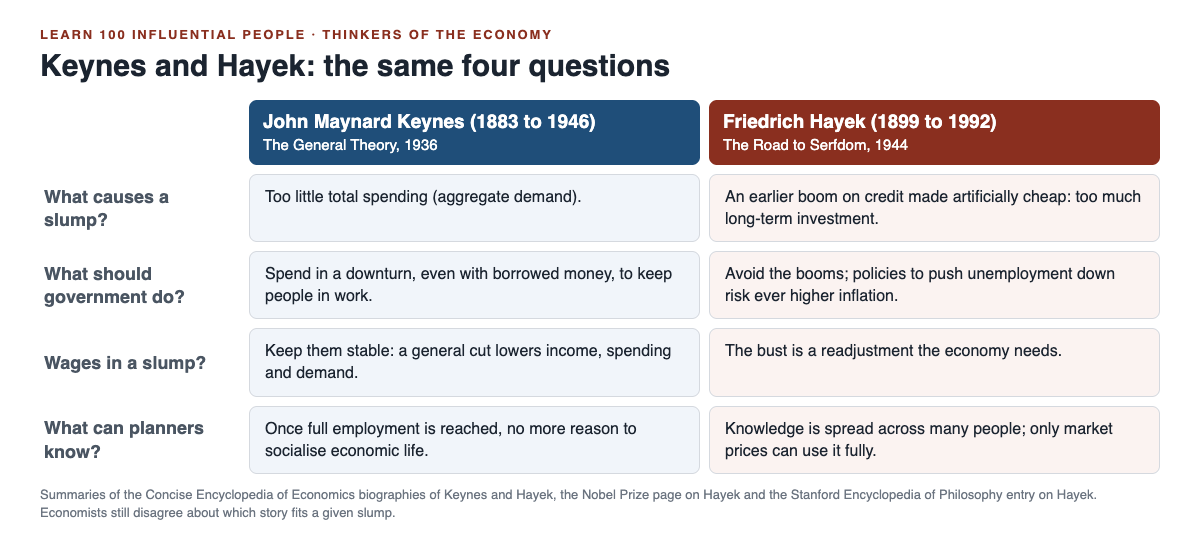
- What causes a slump? Keynes: too little total spending. Hayek: an earlier boom, when the central bank pushed interest rates down and credit became artificially cheap, leading to "malinvestment," too much investment in long-term projects.
- What should government do? Keynes: spend in a downturn, even with borrowed money, for example on public works. Hayek: avoid the booms in the first place. He believed Keynesian policies to fight unemployment would push inflation higher and higher.
- Should wages fall in a slump? Keynes argued for keeping wages stable, because a general cut would lower income, spending and demand. Hayek treated the bust as a readjustment the economy needed.
- What can planners know? Hayek: the knowledge an economy runs on is spread across many people and cannot sit in any one mind; only a decentralized market with free competition and prices can use it fully. Keynes, by contrast, did not ask for planning of everything: once full employment is reached, he wrote, "there is no more reason to socialise economic life than there was before."
Worked example: one recession, two lenses
Take a simple case. A town has a building boom while loans are cheap. Then the boom ends, and half the builders lose their jobs. Run it through both thinkers.
- Describe the slump in one line. Who lost work, and what stopped selling?
- Ask Keynes's questions. Has total spending fallen? If wages are cut, will workers spend less and make it worse? Could public works, such as repairing roads, put the builders back to work until private spending recovers?
- Ask Hayek's questions. Was the boom built on credit that was cheap only because of the central bank? Were those houses long-term projects that only looked profitable at low interest rates? If government props them up, does it delay the readjustment Hayek thought necessary, and risk inflation later?
- Write down where they differ. Keynes treats the lost jobs as the main problem to fix now. Hayek treats the boom as the mistake, and the bust as the correction.
Notice that both stories can fit the same town. That is why the argument has lasted: the facts of a slump rarely settle which story is right.
What they agreed on
They were not opposites on everything. The Keynes biography calls him "a relatively strong advocate of free markets," who believed that once full employment was reached, the market could then work freely. And when Hayek published The Road to Serfdom in 1944, arguing that government control of economic life amounts to totalitarianism, because it is "the control of the means for all our ends," Keynes praised it: "Morally and philosophically I find myself in agreement with virtually the whole of it."
Where economists still disagree
- Who won. The Hayek biography says most economists believe Keynes's General Theory "won the war," but that Hayek never believed it, and neither do other members of the Austrian school.
- Inflation. The same biography says Hayek's warning that keeping unemployment low would mean ever faster money growth and rising inflation, a thought he expressed as early as 1958, is now accepted by mainstream economists.
- Fine-tuning. Alan Blinder's entry on Keynesian economics says almost all economists, including most Keynesians, now believe government cannot know enough soon enough to fine-tune the economy. Many Keynesians still defend more modest steps, such as easier money when unemployment is very high.
- What Keynes meant. Economists still argue about what Keynes thought caused high unemployment, and the Keynes biography says little of his original work survives in modern theory; today's Keynesian economics is largely the work of later economists.
- Hayek's own verdict. In his 1974 prize lecture, Hayek granted that the theory linking employment to total spending was probably the only theory of unemployment with strong quantitative evidence behind it, yet called it "fundamentally false," and said of economists: "as a profession we have made a mess of things."
For the older argument about markets these two inherited, see our guide to Adam Smith vs Karl Marx.
Frequently asked questions
What is the main difference between Keynes and Hayek?
Keynes thought slumps come from too little total spending and that government should spend to restore jobs. Hayek thought slumps follow booms built on artificially cheap credit, and that prices, not planners, should guide the recovery.
Did Keynes and Hayek know each other?
Yes. They built their ideas in the same years, knew each other's views and argued over their differences, yet Keynes praised Hayek's The Road to Serfdom.
Did Hayek win a Nobel Prize?
Yes. In 1974 he shared the prize in economic sciences with Gunnar Myrdal, for work on money and economic fluctuations and on how economic, social and institutional life depend on each other.
Who won the Keynes vs Hayek debate?
Economists still disagree. The Concise Encyclopedia of Economics says most economists believe Keynes's General Theory won, while parts of Hayek's case, on inflation and on what planners can know, are now widely accepted too.
Get started
Keynes and Hayek are both in Thinkers of the Economy, an Intermediate course on Learn 100 Influential People, with Adam Smith, Ricardo, Malthus, Marx and Friedman. Intermediate courses cover "How ideas, faiths, inventions and markets spread and changed the world." Lessons take about 9 minutes. Like this guide, the site gives every side: cards set out where researchers disagree, and every lesson lists its sources. Sign in with your email and an emailed code; accounts are for people aged 13 or older.
Start Learn 100 Influential People: short hands-on lessons on the people who shaped history, with every side of the debate and the sources to read next.
Comments
No comments yet.
Sign in or make an account to comment.