Language exchange problems: one shared list for two
Language exchange problems are easy to miss while they happen. A session runs long, one language gets more time, the same mistake comes back, and you leave unsure what to change. This post shows how to keep one list of language exchange problems, share it with your partner, and test one fix at a time.
The worked example is a Spanish and English pair. The names and the sessions are made up, so read them as a format to copy and not as results.
Why language exchange problems stay unsolved
An exchange is a weekly meeting with a friendly stranger. If something feels off, it can be awkward to say so. A vague feeling after a session is easy to forget before the next one.
Three habits keep a problem alive:
- It is never written down. You remember that the hour felt lopsided, not what made it so.
- Each partner sees half. You think the pace is fast. Your partner may think it is fine.
- Fixes are not tracked. You try something, it half works, and a month later you try it again as if it were new.
A written list helps with all three. It gives you something neutral to point at, so you talk about the problem and not about each other.
Common language exchange problems to write down
Use these as prompts when you write your own. Each one fits on a single line.
- Uneven time. One language gets 40 minutes and the other gets 20.
- Drifting into the easier language. When one person gets stuck, you both slide back to the language you share best.
- Too few corrections, or too many. One partner never corrects. Another interrupts every sentence.
- No topic. You open with "so, what is new?" and the talk dries up.
- Different levels. One of you wants full sentences. The other manages short phrases.
- Missed sessions. Time zones and busy weeks break the rhythm.
- The same error again. You fix it, and it comes back next week.
One line is the right size for a problem. It is short enough to share, to link and to test.
Why one shared list beats two private ones
If you each keep private notes, you may be describing one problem from two sides without noticing. "My partner talks too much" and "I never get time to think" can be the same problem. A list you both can read puts them next to each other.
A shared list also keeps the history:
- The pair works from the same problems and the same fixes.
- Two lines that describe one thing become one line you agree on.
- When a fix fails, the failure stays on the page, so you do not repeat it by accident.
That last point matters most. A failed fix tells you what not to try next.
How to keep the list in Problem Graph
Paper or a shared note works too. If you want the list drawn as a map, Problem Graph is a journal that draws itself, in the web browser on a phone or a computer. One partner keeps the map and the other reads it. Here is the workflow:
- Write each problem in one line. Press Enter and it lands on the graph.
- Pick a lane. There are four: personal, work, expert and scientific. A hobby exchange fits personal. An exchange you do for a job may fit work.
- Mark each problem you want your partner to see as a main node. Only a main node can be shared. Its solutions, their outcomes and the requirements they need go along with it. A problem you only link to it stays home.
- Create a private network and give your partner the invite code. Share the main node into it. Members see the shared node and nobody else does. The app says anyone with the invite code can join, so send it to your partner only.
- Link the problems that belong together. "We drift into English" and "Ana gets no corrections" may be one pattern. A link makes it visible.
Your problems are private by default. Nothing is shared until you choose to share a main node.
The partner who keeps the map writes the problems and the outcomes. The other partner reads the shared nodes and says in the session what to add or change. The same keeper-and-reader setup is used in group project problems: a shared list for students, only with more people.
Worked example: a Spanish and English exchange
Ana speaks Spanish and is learning English. Tom speaks English and is learning Spanish. They meet once a week for an hour. After three sessions, they talk through what felt wrong, and Ana writes it down. She makes each problem a main node in the personal lane and shares all three into their private network.
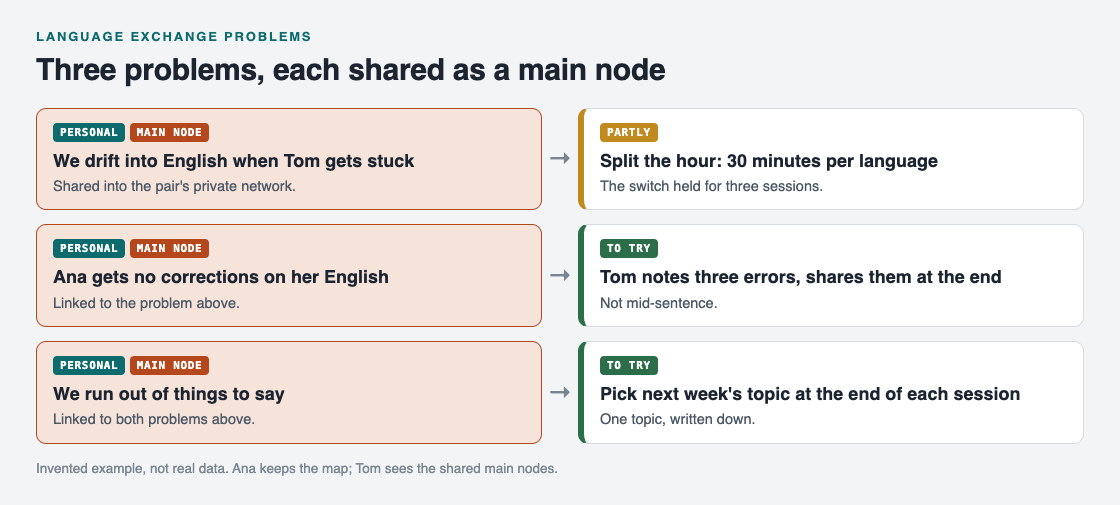
Problem 1: We drift into English when Tom gets stuck
Both of them feel this one. Ana lists two ideas: a "stuck word" signal, where Tom says the word in English once, Ana gives the Spanish and they carry on in Spanish; and a split of the hour into two halves, one per language, with the switch at 30 minutes.
Problem 2: Ana gets no corrections on her English
Tom is reluctant to interrupt. Ana links this to Problem 1, because both may come from avoiding awkward moments. The idea: Tom notes three errors per session and shares them at the end, not mid-sentence.
Problem 3: We run out of things to say
Ana links this to both of the others, since a silence is where the drift into English can start. The idea: pick one topic for next week at the end of each session.
Now the map shows a pattern. Three problems may share one root: the sessions have no structure. That link is easy to miss in a plain list and easy to see on a map. It is a guess to test, not a finding.
Fix one problem at a time and record the result
The common mistake is to change everything at once. You add a topic, split the hour, start a correction habit and move the meeting day. The sessions get better or they do not, and you cannot tell why.
Pick one solution and mark it as the one you are trying. Run it for a few sessions, then record one of three outcomes:
- Worked. Keep it.
- Partly. Note what was missing.
- Failed. Leave it on the map as failed.
In the example, Ana and Tom try the split hour first. After three sessions it partly works: the switch at 30 minutes holds, but Tom still stalls in the Spanish half. Ana records "partly" and marks the stuck word signal as the next thing to try. This is the method in one change at a time: test fixes without guessing.
The same habit works outside language learning. A houseplant problems journal and a freelance client problems log both rest on writing down what you tried and what happened.
You can also ask Problem Graph for suggestions. It proposes solutions grounded in what worked for others on problems like yours. Treat them as proposals to test, not answers.
Frequently asked questions
Which language exchange problem should I write down first?
Start with the one you both noticed. If you cannot choose, take the one that cuts your practice time the most, such as drifting into the easier language.
How do I raise a problem without sounding critical?
Write it about the session, not about the person. "We run out of topics" is easier to hear than "you never prepare." A list you both can read gives the talk something to point at.
Do we both need an account?
The home page says you can look around the public network without one. To add a problem or borrow a solution, you create an account with a username and a password. The pages do not say what a partner needs to join a private network, so check when you invite them.
Can anyone else see our list?
Problems are private by default. If you share a main node into a private network, its members see it and nobody else does. Anyone with the invite code can join, so give it only to your partner.
Get started
Try Problem Graph: it is free, and you can look around the public network without an account. Write one problem down in a line and attach the first thing you will try.
Comments
No comments yet.
Sign in or make an account to comment.