Launceston Castle: Cornwall's fortress, tin and Earl Richard
Launceston Castle stands on a mound at the border between Devon and Cornwall, and for more than 600 years it was the most important fortress and seat of government in Cornwall, according to English Heritage. It was founded soon after the Norman Conquest, grew rich on tin, and ended its working life as a county prison. This guide follows the castle through those three lives, using the history page English Heritage publishes for it.
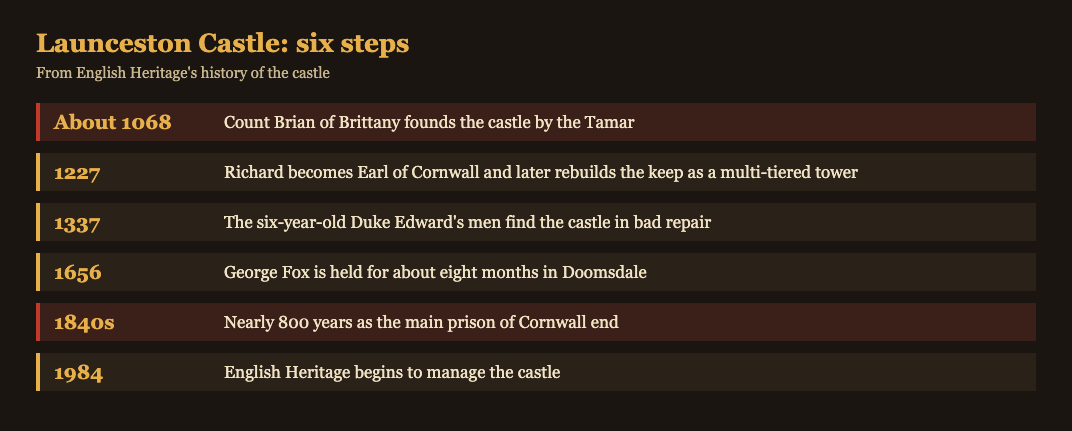
Launceston Castle in six steps. The founding and the end of the prison are the red ones.
Where Launceston Castle stands and why
The castle sits on a site that overlooks a deep valley and lies close to a road crossing of the river Tamar, which forms the eastern border of Cornwall. Count Brian of Brittany, a leading supporter of William the Conqueror, set up a castle here around 1068.
The site mattered to the men at the top. Launceston and Trematon were the only two castles in Cornwall named in Domesday Book in 1086, and both were held by Count Robert of Mortain, whom English Heritage calls the second most important man in England. That began a pattern: Launceston was held by some of the most powerful people in the kingdom.
A town grew up beside it. Before the castle, people lived to the north at Lanstefan, across the river Kensey. In the 1090s Lanstefan's market moved into the castle's outer bailey, the yard below the mound, and more houses followed. By the 13th century the walled town was seen as the natural place from which to run Cornwall.
From timber mound to shell keep
The mound at the north-east corner dates from the late 11th century. At first the buildings and defences were timber. Later in the 12th century stone began to be used, including a shell keep on the mound. A shell keep is a ring of stone wall built round the top of a mound, in place of the old wooden fence. English Heritage says the one at Launceston survives, though much altered.
By the 1180s documents begin to name other buildings inside the castle, among them a "king's chamber" and a prison. So a prison was part of Launceston almost from the time it was written about.
If you want to see how a different tall tower was used as a last refuge, read What was a castle keep for?. For another round tower from the same age, see Conisbrough Castle.
Earl Richard and the multi-tiered tower
In May 1227 King Henry III made his younger brother Richard (1209 to 1272) Earl of Cornwall. Richard held land and castles across England, but his control of the tin industry of Cornwall and Devon brought such an income that he became one of the richest men in the country. In 1257 the prince-electors of Germany elected him their king, the "King of the Romans".
He did not come often. English Heritage says he rarely visited Cornwall and left his men in charge, but he is known to have stayed at Launceston at least six times, including on his 51st birthday. He had a hall, a kitchen and chambers in the bailey rebuilt in stone. He also reshaped the shell keep, adding a central round tower and making what English Heritage calls a unique multi-tiered tower.
Under his son Edmund the earls favoured a new, more comfortable castle at Restormel, near Lostwithiel, which was promoted as a rival capital. Even so, Launceston kept its place as Cornwall's most important courthouse and its county gaol.
Tin, the assay and the pewter makers
Tin explains why a castle in a far corner of England mattered. The mining of tin in Cornwall and Devon was a jealously guarded monopoly of the earls and dukes of Cornwall. It was heavily taxed, which gave men such as Earl Richard a large regular income. In return, the tinners had their own legal system and a good deal of independence.
Castles such as Launceston and Restormel gave the trade somewhere safe to do its most delicate jobs. One was the assay, the testing of tin ingots for purity, known as "coinage", which could be carried out away from outside interference or fraud. Another is a small, odd order: in October 1346 the duke ruled that the only two pewter makers in Cornwall should work inside the castles at Launceston and Restormel.
Neglect, repairs and the Black Prince
In 1337 Edward III made his eldest son, also Edward, Duke of Cornwall. The duke was six. His men surveyed his new property, and at Launceston they found a castle in bad repair. The passage up to the High Tower on the mound had defective steps, two chambers in the tower had doors and windows "of no value", and part of a stone curtain wall had fallen to the ground. The gaol was badly covered with lead, and another prison, called the "Larder", was "weak and almost useless".
When Edward grew up, he became the Black Prince, and under him Launceston and other Cornish castles were repaired. His letters mention the deer park on the castle's western side. Now and then he ordered the fortifications strengthened, for times of unrest. But English Heritage says that the castle was used most of all as a prison, holding people accused of crimes until they could be tried in the great hall.
From Castle Terrible to pleasure garden
In the late 15th and 16th centuries the castle was where Cornish rebels were tried, locked up and executed. In 1577 the Catholic priest Cuthbert Mayne was held there. English Heritage thinks the local nickname "Castle Terrible", recorded by the Cornish writer Richard Carew in the early 17th century, probably echoes such events.
By the 17th century the mayor of Launceston and the castle gaoler ran the place day to day. After the 1640s the courts moved into a building in the town, and the castle was left solely as a prison. In 1656 the founder of the Quakers, George Fox, was arrested, ostensibly for having long hair, and kept for about eight months in a cell in the north gatehouse called Doomsdale. He wrote that the place was so unwholesome that few who went in came out in health. His account of the cell helped win sympathy for his cause.
The castle decayed. An engraving of 1734 shows gaps in the walls and towers and only a small prison house inside. About thirty years later the mayor, Coryndon Carpenter, pulled down the upper storey of the north gatehouse and part of the north curtain wall to make room for a house and garden for himself. Nearly 800 years of use as Cornwall's main prison ended in the 1840s, when the prison closed in favour of the gaol at Bodmin. Workmen who landscaped the courtyard found the remains of the prison cemetery. For more on how castles held prisoners, see Castle prisons: who was locked up in a castle.
From 1843 the Duke of Northumberland, who had leased the castle, laid out the eastern part as a pleasure garden. In the Second World War the western bailey held a temporary hospital for the US Army, and English Heritage has managed the site since 1984.
What the diggers found
Huts from that hospital came down in 1965, and archaeologists dug the bailey on and off until 1983. English Heritage says these were among the most extensive and informative excavations at any castle in Britain. The footings of the great hall, its nearby kitchen and a small building that may have been a stable can still be seen. The finds include fine drinking vessels and jewels, bones of animals eaten at the castle, among them a whale bone, and gaming boards and counters that bored guards and prisoners used to pass the time.
Frequently asked questions
Who built Launceston Castle?
English Heritage says Count Brian of Brittany established a castle here around 1068. Earl Richard of Cornwall rebuilt much of it in stone in the 13th century.
What is special about the keep at Launceston?
It is a shell keep on a mound, and Earl Richard added a central round tower inside it. English Heritage describes the result as a unique multi-tiered tower.
Why was tin important to the castle?
The earls and dukes of Cornwall held a monopoly on tin and taxed it. Castles such as Launceston were safe places to test ingots, a step called coinage.
Was Launceston Castle a prison?
Yes. A prison is mentioned from the 1180s, and for nearly 800 years it served as Cornwall's main prison, until it closed in the 1840s.
Get started
Launceston's keep was a tower on a hill, and Two Towers, a medieval tower defense game, lets you build on hills too. You pick two towers to guard the gate, and you can buy two more for the hills. The game asks 150 gold for the first hill tower and 300 for the second, and either can be any of the four kinds, so the hills are where you answer the attackers that the gate towers miss. To plan which towers go where, read Two Towers hill towers: what to build on West Hill and East Hill. The game does not model tin, coinage or a prison.
Play Two Towers: it is free and plays in your browser on a computer or a phone.
Comments
No comments yet.
Sign in or make an account to comment.