Lavoisier and the chemical revolution: what he changed
Antoine Lavoisier is the name to know for the story of Lavoisier and the chemical revolution, and the short version of what he changed is this: he weighed everything. A French chemist of the eighteenth century, he took an old question, what happens when something burns, and answered it with a balance and a new idea about air. This post walks through the theory he challenged, the experiment that turned it over, what he built afterwards, and the places where the sources disagree.
Who was Antoine Lavoisier?
Lavoisier was born in Paris in 1743 and grew up in comfort. He inherited a large fortune at the age of five, when his mother died, and trained in law, taking his degree in 1763. The law did not hold him. He went to science courses instead, and in 1768 he was elected to the Académie des Sciences, one of its youngest members. In the same year he joined the Ferme Générale, a company that collected taxes for the monarchy, which added to his wealth.
In 1775 he became inspector of royal gunpowder, a post that came with a house and a well-equipped laboratory at the Paris Arsenal. There he worked beside his wife, Marie-Anne Paulze Lavoisier. The Science History Institute calls him the father of modern chemistry. Hold that label lightly for now; the last section looks at it.
The idea he challenged: phlogiston
In the 1700s many chemists explained burning with phlogiston. The theory said that combustible things, such as charcoal and metals, contain phlogiston, and that burning lets it go into the air. What was left behind was a powder called a calx. Heating the calx with charcoal should put phlogiston back and return the metal.
Joseph Priestley heated a calx of mercury with a large burning lens and caught the air that came off. He called it dephlogisticated air, and showed that a mouse lived longer in it than in common air.
Lavoisier and the chemical revolution: the oxygen reading
Priestley travelled to Paris in 1774 and described his experiment to Lavoisier. Lavoisier repeated it, and then read it the other way round. The calx had not taken phlogiston out of the air. It had given off a gas, which he named oxygen, from the Greek for "acid former", and he called the calx an oxide, a word still in use.
That reading explained something phlogiston could not. Lead and tin weigh more after they are burned. If burning meant losing phlogiston, they should have weighed less. If burning meant combining with oxygen, they should have gained weight, and they did. Wikipedia adds that in the spring of 1774 he calcined tin and lead in sealed vessels, and that the results confirmed the extra weight came from combining with air.
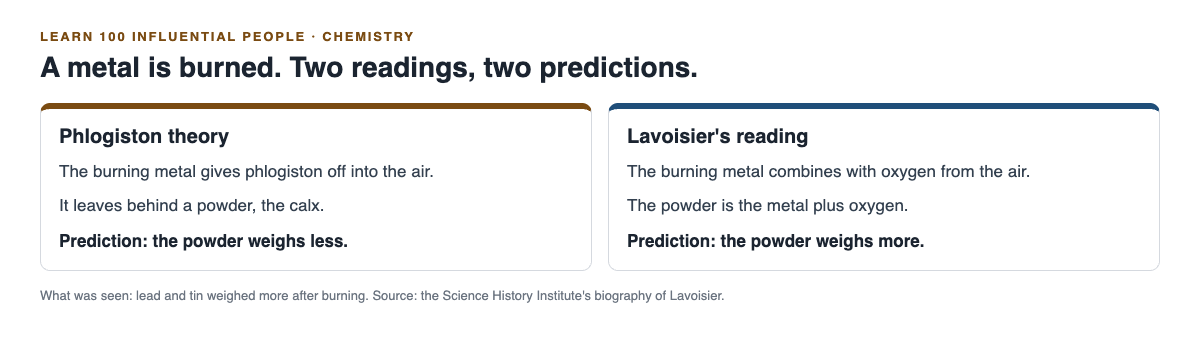
The same burning metal, read two ways, with opposite predictions for the weight.
Try it: test two theories against one weight
You can do what Lavoisier did with a pen and one fact. Take the burned metal and follow four steps.
- Write down what each theory says leaves the metal or joins it. Phlogiston theory says something leaves. Lavoisier says something joins.
- Turn each into a prediction about weight. Something leaving means lighter. Something joining means heavier.
- Look at what was seen. Lead and tin weighed more after burning.
- Score the two. One prediction matches and one does not, so the data favour the oxygen reading.
Add a fifth step that good history needs: ask what the loser could say back. This habit of turning an argument into a test is the same one the post on building a history argument from evidence teaches.
Weighing everything: conservation of mass
The weight of a burned metal was one case of a wider habit. Lavoisier's new chemistry rested on precise measurements, counting every part of a reaction, gases included. By weighing it all, he argued, you could follow any change by the principle of the conservation of mass: matter is changed from one form to another, but not created or destroyed.
This depended on a new idea of an element. Instead of earth, air, fire and water, an element became a substance that chemical analysis has failed to break into anything simpler. By that rule he listed 33 substances. Some are not what you would expect: light is on the list, and so is caloric, the matter of heat.
Water, new names and a textbook
In the 1780s Lavoisier isolated and named hydrogen, from the Greek for "water former". Other researchers had burned Henry Cavendish's inflammable air with dephlogisticated air and seen water form, but they read the result in different ways, all inside phlogiston theory. Lavoisier heard of Cavendish's experiment in June 1783. With his colleague Pierre-Simon Laplace he made water by burning jets of hydrogen and oxygen in a bell jar over mercury. They told the Académie that water is "not a simple substance; it is composed, weight for weight, of inflammable air and vital air." Water, held to be an element for over two thousand years, was a compound.
He then changed the words. In 1787 he, Louis-Bernard Guyton de Morveau, Claude-Louis Berthollet and Antoine Fourcroy put forward a new system of chemical names, the Méthode de nomenclature chimique. The names carried the theory inside them: "oxygen" says what the author thought oxygen did. In 1789 he published the Traité élémentaire de chimie (Elementary Treatise on Chemistry), which uses the new names and which Wikipedia calls the first modern textbook of the subject. A year later he founded a journal, Annales de chimie.
Marie-Anne Paulze Lavoisier appears all through this work. She translated English papers for him, including Priestley's research and Richard Kirwan's essay on phlogiston, helped in the laboratory and drew the instruments.

The home page of Learn 100 Influential People, where the lessons start.
The chemical revolution and the political one
Lavoisier wrote that he wanted to revolutionise chemistry, and he also took part in the political revolution around him. A reform-minded liberal, he sat on the Committee of Weights and Measures, which developed the metric system.
But the Ferme Générale was one of the best-hated parts of the old order, and he had profited enormously from it. That, with his wealth, brought him trouble with the radical wing of the Revolution. He was arrested in 1793 and guillotined in Paris on 8 May 1794, aged 50, with 27 co-defendants. By popular legend the judge answered an appeal to spare him with "The Republic needs neither scholars nor chemists"; Wikipedia labels that a legend. The mathematician Joseph-Louis Lagrange remarked: "Only a moment to chop off that head and a hundred years may not give us another like it." About a year and a half later the French government exonerated him, and his widow received a note calling him falsely convicted.
Chemistry's next step is in the post on Mendeleev's periodic table, which arranges the elements by pattern. The same course also covers medicine: see Alexander Fleming and penicillin.
Where the sources differ on credit
The sources agree on the facts above. They do not give one answer on how big Lavoisier's share was, and the pages you read each lean a little differently.
- Who found oxygen? Both pages say Priestley made the air and Lavoisier gave it its name and its meaning. Wikipedia calls Priestley "known for isolating oxygen". The Science History Institute describes his reading as turning Priestley's own interpretation on its head. Which part counts more is for you to weigh.
- Was conservation of mass his? The Science History Institute says he popularised it. Wikipedia says Lomonosov, in 1748, along with Jean Rey, Joseph Black and Henry Cavendish, had expressed similar ideas before.
- How modern was he? The Science History Institute notes that he kept caloric among his elements and had "one foot" in an older system of active principles, so the clean break from the past is partly a later picture.
- One man or a team? The new names came from four authors, the experiments from Lavoisier with Laplace, and much of the reading and drawing from his wife. "Father of modern chemistry" gives all of that to one name.
These are the questions the post on primary and secondary sources prepares you for: two good accounts, each with its own emphasis, and a reader who has to decide.
Frequently asked questions
What did Lavoisier change in chemistry?
He read burning as a combination with oxygen instead of a loss of phlogiston, weighed every part of a reaction, helped rename substances by what they are made of, and wrote a textbook for the new chemistry.
Did Lavoisier discover oxygen?
Priestley isolated the air, and Lavoisier repeated the experiment, named the gas and explained its role in burning. How to split the credit is a matter of debate.
What is the law of conservation of mass?
It is the idea that matter can change form but is neither created nor destroyed, so the weights before and after a reaction match when every part, gases included, is counted.
Why was Lavoisier executed?
He was arrested in 1793 and guillotined in 1794. His wealth and his work in the unpopular Ferme Générale tax company turned the radical wing of the Revolution against him, and he was exonerated later.
What was the phlogiston theory?
It was the view that burning things contain phlogiston and release it into the air as they burn. It could not explain why lead and tin weigh more after burning.
Get started
Learn 100 Influential People is a web app of short hands-on lessons on the 100 people who most shaped human history. Its Chemistry and Medicine course has a lesson on Lavoisier and Mendeleev, the lessons take about 9 minutes, and every lesson lists its sources. You sign in with your email and an emailed sign-in code. The about page says more about how the lessons work.
Start Learn 100 Influential People: short hands-on lessons on the people who shaped history, with every side of the debate and the sources to read next.
Comments
No comments yet.
Sign in or make an account to comment.