Learning in public: how to write about what you are learning
Learning in public means you write about what you are learning while you learn it, not after you have mastered it. The short version: once a week, write down one thing you figured out, show how you got there, and say plainly what is still unclear. This guide covers how to pick that one thing, a structure you can reuse every week, how to be honest about the gaps, how to fix mistakes in the open, and how to keep the whole series in one place.
What learning in public is, and why it helps you learn
Most people learn in private. They read, take notes in a file nobody sees, and move on. Learning in public adds one step. You turn part of what you learned into something another person can read.
That step can change how you learn. When you write an explanation for someone else, you have to check it. You find the gap between "I read about this" and "I can explain this." Those gaps are the parts you had not understood yet, and now you know where they are.
It also leaves a trail. After a few months you have a set of posts that shows where you started and where you are now. That record is useful to you when you forget a detail, and it may help the next person who is one step behind you.
Why you do not need to wait until you are an expert
If you wait until you are an expert, two things can go wrong. You may never feel ready, so you never write. And you may forget what it was like not to know, so you skip the steps that once confused you because they now feel obvious.
A beginner remembers the confusion. You know which error message stopped you for an hour, and which explanation finally made it click. That is the post a newcomer needs.
You are also not claiming authority. You are reporting progress. "Here is what I tried, and here is what worked" is a claim you can back up, because you were there.
How to choose what to write about each week
You do not need a big topic. You need one specific thing that changed in your head this week. Good places to look:
- Something that confused you, then did not. Write about the moment it made sense and what caused it.
- A mistake you made. What you expected, what happened, and how you found the cause.
- A comparison. Two ways to do the same thing, which one you picked, and why.
- A small project. What you built to practise, with the parts that went wrong.
- A question you still cannot answer. Lay out what you know so far and where you are stuck.
A quick test: if you cannot state the point of the post in one sentence, the topic is still too wide. "Everything about databases" fails. "Why my first join returned too many rows" passes.
A worked example: one week of learning in public
Here is a made-up week, so you can see the loop end to end. Say you are learning SQL, the language for asking questions of a database.
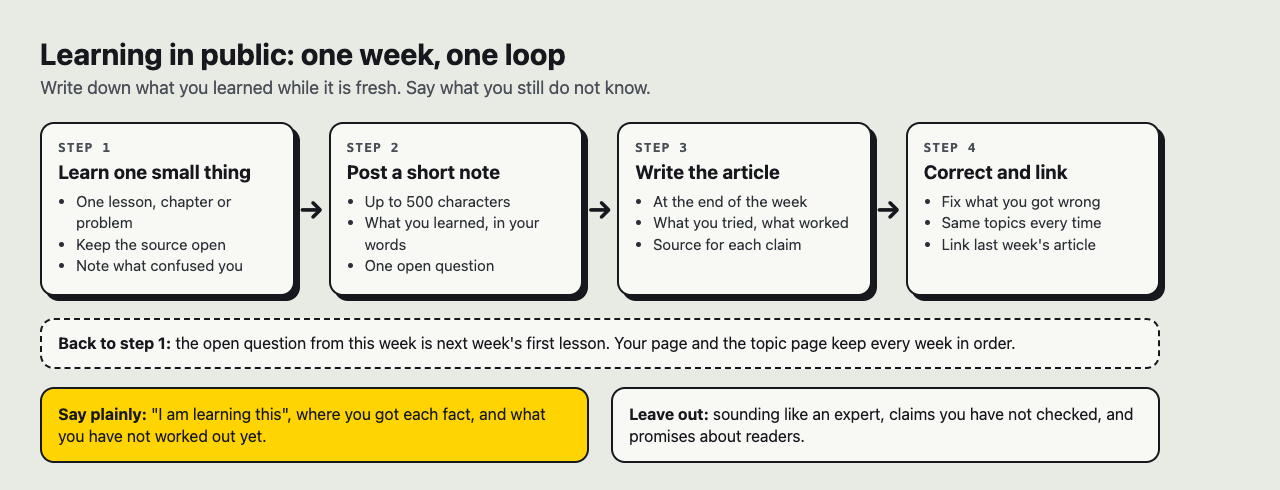
- Monday, learn one small thing. You work through a lesson on joining two tables. Your query returns more rows than you expected. You keep the lesson and the manual open.
- Monday evening, post a note. On Electrified, a note is a short post of up to 500 characters with no title. You write: "Learning SQL, day 3. My join gave me more rows than either table has. I don't know why yet. Reading the manual's page on joins next."
- Wednesday, another note. You found the cause in the manual. You write two sentences on it in your own words, with a link to the page you read.
- Friday, write the article. You pull the notes together under the structure in the next section. Title: "Why my first SQL join returned too many rows". You give it the same two topics you will use all series, for example "Learning SQL" and "Databases".
- The next Monday, correct and link. If a comment or your own rereading shows you got something wrong, you fix it and say so. The open question at the end of Friday's article becomes this week's first lesson, and the new article links back to the last one.
Notice what the example does not do. It does not pretend to know the answer on Monday. It does not quote a number nobody measured. It names the source for the one fact it explains.
A simple structure for a learning in public post
Use the same skeleton every week. It saves you from a blank page.
- The answer first. One or two sentences on what you learned.
- Where you started. What you believed, or could not do, before.
- What you did. The steps, the sources and the attempts, including the failed ones.
- One worked example. One concrete case: a command, a calculation, a before and after.
- What is still open. The parts you do not understand yet.
- What you will try next. This sets up next week's post for you.
On Electrified, an article has a title and as many sections as it needs, and you start each section with ## and a heading. So the skeleton maps straight onto the editor: type ## What I did, ## What is still open and so on, then fill them in. The editor also reads - lists, numbered lists, > quotes and inline code, which helps when your example includes a command.
How to be honest about what you do not know yet
Honesty is the whole point. A post that sounds like expert advice but is not is worse than one that is clear about its limits. Habits that help:
- Label your confidence. "I tested this," "I read this but have not tried it" and "I think this is true" are three different claims. Say which one you are making.
- Link your sources. If a claim came from a paper or a manual, link it so readers can check it.
- Keep an "open questions" section. Put your doubts in one place instead of hedging every sentence.
- Do not invent numbers. If you did not measure it, do not put a figure on it.
A line you can borrow: "This is my understanding as of this week. If you know better, tell me in the comments." On Electrified, people can like and comment on published posts, so that invitation has somewhere to go.
Your notes are written for you; a post is written for someone else. Before you publish, find the one sentence that sums up the post, cut what does not support it, and write out the steps you did in your head. If you use an AI writing assistant to tidy notes, give it a narrow job, such as "Reorder these notes under my headings, add no facts, and flag any sentence I have not backed up", then check every line yourself, because the post goes out under your name.
Where to keep the series so it adds up
Where you publish matters, because the posts should add up to something you can reread. On Electrified, you get your own page at /@handle where your notes and articles live, with your bio at the top. Each post carries up to 5 topics of your choosing, and each topic links to a page of every post about it. Give every post in the series the same topic and the series stays together on that page.
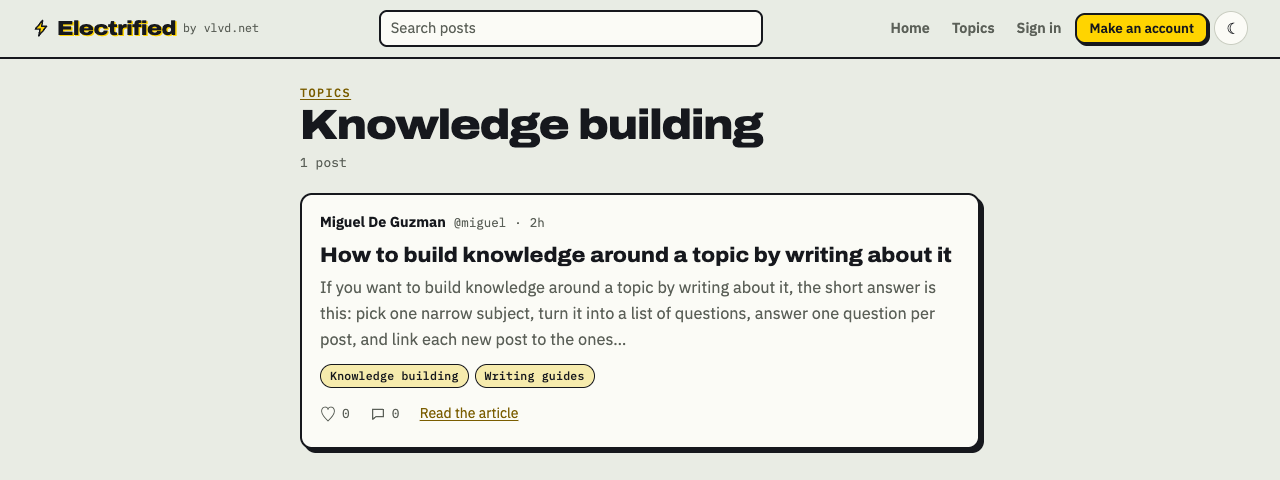
The Knowledge building topic page above is one example: every post filed under that topic shows up there.
The first save of a post makes a draft: "Saved as a draft. Only you can see it until you publish it." A draft is never seen by a search engine, so a half-finished Friday article can wait there until it is ready. Signed in, the home page also has a "Post a note" box that posts a note straight away, which suits the Monday notes. Your page has its own Atom feed at /@handle/feed.xml, the same way @miguel's feed works, so anyone who uses a feed reader can follow the series.
If you are learning while you build something, the same habit pairs well with writing about a side project.
Frequently asked questions
Do I need to be an expert to learn in public?
No. The point is to share progress, not authority. Say what you tested and what you only read, and the post is useful to someone a step behind you.
What if I get something wrong in a published post?
Fix it and say so. On Electrified you can edit a published post and press "Save changes", and the post keeps its address. A short line at the top saying what you corrected and why is more honest than a silent edit.
How long should a learning in public post be?
As long as one point needs. A quick insight fits in a note of up to 500 characters; a worked example with steps usually needs an article.
How is learning in public different from building knowledge by writing?
Learning in public shares each step as it happens, mistakes included. Building knowledge around a topic by writing about it is about the set of articles you end up with, one question per article, organised so they cover a subject.
Get started
Pick one thing you figured out this week and write the one sentence that sums it up. Post it as a note, then fill in the six sections above by Friday, preview it, and publish. To make an account you need a name, a handle, an email and a password of at least 8 characters.
Make an account on Electrified: write about your product, topic or idea on your own page, one article at a time, and let readers follow along.
Comments
No comments yet.
Sign in or make an account to comment.