Leonardo da Vinci's Notebooks: What He Drew and Wrote
Leonardo da Vinci's notebooks are the best evidence we have for how one of the Renaissance's most famous minds worked. He filled them over a lifetime with drawings of machines, studies of the human body, notes for painters and word lists, and many pages are in mirror script. This post sets out what the notebooks contain, what they did and did not achieve, and how to read them, using the World History Encyclopedia article on Leonardo da Vinci.
If you would rather learn this as a short lesson, Learn 100 Influential People puts Leonardo in its Art, Letters and Music course next to Homer, Shakespeare, Michelangelo, Bach and Beethoven, in lessons of about 9 minutes with questions that check what you remember.
Who was Leonardo da Vinci?
The encyclopedia says Leonardo (1452 to 1519) was an Italian Renaissance artist, architect, engineer and scientist. He was born on 15 April 1452, the illegitimate son of a lawyer from the town of Vinci near Florence. Around 1464 he was sent to train as an apprentice in the workshop of the painter Andrea del Verrocchio, and in 1472 he finished his apprenticeship and was registered as a master in the painters' guild of Florence.
He later worked in Milan for the Duke, Ludovico Sforza, as military and naval engineer and as painter and sculptor, and spent 17 years there. In 1517 he moved to France at the invitation of Francis I and died at his home there, Clos Lucé, on 2 May 1519. His most-loved works are the Mona Lisa and The Last Supper, but the notebooks show how much more he did.
What is in Leonardo da Vinci's notebooks?
According to the article, Leonardo "kept notebooks throughout his life in which he recorded the results of his investigations and his ideas for new inventions". The subjects ran across the physical and natural world, as the picture below groups them.
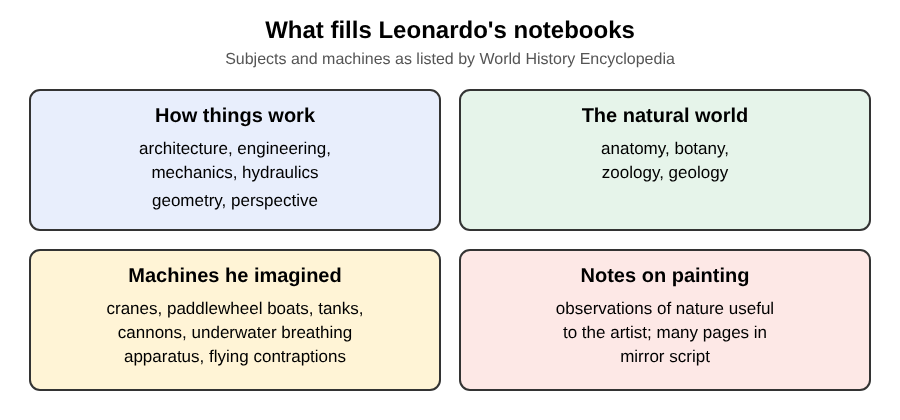
The machines he imagined include cranes, paddlewheel boats, tanks, cannons, an apparatus to breathe underwater and flying contraptions. The article says the only thing many of these designs lacked was an internal combustion engine, which was not invented for centuries. The notes are often mixed with sketches, "many being miniature masterpieces in themselves".
He also wrote down his thoughts on painting and what he saw in nature that would help an artist. One line from them is that "a painter is not admirable unless he is universal". Another note says impatience is the mother of stupidity. The article adds a curiosity about the handwriting: many of the notes are in mirror script, written in the reverse direction of normal handwriting.
His library and the Latin lists
The notebooks were not written in isolation. By 1503 Leonardo owned 116 books, covering medieval and Renaissance medicine, religion and mathematics. The article names Pliny's Natural History, Ptolemy's Geography and Roberto Valturio's On Warfare among them. He also tried to teach himself Latin so he could read medieval manuscripts in the original, and long lists of Latin words appear in the notebooks.
That detail is a useful corrective. The image of Leonardo as a lone genius with no teachers is easy to believe, but the article describes a man who trained in a workshop, owned a library and studied languages. His habit of combining the skills of an artisan with those of a scholar is the core of how the article explains his importance.
Why the notebooks mattered
The article says the notebooks, "not published until after 1570", were influential for their theories on painting and their diagrams on perspective, and for the pursuit of knowledge in general. Its argument is about method. His way of illustrating a subject, from an embryo to a cathedral, used cross-sections, perspective, scaled precision and the same subject drawn from several viewpoints. The encyclopedia says these techniques would shape draughtsmanship in architecture and the diagrams of science ever after.
The article also gives a precise example of his drawing: his 1502 map of Imola, which shows every structure from above on a precise scale and is described as the first such map to be made. Above all, it says, Leonardo showed that practice and theory should not be separated, because full knowledge of a subject needs the skill of an artisan, the imagination of an artist and the research of a scholar.
What the notebooks do not prove
Admiration can run ahead of evidence, and the encyclopedia is careful in places. It says the double spiral staircase of the Château de Chambord is "frequently credited" to Leonardo, "even if firm evidence is lacking", although he may have joined the first design stage. It notes that his bronze horse for the Sforza family never got past a terracotta model, "by no means the only work Leonardo never finished". And it records that his experiment with oil and tempera on plaster for The Last Supper, instead of true fresco, made the paint start to crumble within a decade.
So the notebooks show ideas and experiments, not a record of working machines. A drawing of a flying contraption tells you what he imagined, not that it flew. This is a fair way to hold both the praise and the limits: the notebooks are rich evidence of how he thought, but they are not proof that every idea worked.
A worked example: read the Vitruvian Man
The Vitruvian Man is the most famous sketch associated with the notebooks, and you can read it as evidence in four steps:
- Find the facts of the object. It is a pen and ink sketch on paper, 34 by 25 centimetres, drawn around 1492, and now in the Accademia Gallery in Venice.
- Find the source behind it. The name comes from Vitruvius, the Roman architect who wrote On Architecture. In one passage he recommends that architectural proportions come from the proportions of the human body, and he describes a body within a circle and a square.
- See what Leonardo did with the text. He drew what Vitruvius only described: the navel at the centre of the circle, the fingertips and feet touching its edge, and a second male figure set in a square.
- Separate fact from interpretation. The encyclopedia says the sketch is "perhaps" a metaphor for humanity's place at the centre of an ordered universe. Note the word "perhaps": that is a reading, not a fact.
The same four steps work on any page of the notebooks: describe the object, find its source, see what Leonardo changed, and mark where the evidence stops.
Frequently asked questions
Why did Leonardo write in mirror script?
The article notes that many notes are in mirror script and calls it a curiosity but does not give a reason, so treat any explanation as a guess.
Were Leonardo's inventions ever built?
The encyclopedia lists the machines he designed and says many lacked an engine. It does not claim they were built, and it notes that many of his projects were never finished.
When were the notebooks published?
The article says they were not published until after 1570, after his death in 1519.
What is the Vitruvian Man?
It is a pen and ink sketch of c. 1492 that shows a male figure within a circle and a square, based on a passage by the Roman architect Vitruvius.
Get started
If you want more than a summary, Leonardo sits in the Art, Letters and Music course, one of 15 courses made of short lessons. You read, study the diagrams, try a hands-on activity and answer questions. Every lesson lists its sources, and cards set out where researchers disagree, which matters for a figure whose legend is bigger than the evidence.
You sign in with your email and an emailed sign-in code. It is a web app, so you can open it in a browser.
Start Learn 100 Influential People: short hands-on lessons on the people who shaped history, with every side of the debate and the sources to read next.
100 people who shaped history, from Moses to the web.
Visit influentialpeople.vlvd.net↗


Comments
No comments yet.
Sign in or make an account to comment.