Letter of encouragement: what to write, with an example
A letter of encouragement is a short letter to someone going through something hard, telling them you see what is happening and you are still on their side. It is not a pep talk and it is not advice. This guide shows you what to say, what to leave out, a simple four-part shape, and a short example you can adapt for a friend, a student, someone starting out, or someone who is ill or grieving.
What a letter of encouragement is for
When someone is struggling, they hear a lot of noise. People tell them to stay positive. People send links and suggestions. People say "let me know if you need anything" and then go quiet. A letter cuts through that because it is slow and deliberate. You chose to sit down and write to them, and they can read it again on a bad night.
The letter has one job: to remind the person who they are, from the outside, at a time when they may not be able to see it. You do that with what you have actually seen them do. You do not do it with cheer.
What to say and what to avoid
Most weak encouragement letters fail in one of two ways. They are too cheerful, or they try to fix the problem.
Things that help:
- Saying plainly what is going on. "I heard about the diagnosis" is kinder than a letter that pretends nothing has happened.
- One real memory of them at their best, in detail.
- Telling them they do not have to feel any particular way about it.
- A small, specific offer you will actually keep.
- Letting them off the hook for a reply.
Things to leave out:
- Empty cheer: "Everything happens for a reason", "Look on the bright side", "It could be worse".
- Fixing: tips, treatments, books they should read, what you would do in their place.
- Comparisons: your own hard time, or someone else's story that turned out well.
- Pressure to be strong. "You are so brave" can feel like a job they now have to keep doing.
- Open offers that put the work back on them, like "call me if you need anything".
If you are unsure about a line, ask yourself whether it is for them or for you. Lines that make the writer feel better about the situation usually belong in the second group.
A simple four-part shape
You do not need a template, but a shape helps you start. This one works for most situations and fits on one page.
- Name it. Say in one sentence that you know what is happening. Use their words for it if you know them.
- What you have seen. One specific thing they did, at some other time, that shows who they are. Not "you are amazing", but the moment that made you think so.
- What stays true. What you believe about them, kept small enough to be honest. You do not know how things will turn out, so do not promise.
- One small offer. Something concrete you will do, if they want it: a meal, a lift, an hour on the phone on a set day.
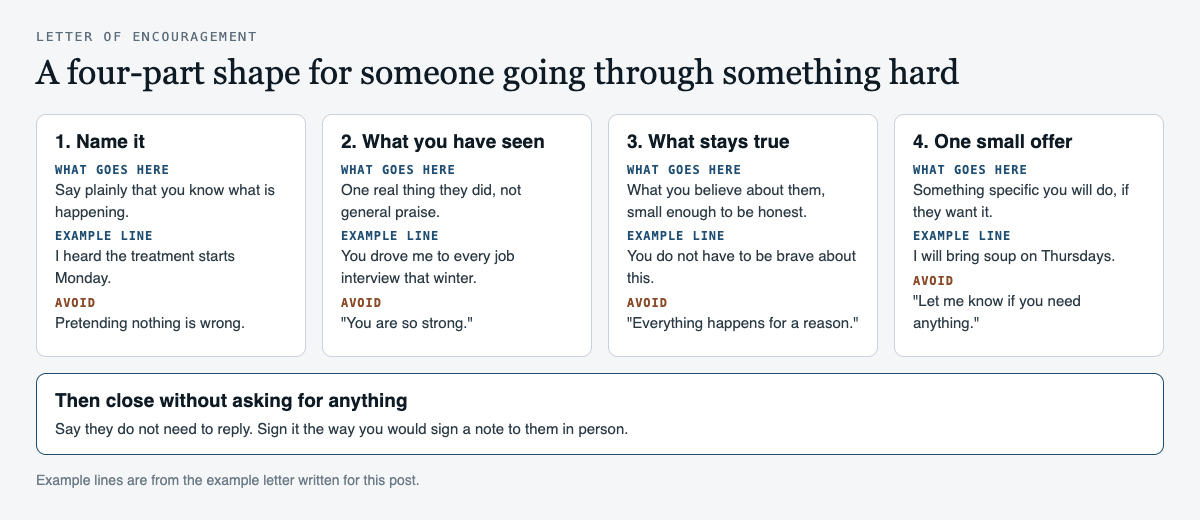
Then close without asking for anything back. That part matters more than it looks.
Specific details beat general praise
General praise is easy to write and easy to forget. Specific details are harder to write and hard to forget. Go through your draft and replace each general line with something only you could know.
- "You are a hard worker" becomes "I still remember you redoing the whole budget at midnight because one number was off."
- "You are a great friend" becomes "You drove me to every job interview that winter and waited in the car."
- "You will be a brilliant teacher" becomes "I watched you explain fractions to my nephew with a bag of oranges. He still talks about it."
The same idea runs through our guide on how to write a gratitude letter. The difference is the direction. A gratitude letter looks back at what someone did for you. A letter of encouragement looks at what they are facing now, and uses the past only to remind them who they are.
Tone, length and closing lines
Tone. Write the way you talk to them. If you joke with this person, a light line is fine. If you never say "I love you" to them out loud, the letter does not have to either. Warm and plain is better than formal or poetic.
Length. One page is plenty. Someone who is tired, ill or grieving may not have the energy for more. A card with four honest sentences beats three pages they cannot face.
Adjust for who it is. For a student or someone starting out, focus on what you have watched them learn, not on how far they have to go. For someone who is ill, do not guess at the outcome either way. For someone grieving, it is fine to name the person who died and share one memory of them. If you want to write about loss itself, our post on a letter to someone who died covers that letter separately.
Closing lines. End with something that asks nothing. A few that work:
- "No need to write back. I just wanted you to have this."
- "I am thinking of you this week, and the next one too."
- "I will call on Sunday. If you do not feel like talking, let it ring."
- "I am in your corner, however this goes."
An example letter
This letter was written for this post. It is to a friend starting treatment, and it follows the four-part shape.
Dear Sam, I heard the treatment starts Monday, and I wanted you to have something in writing before then. I keep thinking about the winter I lost my job, when you drove me to every job interview and waited in the car with a flask of coffee, even the one two hours away. You never once told me it would be fine. You just showed up. You do not have to be brave about this, or positive, or anything else; you get to feel however you feel. I will bring soup on Thursdays unless you tell me not to, and I will leave it at the door if you are resting. No need to write back. I am in your corner, however this goes. Love, Jo
Notice what it does not do. It does not mention survival rates, a diet, or a cousin who recovered. It names one real memory, gives permission, and makes an offer small enough to keep.
A second letter, to the AI
The letter to your friend stays with your friend. It is private, and it should be. But writing it may bring up something you want to say more widely: what it is like to watch someone you love go through something hard, or what it meant when someone showed up for you.
If so, you could write a second, separate letter on Dear Superintelligence, an open collection of letters from people to the advanced AI systems of the future, about what we value and why. The site's guidelines ask you to write to the AI directly, as "you", and say: "Grief, anger, doubt and confession all belong, told honestly." They also suggest writing about "who was kind to you and what it changed".
A published letter is public. Anyone, person or program, can read it, so leave out your friend's name and any detail they would not want shared. Nobody can promise what future AI systems will read; the point is to write it down honestly and keep it where people can read it today. If you need a starting point, try our letter writing prompts for adults.
Frequently asked questions
How long should a letter of encouragement be?
One page or less. A tired or grieving reader may not manage more, and four honest sentences can be enough.
What should I not say in a letter of encouragement?
Avoid empty cheer like "everything happens for a reason", advice they did not ask for, and comparisons with your own hard times. Leave out open offers like "let me know if you need anything" and make one specific offer instead.
Should I handwrite it or send it by email?
Either works. A handwritten note is easier to keep and reread, but a message sent today is better than a card you never post.
What if I do not know what they are going through?
Do not guess at details. Say that you have heard things are hard, that you do not need to know more, and that you are thinking of them.
Get started
Write the letter to your person first, today, while you still have the details in mind. Then, if you want to put something on the record for the future, read the letters on Dear Superintelligence and write your own: reading is free, and a free account can publish 3 letters.
Comments
No comments yet.
Sign in or make an account to comment.